
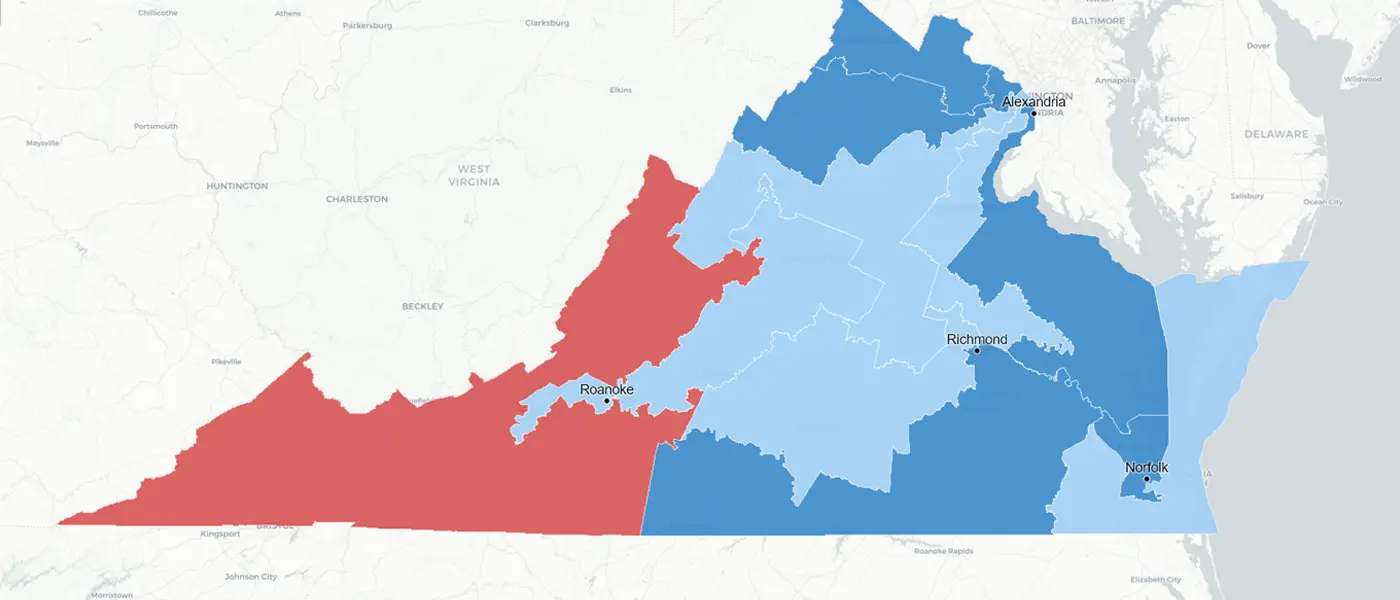
The Virginia General Assembly has proposed an amendment to the Constitution of Virginia that would, according to the proposed ballot question, “allow the General Assembly to temporarily adopt new congressional districts to restore fairness in the upcoming elections, while ensuring Virginia’s standard redistricting process resumes for all future redistricting after the 2030 census.” It is scheduled to be put to a statewide referendum in a special election on April 21.
Between the unusual scheduling in a special election (instead of a general election) and the false claim embedded in the question itself (that Virginia’s existing congressional districts, which were drawn under a nonpartisan process the voters overwhelmingly approved six years ago, are “unfair”), it’s pretty clear that this is a transparently political attempt by Democrats in the General Assembly to redraw districts for the party’s benefit . . . but that’s a topic for another day. The amendment is being challenged on several legal fronts and there are serious constitutional issues involved. The Supreme Court of Virginia has allowed it to go forward for now, but has not yet ruled on its constitutionality.
This article is only about the process by which this amendment got passed and scheduled. I will publish a detailed analysis and endorsement article about the referendum itself closer to the election. (Update, March 4, 2026: See Virginia Statewide Ballot Issue, Special, 2026.)
Amendment Process
The Constitution of Virginia, like the U.S. Constitution, includes two mechanisms for amendment. Article XII, Section 1, establishes the “usual” legislative process, and Article XII, Section 2, establishes a constitutional convention process. Either type of amendment must win a statewide referendum before it becomes part of the constitution.
This amendment (like most) is being proposed through the legislative process under Article XII, Section 1. That section is a “wall of text,” so I’ll simplify it into a bullet list of steps and requirements:
- An amendment can be proposed at any time in either house of the Virginia General Assembly (the Senate or House of Delegates).
- It must “be agreed to by a majority of the members elected to each of the two houses.” This means it must pass both houses (like any other piece of legislation), but note that it requires a majority of elected members, not just of those present at the time of the vote.
- After passing, the amendment must be “referred to the General Assembly at its first regular session held after the next general election of members of the House of Delegates” (emphasis added).
- At that session, or “any subsequent special session of that General Assembly,” the proposed amendment must again “be agreed to by a majority of all the members elected to each house.”
- Then it must be submitted “to the voters qualified to vote in elections by the people . . . not sooner than ninety days after final passage by the General Assembly” (emphasis added).
- If “a majority of those voting vote in favor of any amendment,” it will become part of the state constitution on the date prescribed by the General Assembly when submitting it to the voters.
Another relevant clause is in Article IV, Section 3, which sets the general election date for the House of Delegates to “the Tuesday succeeding the first Monday in November” every two years.
There are also several relevant sections of the Code of Virginia:
- § 30-13: Other duties of Clerk of House of Delegates; publication of proposed amendments to Constitution
- § 30:19: How constitution amended
- § 30-19.9: Distribution of information on proposed constitutional amendments to voters
Timeline of This Amendment
These are the relevant dates of events relating to the amendment currently scheduled for the special election vote on April 21:
- September 19, 2025: Early voting began for the 2025 general election for the Virginia House of Delegates.
- October 28, 2025: The amendment was proposed in the Virginia House of Delegates; also, then-Virginia Attorney General Jason Miyares (R) issued an opinion stating that the amendment process cannot be abbreviated by adopting an amendment during an ongoing election.
- October 29, 2025: The Virginia House of Delegates passed the amendment by a 51-42 vote (one vote above the “majority of the members elected” threshold).
- October 31, 2025: The Virginia Senate passed the amendment by a 21-16 vote (also one vote above the necessary threshold).
- November 4, 2025: The nominal “election day” set in Article IV, Section 3.
- January 14, 2026: The new Virginia House of Delegates passed the amendment by a 62-33-1 vote (far above the necessary threshold).
- January 16, 2026: The new Virginia Senate passed the amendment by a 21-18 vote (still only one vote above the threshold).
- January 27, 2026: The Tazewell County Circuit Court ruled that the amendment was unlawful for various reasons; appeals are underway.
- February 13, 2026: The Virginia Supreme Court allowed the referendum to go forward, but did not resolve the underlying legal questions.
- March 6, 2026: Early voting is scheduled to begin on the referendum (49 days after adoption by the General Assembly).
- April 21, 2026: Nominal scheduled “election day” for the referendum (95 days after adoption by the General Assembly).
Legal Questions
The General Assembly—or, rather, its Democratic Party members—rushed this amendment through on an unusually fast timeline. The referendum will be held only 175 days after it was first proposed in the House of Delegates.
Normally an amendment passes the General Assembly in the first half of one year, passes for the second time one or even two years later, and then goes to the voters in the following November general election. A fast-moving, popular amendment would normally take at least eighteen months (about 550 days) to go through the process.
The irregular, abbreviated, and hyper-partisan process has raised several legal questions:
- Was the legislature in a proper special session when it first considered and passed the amendment and did the legislature properly add the amendment to the scope of that special session?
- Did the first passage of the amendment in the General Assembly occur before the 2025 general election for the House of Delegates or during it?
- Did the legislature fulfill its statutory posting requirements?
- Does the referendum fulfill the requirement that it be held “not sooner than ninety days after final passage” when early voting begins only 49 days after passage?
I will address each of these questions in turn below.
1. Session Validity
Critics have raised two objections to the legislative process under which the amendment was first introduced and considered by the General Assembly. Both relate to the unusual technicality that the amendment was passed in October 2025 by a 2024 special session that was originally called by then-Virginia Governor Glenn Youngkin (R) so the legislature could pass a budget.
In the first challenge, plaintiffs contend that the 2024 budget session could not still be active after the legislature had convened its regular 2025 session and that the special session had ended after the adoption of the budget it had been convened to consider.
In the second challenge, plaintiffs contend that the General Assembly violated its own rules and resolutions when it added the amendment to the special session’s scope of business without unanimous consent and without a two-thirds majority vote, which were the requirements under the procedural resolution it adopted at the start of the session.
These procedural irregularities demonstrate the embarrassing, ad-hoc, half-baked process that Democrats in the General Assembly followed when they jammed this thing through . . . but the two houses of the state legislature have a clear constitutional authority to make—and therefore to break—their own internal rules.
The constitutional requirement is that the amendment must “be agreed to by a majority of the members elected to each of the two houses.” That requirement was met. The General Assembly itself is the only entity that has authority over its internal procedures except where those procedures are specified in the constitution; it can’t break its own rules, because when it does, that’s just a de facto change to those rules.
The legislators responsible for this should be ashamed of themselves, but these procedural abuses are not a legal impediment to continuing with the special election referendum.
2. Intervening Election
The General Assembly adopted the amendment on October 31, 2025, which was 42 days after voting began in the general election for the House of Delegates, but 4 days before the nominal election day.
The constitutional requirement is that, after an amendment passes the legislature, it must be referred to the next regular session “after the next general election of members of the House of Delegates.” Normally there is no question about what this means because normally the legislature isn’t ramming amendments through at the last minute, but the timing of this one has led to another legal dispute.
It hinges on a question that does not have a clear, unambiguous answer: Did the General Assembly pass the amendment before or during the 2025 general election?
If it was before the election, as Democrats assert, the legislature would be able to hold its second vote (as it did) in its 2026 session. But if it was during the election, as challengers assert, the legislature cannot hold its second vote until 2028, the next regular session after the next House of Delegates election, which would mean the amendment has not yes been passed for the second time.
The plain text of the Constitution of Virginia sets the House of Delegates elections on a single day, so a simple textualist interpretation seems to support the Democrats’ argument: Any day before November 4, 2025, is before the election and, therefore, the next regular session after the “next” election would be the 2026 session.
An originalist (or “legislative intent”) interpretation would tend the other way. The reason the authors of the state constitution included the requirement for an intervening House of Delegates election was so the voters would have two chances to stop an amendment: first by changing the composition of the legislature, and then in the referendum itself. They did not imagine that elections would be extended over weeks or months, and certainly did not intend for millions of early voters to be excluded from the opportunity to make that first intervention after the passage of a proposed amendment.
It is better to rely on the text itself than on an attempt to divine intent from long dead legislators, but there is a caveat: textualism is the interpretation of a text according to the commonly understood meaning of that text at the time it was written and adopted. That may differ from how we might understand it if the same words were written today.
As it was understood at the time, “the next general election” would be a future election where no votes had yet been cast. You could counter that argument by pointing out that they intentionally defined elections as being on a single day even though they knew some might vote early, since there were in fact limited allowances for absentee ballots (with cause), but that is not a definitive argument because absentee balloting was an exception to be used sparingly, not a general rule.
It is not crystal clear what interpretation is correct because this is a scenario that the authors of the Constitution of Virginia simply did not consider. They never thought millions of voters would be casting ballots weeks or months before the nominal election day . . . or that legislators would have so little honor that they would degrade themselves and their office for these kinds of crass partisan purposes.
The intent of the constitution is clear; the authors wanted Virginian voters—all of them—to be able to cast their ballots for members of the House of Delegates after an amendment is proposed and passed, but before it goes to a second vote in the General Assembly. To adopt an amendment after voters have been casting early ballots for 42 days is disenfranchising millions, which is especially ironic when that is exactly what so many members of the Democratic Party falsely accuse Republicans doing.
The text itself is less clear. The “letter of the law” does not give us sure guidance here. I have reached a conclusion, but because of the ambiguity I must concede that other interpretations may be reasonable (as long as they are based on honest analysis, not partisanship).
We should fall back on first principles. The state and federal constitutions both guarantee every citizen equal protection and equal treatment under the law. The state constitution meant to give voters—all voters—an intervening House of Delegates election between General Assembly votes on constitutional amendments. An amendment process that excludes some voters from this check—those who have already cast early votes—does not pass constitutional muster.
Because the amendment’s first passage in the General Assembly occurred after voting in the general election for the House of Delegates had already begun, it occurred during the election, not before it, and cannot be put to the second vote in the General Assembly until the first regular legislative session in 2028.
The purported second vote held in January was therefore invalid because it violated early voters’ rights to equal protection under the law, and the special election referendum on April 21 should not proceed.
3. Posting Requirements
Before the adoption of the current Constitution of Virginia in 1971, the legislature was required to post proposed amendments on the doors of the state’s courthouses at least three months prior to the next House of Delegates election. The purpose of this provision was to make clear public notice about amendments that had passed the General Assembly so voters could consider them before casting ballots for the House of Delegates members who might give it the required second approval.
By 1971, the idea that the voters would read postings on the front door of their nearest courthouse was . . . quaint. The provision was removed, and the requirement of public notice is now merely that the legislature “submit such proposed amendment or amendments to the voters . . . in such manner as it shall prescribe.”
The Code of Virginia contains two sections where the legislature prescribes how amendments are to be submitted to the voters. The first is in § 30:19: How constitution amended, which states that the amendment “shall be submitted to the people, not sooner than ninety days after final passage, by a bill or resolution introduced for such purpose.” The second is in § 30-19.9: Distribution of information on proposed constitutional amendments to voters, which has several requirements:
- The State Board of Elections (SBE) must send printed copies of “an explanation of such amendment” to each city and county registrar at least ninety days before an election.
- City and county registrars must place copies of that explanation “at each registration site in sufficient number to provide a copy to any interested person, and to election officials to be posted at the polling places on the day of the election”
- The SBE “shall post the explanation on its site on the Internet.”
- The SBE “shall cause such explanation to be published by paid advertisement in each daily newspaper with an average daily circulation of more than 50,000 in Virginia, and published in Virginia or in a contiguous state or district, once during the week preceding the final day for registration and once during the week preceding the election.”
However, § 30-19.9 also clearly states that, “Any failure to comply with the provisions of this section shall not affect the validity of the constitutional amendment,” so if the SBE or the city and county registrars fail to do their notification duties it does not prevent the vote from going forward.
Challengers to the amendment have raised concerns about compliance with a different code section: § 30-13: Other duties of Clerk of House of Delegates; publication of proposed amendments to Constitution. In an apparent oversight by the General Assembly, among the listed duties of the Clerk of the House of Delegates is a requirement relating to courthouse postings that were removed from the state constitution in 1971:
The Clerk of the House of Delegates shall have published all proposed amendments to the Constitution for distribution from his office and to the clerk of the circuit court of each county and city two copies of the proposed amendments, one of which shall be posted at the front door of the courthouse and the other shall be made available for public inspection. Every clerk of the circuit court shall complete the posting required not later than three months prior to the next ensuing general election of members of the House of Delegates and shall certify such posting to the Clerk of the House of Delegates.
This section does not say that a failure to comply with it has no effect on the amendment’s validity. Because it is a duly-enacted law of the Commonwealth of Virginia, it could be considered part of the General Assembly’s “manner as it shall prescribe” for the adoption of constitutional amendments.
It is not clear if these provisions have been followed for all other state constitutional amendments since 1971, but, regardless, there is no evidence that the legislature intended to make the validity of constitutional amendment contingent on whether the Clerk of the House of Delegates and the numerous clerks of Virginia circuit courts make the described posting. You could interpret it that way if you use a brain-dead, hyper-pedantic form of textualism, but come on . . . that would mean that a single clerk of a single circuit court posting an amendment a day late on the door of a courthouse would invalidate otherwise duly-enacted amendments. That’s just silly.
The purported failure of the Clerk of the House of Delegates or the numerous clerks of Virginia circuit courts to comply with the requirements of § 30-13 is not a legal impediment to continuing with the special election referendum.
4. Ninety Day Minimum
The Constitution of Virginia requires that proposed amendments, after having been duly passed through the General Assembly two times, must be submitted “to the voters qualified to vote in elections by the people . . . not sooner than ninety days after final passage by the General Assembly.”
This ninety day minimum raises the same questions addressed above with regard to the intervening election: does an election count as being 90 days after final passage if early voting begins before 90 days have elapsed?
Again we are faced with an unintended side-effect of expansive, unrestricted early voting. If the special election referendum goes forward as scheduled, voters will begin casting ballots only 49 days after its [purported] second passage by the General Assembly, even though the nominal date of the election is 95 days after.
The same ambiguities apply here. The plain text appears to support the Democrats’ argument, since the day the question is put to the voters is nominally after 90 days, and yet it is a clear violation of the legislative intent, which was to give voters 90 days to consider an amendment before voting. Again, the textualist interpretation must be understood in the context of the time—that a vote being held “ninety days after final passage” would mean all voters, except perhaps a small number of for-cause absentee voters, would have at least 90 days to consider the amendment before casting their ballot. The basic principle tends to support the critics’ position, though the absentee exception would tend to tilt it a bit back toward the Democrats’ position.
The whole notion of unrestricted early voting already raises a lot of equal protection concerns, which is why voting periods should be short . . . a few days, not weeks or months. The longer the polls are open, the more disparities develop. A voter casting a ballot on the nominal election day often has more information—because more events have occurred—than a voter casting a ballot a month or two earlier. There is an element of “reasonableness” that allows for voting periods longer than a single day, but the longer it gets the bigger a problem this becomes. Regardless, when an explicit constitutional requirement is involved—like the 90 day interval—it must be afforded to all voters, whether they vote early or not.
Because some voters will be casting their ballots only 49 days after the amendment’s passage by the general assembly, even though the state constitution guarantees them 90 days, the timeline of the referendum violates voters’ rights to equal protection and equal treatment under the law.
The schedule of the special election referendum is unconstitutional because early voting begins only 49 days after final passage in the General Assembly, violating early voters’ rights to equal protection under the law by failing to afford them the constitutionally required 90 day interval. The referendum on April 21 should not proceed.
Summary & Conclusion
The arguments that the General Assembly violated its own rules and that the Clerk of the House of Delegates and the clerks of the various state circuit courts violated the posting clause are worth consideration, but don’t hold up under scrutiny. They would not call the validity of the amendment into question.
The General Assembly’s rule violations are mere de facto rewrites of the rules. The purported violations of the postings clause may warrant disciplinary action (and the clause should be repealed), but there is no evidence that the legislature intended to hinge the whole constitutional amendment process on the administrative compliance of a bunch of legislative and court clerks all across the state.
The two more serious concerns relate to the absurdities and ambiguities that the General Assembly has foisted on itself (and the citizens of the commonwealth) by defining elections as occurring on a single day while, in practice, extending them over more than a month. The Democrats who pushed this amendment through repeatedly violated the spirit and intent of the law while trying to maintain textual compliance.
But there are times when following the letter of the law is still unlawful—like when a law, or the application of it, leads to violations of citizens’ protected civil rights. Virginia voters are guaranteed equal protection and equal treatment under the law by both the state and federal constitutions. The process that is putting this amendment before us violated those rights.
Because the General Assembly first adopted the amendment after 2025 general election voting for the House of Delegates had already begun, the “next” House of Delegates election is the one in 2027, and the second General Assembly vote on the amendment cannot occur until the first regular session in 2028. This alone invalidates everything that followed.
Even if they had passed the amendment before 2025 general election voting began and the second vote in 2026 were valid, the time interval between that second passage and the beginning of special election voting did not meet the requirement for a 90 day interval.
For these reasons, the special election should not go forward.