Bypass TurboTax Browser Check in Chrome OS

I’ve used Intuit’s TurboTax service to file my taxes for many years, and I’ve generally been pretty happy with them. Today, I decided to check my refund status with the IRS’s Where’s My Refund service, which requires me to enter my Social Security number, filing status, and refund amount.

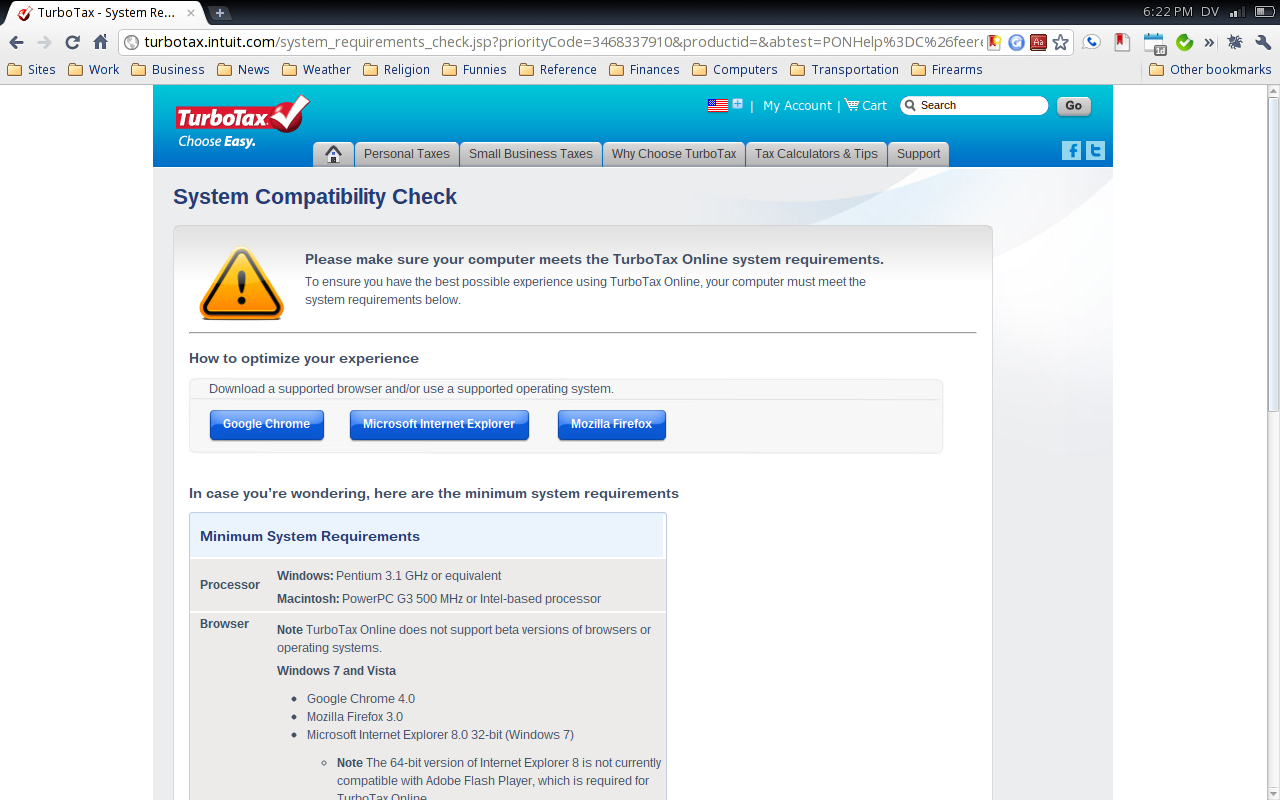
Well, I don’t have my refund amount memorized, so I went to the TurboTax site to log in and get the magic number . . . only to discover that, according to Intuit, the version of the Chrome browser that ships in Chrome OS is officially unsupported. Usually in these situations, companies design their sites to let you continue anyway (with a warning that things might not work right). Intuit, however, decided to just completely block their site for users of officially unsupported browsers.

Normally I would just spoof the user agent of a supported browser, but Chrome OS doesn’t have any practical way to do this (and, frankly, I shouldn’t have to anyway). Luckily, however, Intuit didn’t spend a lot of time on their browser checker. It is very easy to bypass.

All you need to do is bring up the developer tools (in Chrome, wrench menu > tools > developer tools), click on ‘Console’ (at the far right), type or paste this command at the console, and press enter: greenStartAsPost(productid,true);

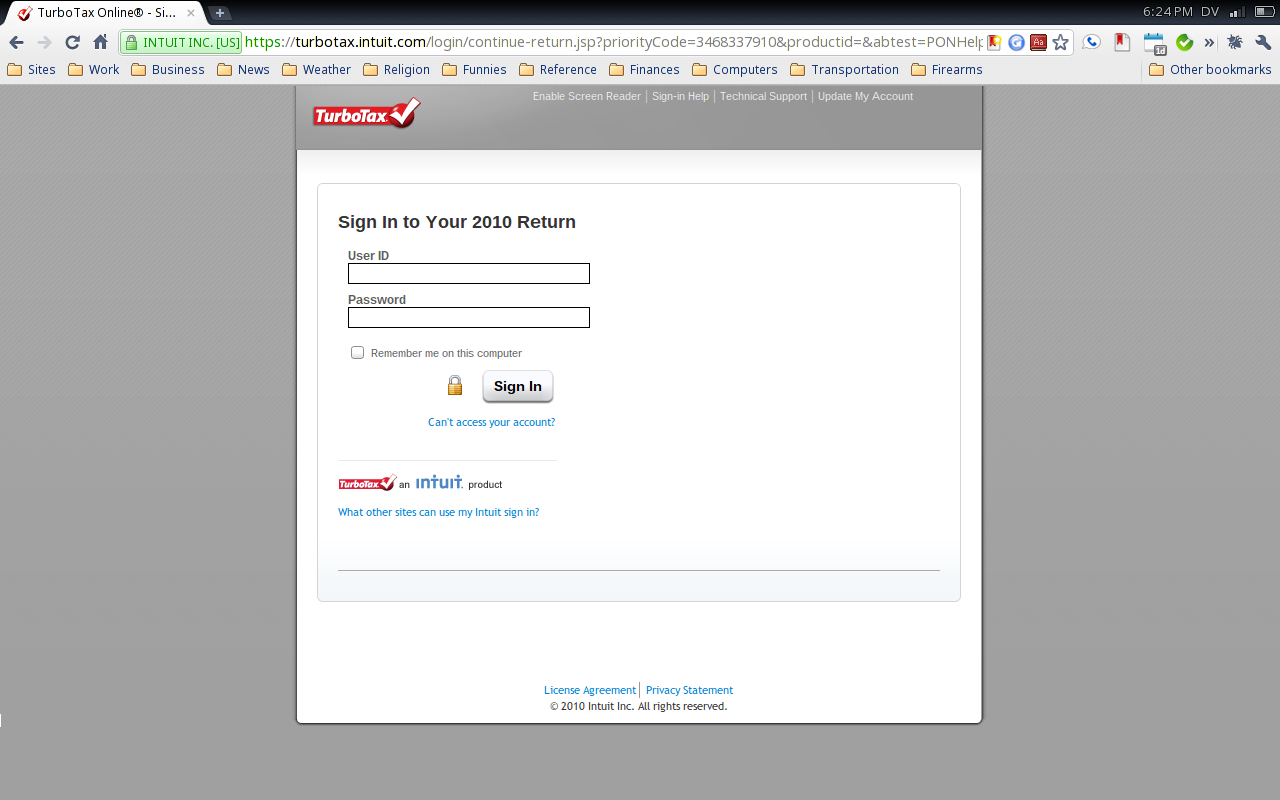
Tahdah! The browser proceeds to the login screen and everything seems to work as-expected from there on. Note, Intuit doesn’t support this version of Chrome because they haven’t tested it. Using an unsupported browser might not work right. I’m not responsible if you use this trick and your taxes get all screwed up ;-).

Unsustainable

The fact that we are here today to debate raising America’s debt limit is a sign of leadership failure. It is a sign that the U.S. Government can’t pay its own bills. It is a sign that we now depend on ongoing financial assistance from foreign countries to finance our Government’s reckless fiscal policies.” – Senator Barack Obama (D-IL), Mar. 16, 2006, (emphasis added).

By President Barack Obama’s (D) own criteria, he and the Democratic super-majorities in the House and Senate that have run the show for the last two years are failed leaders.

Faced with a recession that the government could have stopped in its tracks with a sane tax policy and long-overdue federal budget cuts, the new administration doubled-down on President George W. Bush’s (R) dysfunctional bailout and deficit policies and quadrupled the annual deficit in their first year, setting a new record that dwarfed the worst Bush ever did. While the Bush/Obama Bailout Bonanza seems to have mostly come to an end, the destructive deficit spending continues apace. The U.S. federal government—by which I mean us, the taxpayers—now owes $14,083,345,766,082.15 to countless creditors, including foreign companies and governments (as of 2/10/2010, according to the U.S. Dept. of the Treasury). At some point in the next one or two years, U.S. public debt is expected to rise above 100 percent of our Gross Domestic Product (GDP)—meaning we will owe more to our creditors than the worth of the entire country’s economic production in a year. The last time our debt was more than 100 percent of our GDP was during and immediately following the Second World War.

Bruce L. Hargraves, USN Retired, wrote a pithy letter to the editor which appeared in the Northern Wyoming Daily News on April 2, 2010. Hargraves said, “I object and take exception to everyone saying that Obama and Congress are spending money like a drunken sailor. As a former drunken sailor, I quit when I ran out of money” (emphasis added). It was funny when I read it last year. It’s not so funny anymore.

Mubarak Out; Military to Run Egypt (Updated)

Egyptian Vice President Omar Suleiman announced today on state television that President Hosni Mubarak has ‘stepped down,’ and Egypt will now be run by the Supreme Council of the Armed Forces pending the establishment of a new democratic republic. Following the announcement, street protesters throughout Cairo erupted into cries of, “Egypt is free!”

This follows eighteen days of unprecedented protests on the streets of Egypt’s main cities against Mubarak’s thirty-year rule. Mubarak was widely expected to step down in a televised speech yesterday, but he did not do so. Some time after the speech, he fled Cairo for the Red Sea resort town of Sharm el-Sheikh. His current disposition is unknown.

Although the official announcement characterized Mubarak as having ‘resigned’ the Egyptian Presidency, all indications are that this was a bloodless military coup. The military had lent tacit support to the widespread street protests, and the Supreme Council of the Armed Forces had begun meeting without Mubarak on Thursday although Mubarak was still technically its leader. The Council has stated through official channels that it will only run the country during the transition period between governments, and would stand aside once a new civilian government is established.

President Barack Obama (D) issued a statement lending support to the establishment of a democratic republic in Egypt. Unconfirmed reports indicate that the U.S. Department of State will be providing assistance to Egyptian officials and groups toward their establishing free institutions and elections.

UPDATE; 2/13/2011, 10:25am: The military council has dissolved the Egyptian parliament and suspended the constitution. It has announced that it will run Egypt for six months or until new elections can be held.

Proof of Concept: No-Nonsense Weather Cross-Platform

I’ve been doing a little bit of work toward getting my No-Nonsense Weather app, currently available for HP WebOS, ported so that I can release versions for other mobile platforms like iOS, Android, BlackBerry OS, and Windows Phone. Since the app is written in HTML, CSS, and JavaScript, this is fairly easy using various available frameworks.

I made heavy use of the jQuery framework in the app (and on this web site, and at my day job for that matter), so I figured I’d do most of the user-interface work in the jQuery Mobile framework. I already have a proof-of-concept built in the framework, which is just a surprisingly-painless port from the existing WebOS code. It has some rough edges and still needs some work, but it functions. You can see some screenshots below.

After I get it polished up and solid from the UI and basic-functionality perspectives, I’m planning to use the PhoneGap framework to access the different platforms’ location services and preference storage APIs. Once that’s working, I’ll start doing a lot of testing to make sure it works as expected on the different platforms. I’m not committing to any particular platforms yet. Since the app is free and will make me $0, I’m not interested in paying for access to the app stores, and some of the stores (I’m looking at you, Apple) are idiotically restrictive anyway.

More information as I get this better developed . . . it’s still very early at this point.

Beware the NIMBYs

I get very, very annoyed at the NIMBYs . . . people who, when faced with anything that might mar their precious neighborhoods in order to provide for some greater good, say, “not in my back yard!”

For example, I often hear of homeowners’ associations and community groups banding together to prevent the installation of new cellular phone towers. Yes, we know, the towers are ugly. Sometimes, a little ugliness is the price we pay for progress. Whenever I hear about some obstructionist community refusing to allow the installation of a much-needed cell tower, I always wish we could just terminate the entire neighborhood’s wireless phone service. Wireless companies don’t have to provide service to people actively trying to harm their business. The people in those neighborhoods clearly don’t want service anyway.

I’m a real jerk about these kinds of things. If you refuse to allow progress because it happens to be in your back yard, then why should you be allowed reap its benefits? This should be the consequence of deciding to obstruct infrastructure improvement: you don’t get to use the infrastructure. If Arlington County doesn’t want to allow I-66 to be widened inside the beltway, for example, fine . . . block off the Arlington exits so the county doesn’t reap any of the highway’s benefits. The reduced traffic volume would improve flow for the rest of us just as much as the increased capacity would’ve anyway.

The same thing happens a lot with high voltage power lines. Many officials and residents here in Loudoun County are going on and on in opposition to the PATH project, a high voltage line that would pass through a small, isolated, rural corner of the county. Once again, yes, I know power lines are ugly. So what? If everybody in the United States refused to let power lines run through their counties, there would be no national power grid. If this county really wants to oppose progress, then American Electric Power and Allegheny Energy should stop supplying electricity to the county or to any of the power companies that supply it. Again, clearly we don’t want it.

I, for one, stand on the side of progress and infrastructure improvement . . . even if it’s a little ugly sometimes.

Scott Bradford is a writer and technologist who has been putting his opinions online since 1995. He believes in three inviolable human rights: life, liberty, and property. He is a Catholic Christian who worships the trinitarian God described in the Nicene Creed. Scott is a husband, nerd, pet lover, and AMC/Jeep enthusiast with a B.S. degree in public administration from George Mason University.