Proof of Concept: No-Nonsense Weather Cross-Platform

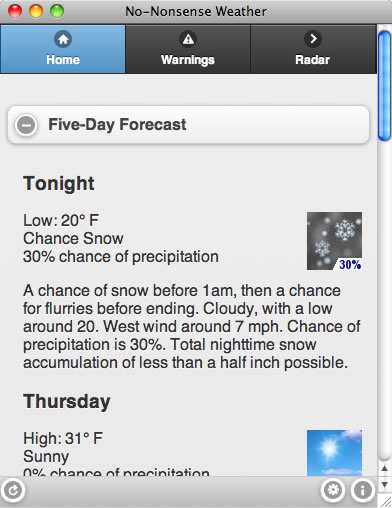
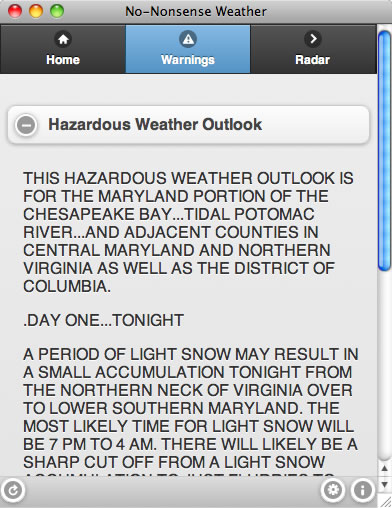
I’ve been doing a little bit of work toward getting my No-Nonsense Weather app, currently available for HP WebOS, ported so that I can release versions for other mobile platforms like iOS, Android, BlackBerry OS, and Windows Phone. Since the app is written in HTML, CSS, and JavaScript, this is fairly easy using various available frameworks.

I made heavy use of the jQuery framework in the app (and on this web site, and at my day job for that matter), so I figured I’d do most of the user-interface work in the jQuery Mobile framework. I already have a proof-of-concept built in the framework, which is just a surprisingly-painless port from the existing WebOS code. It has some rough edges and still needs some work, but it functions. You can see some screenshots below.

After I get it polished up and solid from the UI and basic-functionality perspectives, I’m planning to use the PhoneGap framework to access the different platforms’ location services and preference storage APIs. Once that’s working, I’ll start doing a lot of testing to make sure it works as expected on the different platforms. I’m not committing to any particular platforms yet. Since the app is free and will make me $0, I’m not interested in paying for access to the app stores, and some of the stores (I’m looking at you, Apple) are idiotically restrictive anyway.

More information as I get this better developed . . . it’s still very early at this point.

Beware the NIMBYs

I get very, very annoyed at the NIMBYs . . . people who, when faced with anything that might mar their precious neighborhoods in order to provide for some greater good, say, “not in my back yard!”

For example, I often hear of homeowners’ associations and community groups banding together to prevent the installation of new cellular phone towers. Yes, we know, the towers are ugly. Sometimes, a little ugliness is the price we pay for progress. Whenever I hear about some obstructionist community refusing to allow the installation of a much-needed cell tower, I always wish we could just terminate the entire neighborhood’s wireless phone service. Wireless companies don’t have to provide service to people actively trying to harm their business. The people in those neighborhoods clearly don’t want service anyway.

I’m a real jerk about these kinds of things. If you refuse to allow progress because it happens to be in your back yard, then why should you be allowed reap its benefits? This should be the consequence of deciding to obstruct infrastructure improvement: you don’t get to use the infrastructure. If Arlington County doesn’t want to allow I-66 to be widened inside the beltway, for example, fine . . . block off the Arlington exits so the county doesn’t reap any of the highway’s benefits. The reduced traffic volume would improve flow for the rest of us just as much as the increased capacity would’ve anyway.

The same thing happens a lot with high voltage power lines. Many officials and residents here in Loudoun County are going on and on in opposition to the PATH project, a high voltage line that would pass through a small, isolated, rural corner of the county. Once again, yes, I know power lines are ugly. So what? If everybody in the United States refused to let power lines run through their counties, there would be no national power grid. If this county really wants to oppose progress, then American Electric Power and Allegheny Energy should stop supplying electricity to the county or to any of the power companies that supply it. Again, clearly we don’t want it.

I, for one, stand on the side of progress and infrastructure improvement . . . even if it’s a little ugly sometimes.

Our Real Sputnik Moment

In President Barack Obama’s (D) State of the Union address last week, he declared, “This is our generation’s Sputnik moment.” It was a lovely, if typical, rhetorical flourish from our president. He was trying to rouse the American people to major investments in research, science, and technology in response to the great strides made by China and other countries in these and other fields.

Sputnik 1 was the first man-made object to orbit the Earth. It was launched by the Soviet Union on October 4, 1957, much to the surprise of American observers who almost universally expected the U.S. space program to reach orbit first. The Soviets followed with Sputnik 2 on November 3 of the same year. Our own first satellite was Explorer 1, which launched on January 31, 1958—almost four months later. This national embarrassment in the midst of the Cold War was a wake-up call for Americans. We weren’t doing enough. The Soviet Union was a serious threat to our security, and it was ahead of us in a key area of scientific development.

Soviet cosmonaut Yuri Gagarin flew into space and orbited the Earth on Vostok 1 on April 12, 1961, becoming the first human in space. U.S. astronaut Alan Shepard flew into space on Freedom 7 only three weeks later, but we were not able to get a human into orbit until John Glenn flew on Friendship 7 on February 2, 1962. We were still, arguably, far behind the Soviets. The ‘space race’ between the U.S. and the Soviet Union was on, and would become a national obsession for years to come. We seemingly put everything we had into development of space technology, and the effort to beat the Soviets culminated with the Apollo program, where we successfully landed human beings on the moon.

Second Judge Rules ‘Mandate’ Unconstitutional

Judge Roger Vinson of the United States District Court for the Northern District of Florida ruled today that the federal government does not have constitutional authority to require citizens to purchase health insurance. This ruling concurs with a separate ruling last December in Virginia that invalidates the ‘individual mandate,’ a core provision of President Barack Obama’s (D) landmark Patient Protection and Affordable Care Act.

Notably, Vinson’s ruling invalidates the entire health care reform bill on the argument that the unconstitutional individual mandate is ‘not severable’ from the rest of the act.

The health care reform act was signed into law in March of 2010 and immediately challenged by many states on Constitutional grounds. This particular case, ‘Florida et al v. United States Department of Health and Human Services’ (3:10-CV-91-RV/EMT), is the largest challenge with 26 state plaintiffs: Alabama, Alaska, Arizona, Colorado, Florida, Georgia, Idaho, Indiana, Iowa, Kansas, Louisiana, Maine, Michigan, Mississippi, Nebraska, Nevada, North Dakota, Ohio, Pennsylvania, South Carolina, South Dakota, Texas, Utah, Washington, Wisconsin, and Wyoming.

State of the Union Experimental Live Blog

I live-blogged the State of the Union address and the Republican response this evening on the Off on a Tangent live coverage page. This was my first attempt at a live blog, so it was definitely an experimental trial-run (and a first technical test of my simple live coverage platform, which I intend to use for other events in the future).

The transcript of the live blog is included below (with some minor formatting added).

Scott Bradford is a writer and technologist who has been putting his opinions online since 1995. He believes in three inviolable human rights: life, liberty, and property. He is a Catholic Christian who worships the trinitarian God described in the Nicene Creed. Scott is a husband, nerd, pet lover, and AMC/Jeep enthusiast with a B.S. degree in public administration from George Mason University.