
Your Tax Money Going to Political Campaigns?

How would you feel if a federal government agency, funded from a combination of tax dollars and fees, used some of its money to fund political campaigns? You’d be pretty pissed, wouldn’t you? Your tax dollars shouldn’t be going to fund political campaigns!

I agree. Private companies have the right, as free associations, to engage in political speech and make political donations if they wish, but the federal bureaucracy is a different animal. Of course individual bureaucrats can do whatever they want, and can even create their own free associations if they want, but government agencies themselves have a responsibility to serve the American public under the guidance of their elected or appointed leaders. They are not permitted to engage in political campaigns.

Well, according to the Wall St. Journal (as reported on AutoBlog), federally owned General Motors has broken its self-imposed moratorium on political donations and has spent $90,000 on its preferred candidates in the upcoming elections.

General Motors, despite the appearance of being a private company, is 61 percent owned by the United States government, and it’s ‘profit’ of late is probably some combination of tax money ‘investment’ and sale of product. The company’s very existence is predicated on many billions of that tax dollar ‘investment.’ As long as the government owns any of General Motors it is a government agency, not a private company. As such, it has no right to make political donations of any kind. Period.
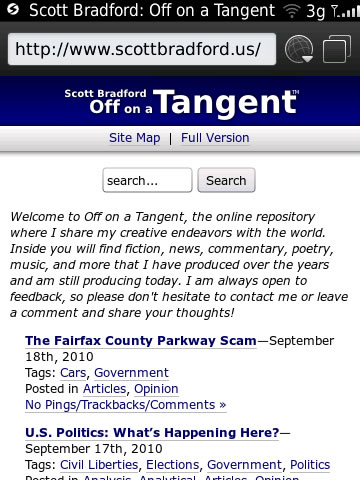
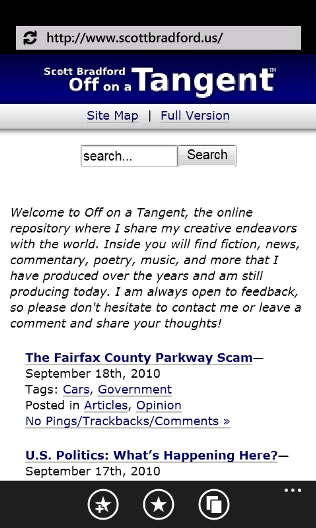
Mobile Browser Support Notes

Finally, the universe of mobile browsers seems to be stabilizing. While there are many mobile platforms out there—iOS, Android, WebOS, BlackBerry OS, Windows Phone, and Symbian—almost all of them are settling on a single browser display engine. All of those platforms except Windows Phone use the WebKit engine, or will soon.

RIM’s BlackBerry OS platform switches to WebKit with version 6, which will be coming out soon for a number of newer BlackBerry phones, leaving Microsoft Windows Phone as the last major holdout. However, this is still great news for web developers. We basically have to support WebKit and the mobile version of Internet Explorer, rather than a multifaceted hodge-podge of proprietary and non-proprietary mobile browsers. To add even broader support, just add Opera Mini and Firefox Mobile too. Those four cover pretty much everybody.

Anyway, the main reason for this entry: BlackBerry OS 6 and Windows Phone 7 are both coming out very soon on new phones (and, in RIM’s case, for some old ones too). Both platforms have completely new browsers. I’m pleased to announce that Off on a Tangent already works in the default browsers for bothof these platforms, and will be officially supported in them moving forward (in addition to the wide support I already offer for most of the platforms listed above).

The Fairfax County Parkway Scam

The first sign of trouble was that there were no signs. After waiting a quarter century to build the last segment of the Fairfax County Parkway (7100), surely they would put up signs when it was done to direct through traffic onto the new highway.

As long as I can remember, signs on route 7100 indicated it ended where it passed underneath Rolling Rd. and turned into the Franconia-Springfield Parkway (7900). You had to perform a number of random turns from there to connect to a separate section of 7100 near Fort Belvoir. It’s been a perennial point of confusion—there were two separate stretches of road labeled as route 7100 that didn’t connect directly to one another. There was a gaping hole, only a couple miles long, and to get around it you had to travel miles out of your way on confusing local roads without clear direction.

The Rolling Rd. interchange was always intended to be the spot at which the two 7100’s would eventually connect; in fact, all of the Rolling Rd. exit signs had ‘7100’ and ‘Fairfax County Parkway’ wording on them, it was just covered up. Those signs were a rare example of forward thinking; they would not need to be replaced when the highway was finally done, they would simply need to have their temporary adhesive coverings removed. The mythical future south-bound traveler on 7100 would need to bear right at the interchange to stay on the highway and proceed toward Ford Belvoir and U.S. 1.

‘Surely this can’t be right,’ I thought, as I approached the 7100 south (née Rolling Rd.) interchange. The signs that should have said 7100 south still didn’t; in fact, the signs still said that 7100 was ending. To much fanfare and local media coverage, the highway had supposedly been finished and opened over a week ago! According to the Washington Post, the ribbon cutting and opening of the last segment of 7100 was scheduled for September 13. There was still work to do on the ‘trubutary’ roads around it, said the Post, but the main thoroughfare would be open. I had decided to go this way today mainly to try out the new connector. ‘Maybe,’ I thought, ‘they just haven’t updated the signs yet.’

U.S. Politics: What’s Happening Here?

The political ‘lay-of-the-land’ in the United States has transformed incredibly in the last three or four years. The pundits and politicos are working themselves into a froth trying to figure out, define, and—yes—control what is happening in this country. All of the old rules seem to be breaking down, with long-time Republican Party insiders finding themselves ousted in the primaries by supposedly ‘radical’ firebrands and seats that have been held by Democrats for decades suddenly in-play and under Republican threat. How did we get here? How did everything change so much and so fast?

There are two main elements at play here, both of which have served to aid the Republican Party in this election cycle though it remains to be seen whether it will continue to do so. The first element is an internal struggle within the Republican Party which has gone on for many years, but has only recently risen to prominence among the outside punditry. The second element is a sea-change, entirely in the last two years, in how the great middle perceives each of our two major political parties.

Republican Party Internal Reform

Despite all the blather over his eight-year presidency, George W. Bush (R) was not the radical right-wing ideologue that his opponents made him out to be. Stinging from Bush’s razor-thin victory over Vice President Al Gore (D) in 2000—a historic election rife with controversy—the political opposition very quickly embarked on an effort to cast the Bush administration as a cabal of hyperactive right-wing psychopaths. The facts simply do not back up this characterization. For example, before the terrorist attacks of September 11, 2001, Bush’s main policy accomplishment was the No Child Left Behind law—a law he crafted with ‘liberal lion’ Senator Ted Kennedy (D-MA) that went on to pass both houses of Congress with broad bipartisan support. Yeah, you’ve got to watch out for those radical right-wing extremists and their bipartisan education bills!

Taking Control from the Carriers

In the United States (and in other places too), our wireless phone carriers have too much control. As an example, I have a Palm Pre Plus that is currently running Palm WebOS 1.4.1. Palm updated the operating system to version 1.4.5 on July 15, which brought a number of new features and capabilities, including support for newer and more-advanced games and applications.

Verizon Wireless, however, has withheld this update from its users. This isn’t unique to Palm users, or Verizon customers. With pretty much every phone other than the iPhone, updated software from phone manufacturers are not released to users until the carriers release them—usually many months late, if they are ever released at all. My old AT&T 8525 (made by HTC) running Windows Mobile was capable of running Windows Mobile 6.5, but AT&T never updated it beyond 6.1. AT&T eventually updated my BlackBerry Bold’s software to BlackBerry OS 5.0, but finally did so many, many months after it became available from RIM (and after I had abandoned AT&T for Verizon anyway).

It’s time to put the control in the hands of the manufacturer of the phone, not the carrier. The company that made my phone has created updated software for it, so let me install it. Verizon has no right to withhold an available software update from me.

Sometimes you can work around these limitations. With BlackBerrys, it’s fairly easy (with the right know-how) to install available software updates on the ‘wrong’ carrier’s phones (during the year+ I had the BlackBerry, I spent most of my time running ‘unofficial’ OS’s that were newer and better than the ‘official’ ones from AT&T). With the old Palm OS phones you could usually hack the ‘unlocked’ versions of the Palm OS onto carrier models. With many Windows and Android phones, vibrant enthusiast communities produce unofficial ‘ROMs’ with updated systems. Sadly there’s no known way (yet) to do this stuff with WebOS because of the uniquely efficient way that Palm packages and distributes its OS updates.

But it’s very simple: we should not have to hack around to run the newest operating systems available for our phones anyway. They are our phones, not Verizon’s or AT&T’s. We should be able to get an updater from the company that made the phone and install it, if we want to, and the carriers should put no roadblocks in our way. Sure, they have the right not to support an unofficial OS version, but they have no right to use technical means to prevent us from installing them if we want to. I’ll say it again: they’re our phones!

Scott Bradford is a writer and technologist who has been putting his opinions online since 1995. He believes in three inviolable human rights: life, liberty, and property. He is a Catholic Christian who worships the trinitarian God described in the Nicene Creed. Scott is a husband, nerd, pet lover, and AMC/Jeep enthusiast with a B.S. degree in public administration from George Mason University.