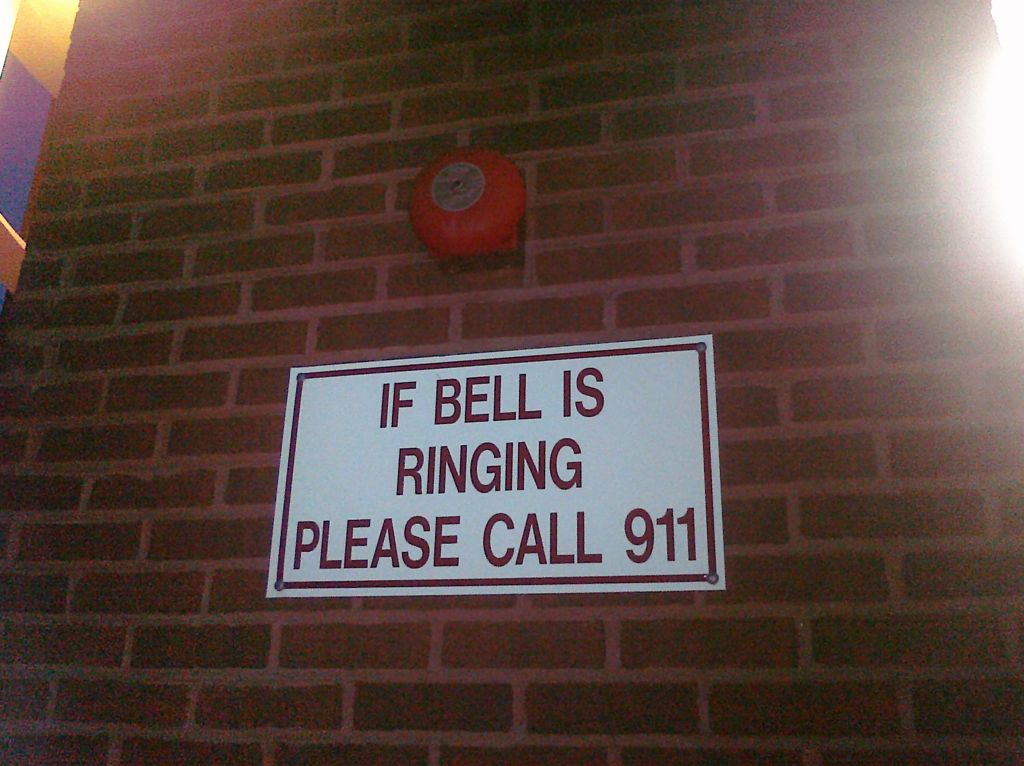
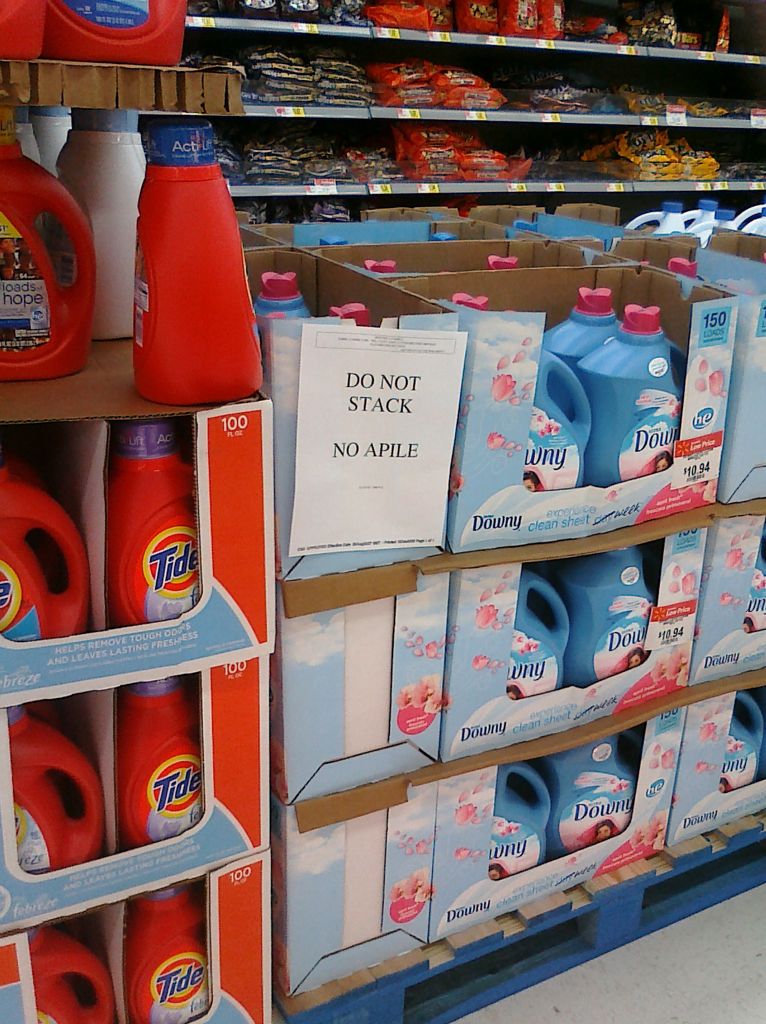
And now for four more random photos! First, a truly high-tech security system at a CVS that apparently requires passing customers to call 911 when a bell is ringing. Second, our two cats secretly liking each other. Third, our youngest cat Vincent cuddling with an octopus toy. Finally, some stacked containers at a WalMart helpfully labeled, “DO NOT STACK.”
35 Miles in 50 Years: Your Governments at Work
Ashley Halsey III writes in the Washington Post about the Fairfax County Parkway, a 35-mile long thoroughfare that has been talked about for fifty years and took a quarter-century to build. I [vaguely] remember when I was in kindergarten or 1st grade riding my bike with my dad through the construction zone where a segment of the highway was being built. I remember it being called, at different times, the ‘Springfield Bypass’ and the ‘Fairfax Center Parkway’ before the powers-that-be settled on its final name.
I remember that, after the segment I had biked on opened, I noticed two errors on signs. I wrote a letter to the Virginia Dept. of Transportation (VDOT) about it and the errors soon got fixed. Even today, if you’re driving on Fairfax County Parkway heading north, you’ll notice that the signs saying ‘Fox Mill Rd. Next Signal’ and ‘Sunrise Valley Dr. Next Signal’ both have corrective ‘patches’ over the Dr. and Rd. appellations. I’m responsible for that; they originally said ‘Fox Mill Dr.’ and ‘Sunrise Valley Rd.’
Well, today—six years after that kindergartener finished college—the last segment of this 35-mile highway is finally about to open. Way to go, guys. At this rate our transportation infrastructure will catch up with 2010 traffic volume no later than, say, 3827.
2010 Endorsement & Election Plans
Since 2004 I have made political endorsements on this web site for every election in-which I am eligible to vote. The 2010 general election is no different. Next week, I will be publishing the Off on a Tangent endorsements for Virginia’s 10th District in the U.S. House of Representatives, three Commonwealth of Virginia constitutional amendments, and a Loudoun County, Virginia, bonds referendum.
I will also be introducing something new this year: a sort of ‘general endorsement’ (I haven’t come up with a real name for it yet). Especially in years like this one, the elections in which I’m making endorsements only matter to a relatively small percentage of my readers. In addition to these specific endorsements, I’ll be adding an overarching ‘things you should consider when voting this year’ piece that will apply across-the-board to U.S. voters. I will not specifically endorse any particular candidates or party in this piece, but will hopefully provide you with some ‘food for thought’ as you consider your respective votes.
As I have done since 2004, I am planning to provide live election coverage from approx. 7pm until approx. midnight on 11/2/2010. This will include results for all races in which I’ve made endorsements and a feed of any relevant national news that might come up. I project winners based on my own method that includes analysis of media reports, exit polling, and official returns. I have been known to occasionally call an election winner correctly before any mainstream media outlet does, if the data supports it. (For example, I called the 2004 Presidential election for George W. Bush [R] several hours before any major media outlet had done so.)
Let’s Talk ‘Apocalyptic’ Politics
Robert McCartney writes in The Washington Post about attendees of Glenn Beck’s rally Saturday in Washington, DC. While estimates of the crowd’s size vary widely, the most reputable estimates put it somewhere in the half-million range. Most of the media coverage of the event (before, during, and after) has focused on its fringy elements and tried to paint the group as a bunch of hateful racists, but—as I’ve written before about the so-called ‘tea party’ movement—the realities are much more nuanced.
McCartney puts aside these hyper-exaggerated caricatures, and rightfully so, but then latches on the supposed ‘apocalyptic’ views held my many of the participants as being a bad thing for political debate. Normally, I might agree with this thesis. In normal times, this kind of ‘so-and-so is destroying America’ rhetoric cheapens and degrades our political discourse—another subject I’ve covered before.
In the article, the author points to a seemingly random selection of rally attendees who speak in nebulous terms about an impending apocalyptic end to the United States, at least as it exists today. It is unfortunate that so many people have these kinds of one-dimensional, over-simplified views on current events—although, in the interest of fairness, the majority of folks attending the last half-decade of anti-war protests probably couldn’t have articulated their views any more deftly. The American masses have never been known for their articulateness.
But here is the problem: while most of the people who swarmed Washington on Saturday to make a conservative political statement couldn’t explain their ‘apocalyptic’ views on the state of the republic, their views have a core truth behind them that too few people are discussing. Perhaps we should all be thinking a little apocalyptically right now.
Film Disclaimer Absurdity
I wrote back in June about how our society seems to simply accept dishonorable behavior now. ‘Unlimited Internet’ doesn’t mean unlimited. ‘Right to health insurance’ means you have to buy it whether you want it or not. Swearing to ‘preserve, protect and defend the Constitution of the United States’ apparently only applies to whatever parts of the Constitution that particular politician likes. The list goes on and on, and nobody seems to say what they really mean anymore.
I ran across another dishonorable misrepresentation today—one we see all the time and never give a second thought to. I was watching Indiana Jones and the Last Crusade today and noticed a pretty standard statement nestled in the end credits:
The story, all names, characters[,] and incidents portrayed in this production are fictitious. No identification with actual persons, places, buildings[,] and products is intended or should be inferred.
Almost every movie has this statement, or something very similar, it its credits. We’ve grown blind to it. But, in this case and many others, it is a bald-faced lie. In one scene, Indiana Jones finds himself face-to-face with Adolf Hitler. Hitler, thinking Jones wants an autograph, signs ‘Adolf Hitler’ in Jones’s father’s Grail Diary. The bad guys in the movie are Nazis who wear Nazi uniforms. The city of Berlin is one of the places where the action supposedly takes place.
Are we to honestly believe that a Nazi leader in Berlin, in 1938, with an iconic mustache, and named Adolf Hitler is not ‘intended or should be inferred’ to be identified with the ‘actual person’ named Adolf Hitler? Or that his name is ‘fictitious?’ Are we to believe that the city of Berlin is not ‘intended or should be inferred’ to be identified with ‘actual place’ Berlin? Come on, give us a little credit! It’s obviously a fictional film, and there’s no harm in having a disclaimer in the credits, but at least write one that tells the truth.
I don’t mean to pick on this particular film. Almost every fictional film that makes reference to real-world celebrities, historical figures, movements, places, and events is ‘intended and should be inferred’ to refer to those very people, places, and events and yet carries a warning like this explicitly stating otherwise. That’s called a lie, and it’s another [admittedly minor] symptom of a society that no longer values accuracy and honesty.

Scott Bradford is a writer and technologist who has been putting his opinions online since 1995. He believes in three inviolable human rights: life, liberty, and property. He is a Catholic Christian who worships the trinitarian God described in the Nicene Creed. Scott is a husband, nerd, pet lover, and AMC/Jeep enthusiast with a B.S. degree in public administration from George Mason University.