Palm WebOS 1.4

Of course, mere days after posting my in-depth review of the Palm Pre Plus and the Palm WebOS operating system, the much-anticipated WebOS 1.4 update came out. The updated operating system was released on Saturday, February 27 to Sprint customers, and Sunday, February 28 to Verizon customers like Melissa and me.

Palm’s update mechanism is dummy-proof: the phone downloads the update and installs it on its own while it’s charging (usually overnight, I’d assume). From what I’ve been reading, this is spread out over time to prevent Palm’s servers from getting overloaded. If you’re a nerd like me who can’t bear waiting for the OS to do its own thing, you can also manually initiate the update whenever you like. I did it Sunday morning, as soon as I read online that the update was available. I have no idea how long it would have taken for the phone to find out on its own.

The update probably took a half hour or so to download (over WiFi) and install. Download times likely would have been quite a bit longer over the data network, even on 3G. After completing the download the phone reset itself and installed the update (with a classy, no-frills, round progress indicator). Without any hiccups, everything was ready to go

The biggest new feature Palm brings out with WebOS 1.4 is video recording. Palm took their time bringing this feature to the platform, but they did a good job with it. It records in the MP4 format and allows for limited editing and direct sharing via YouTube, Facebook, email, and MMS. Beyond this major feature addition, WebOS 1.4 mostly offers increased polish and incremental improvement. The LED in the gesture area will now blink to indicate you have a waiting notification. When you launch an application, a ‘placeholder’ card shows up immediately which lets you know it’s doing something (and lets you preemptively close the app. if you opened it in error).

Performance seems to be slightly improved and ‘snappier,’ and battery life seems to be improved. I seem to be getting about 20 percent better battery life so far, which is pretty significant. All-in-all, a solid improvement. Thanks, Palm! :-)

Majority See Government As a Threat

Government is a threat. Sound crazy? It didn’t to the founders of our country who, after witnessing the ostensibly-republican government of Britain’s despotism toward them, crafted a government for the new United States of America that would have strictly limited and broadly distributed powers and authorities. They saw government un-checked as a threat to liberty and did everything they could to ensure that our government would always answer to ‘we the people.’

It turns out, however, that the founders and I are preaching to the choir these days. Amid the Great Awakening in America going on now, CNN reports that 56 percent of Americans now rightfully view the government as a potential threat to our civil liberties. Broken down ideologically, strong majorities of both Republicans and independents (70 percent and 63 percent, respectively) see the government as a threat. 37 percent of Democrats are also mistrustful of the government.

I’m cautiously optimistic that the people of this great country are finally waking up.

Hooray for Health Insurance

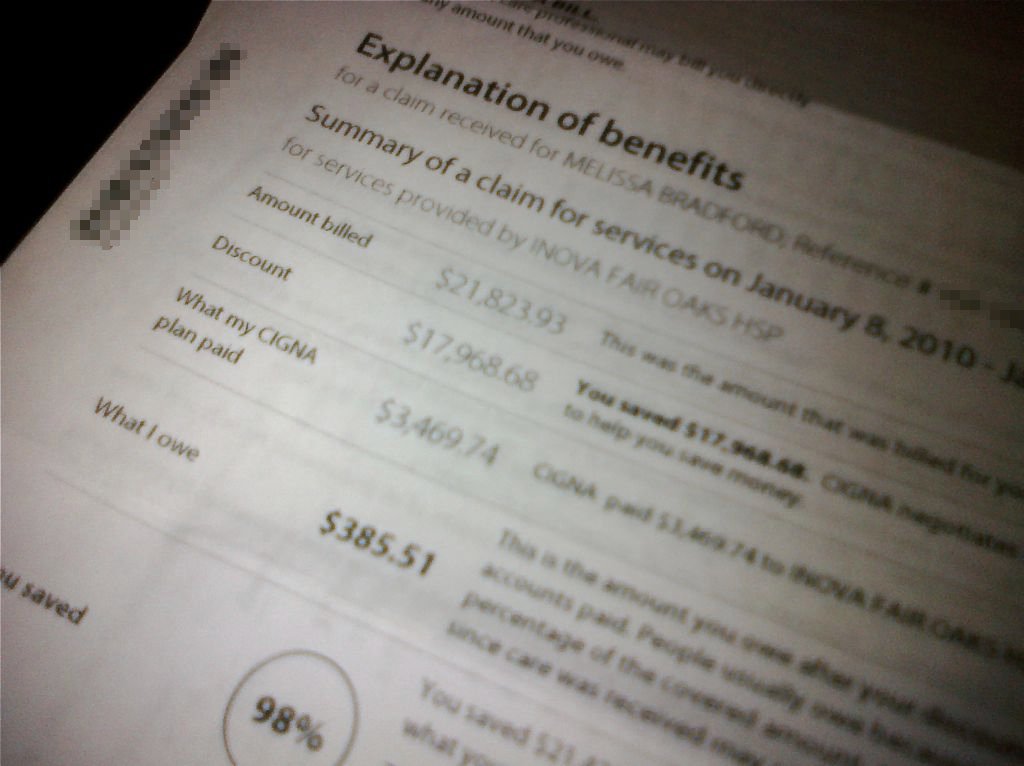
I’m not generally a fan of medical insurance companies, but boy do I appreciate them at times like this. I just got our claim information for Melissa’s surgery in January.

The total hospital bill was $21,823.93, but we only have to pay $385.51. Not bad, huh?

Keep in mind too that this is just the hospital stuff. The surgeon’s bill is handled separately, as are some of the other things, so the real total bill amount (and the real total out-of-pocket amount) will be much higher.

But, because we have the good sense to be insured against this kind of thing, we’re certainly not at any serious financial risk. The total out-of-pocket amount will probably be less than the cost of a major car repair.

Palm Pre Plus and Palm WebOS

Background

In September of 2008, I wrote about the then-sorry state of smartphones. I wanted five things: reliability, extensibility, usability, push email, and a real keyboard. At the time I went through the litany of major smartphone operating systems available at the time and how they all fell short on one or more of my simple requirements.

A little over two months later, I bought the best phone available at the time: the BlackBerry ‘Bold’ 9000. It served me very well for the time I had it, and I really only had two major complaints—the reliance on the Research in Motion (RIM) data center as a data go-between, and the lack of real IMAP email support. Of course, it was also on the AT&T network, which deteriorated rapidly over the last six months or so in the D.C. metro area. That can’t be blamed on the phone or its operating system.

When we decided to eat our early termination fee and switch back to Verizon, it was time to evaluate our smartphone options once again. Since I got the Bold, two new players came on the scene: Google’s Android operating system, and Palm’s WebOS. Both bring the flare of a modern mobile operating system without the kludgey limitations of Apple’s iPhone or the RIM data center. After considering both options (and also duly considering sticking with BlackBerry), we decided to go with our old friend, Palm.

Scott Bradford is a writer and technologist who has been putting his opinions online since 1995. He believes in three inviolable human rights: life, liberty, and property. He is a Catholic Christian who worships the trinitarian God described in the Nicene Creed. Scott is a husband, nerd, pet lover, and AMC/Jeep enthusiast with a B.S. degree in public administration from George Mason University.