Hooray for Health Insurance

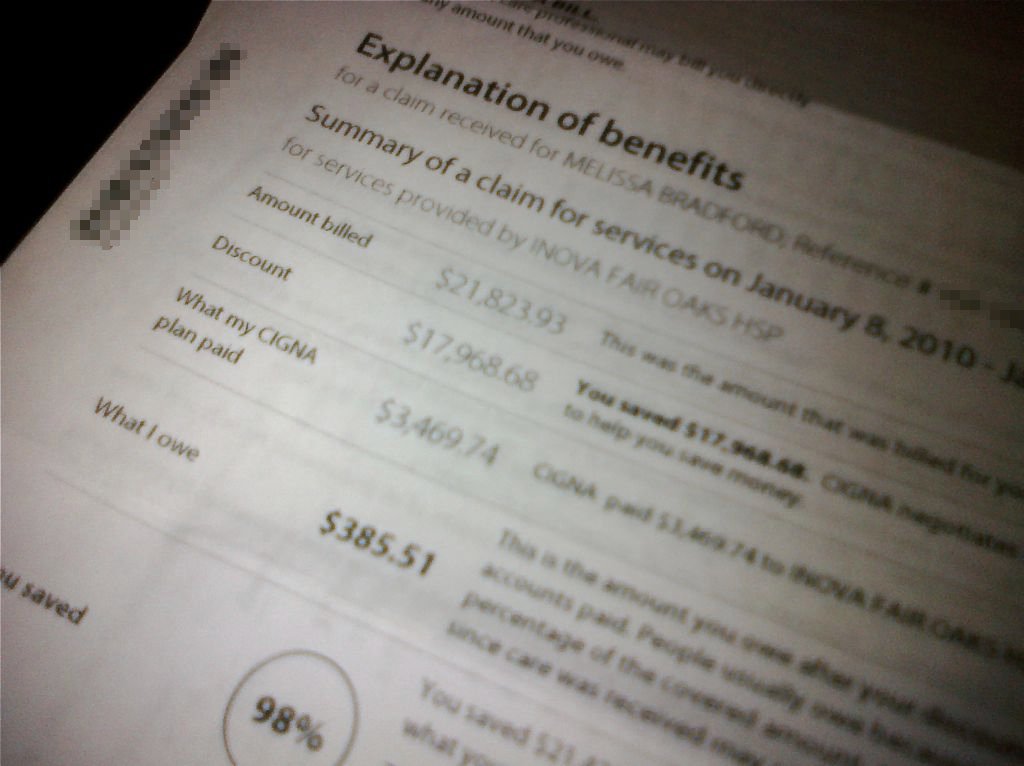
I’m not generally a fan of medical insurance companies, but boy do I appreciate them at times like this. I just got our claim information for Melissa’s surgery in January.

The total hospital bill was $21,823.93, but we only have to pay $385.51. Not bad, huh?

Keep in mind too that this is just the hospital stuff. The surgeon’s bill is handled separately, as are some of the other things, so the real total bill amount (and the real total out-of-pocket amount) will be much higher.

But, because we have the good sense to be insured against this kind of thing, we’re certainly not at any serious financial risk. The total out-of-pocket amount will probably be less than the cost of a major car repair.

Palm Pre Plus and Palm WebOS

Background

In September of 2008, I wrote about the then-sorry state of smartphones. I wanted five things: reliability, extensibility, usability, push email, and a real keyboard. At the time I went through the litany of major smartphone operating systems available at the time and how they all fell short on one or more of my simple requirements.

A little over two months later, I bought the best phone available at the time: the BlackBerry ‘Bold’ 9000. It served me very well for the time I had it, and I really only had two major complaints—the reliance on the Research in Motion (RIM) data center as a data go-between, and the lack of real IMAP email support. Of course, it was also on the AT&T network, which deteriorated rapidly over the last six months or so in the D.C. metro area. That can’t be blamed on the phone or its operating system.

When we decided to eat our early termination fee and switch back to Verizon, it was time to evaluate our smartphone options once again. Since I got the Bold, two new players came on the scene: Google’s Android operating system, and Palm’s WebOS. Both bring the flare of a modern mobile operating system without the kludgey limitations of Apple’s iPhone or the RIM data center. After considering both options (and also duly considering sticking with BlackBerry), we decided to go with our old friend, Palm.

Public Schools: Still Shredding the Constitution

I really still can’t make sense of why so many public schools insist that they have the right to invade the privacy of their students. Even though they are government entities, and thus bound by Constitutional limits on the powers of government, they blithely insist they have the right to subject students to invasive searches without probable cause, confine them against their will, limit or eliminate entirely their free speech and press rights, and more. These things are bad enough on school property during school hours, but more and more our public schools claim these same fictional authorities over students after-hours and off-grounds.

A fine example occurred recently in Pennsylvania—one that is surprising to me only because people are acting like it’s something out of the ordinary. The Lower Merion School District, like many districts, issued laptop computers to its students for the year which, provided they paid for some insurance, they were permitted to take home and use after hours. The school, however, had installed software that allowed them to remotely monitor the webcams on these computers. The district claims that they only used the technology when laptops were reported stolen, but at least one student—who is now suing the district—was confronted by school officials after being caught on webcam supposedly breaking school rules in his own home.

First off, school rules and authority do not apply at home. Period. The end. Even if the school had the right to use the webcam to take the picture of the student supposedly doing something wrong, what happens outside of school is none of the school’s business. Second and more importantly, schools simply do not have the authority to invade a student’s home, electronically or otherwise. In fact, what the school system did here was egregious enough that the Federal Bureau of Investigation has launched an investigation . . . though if they were to start an investigation every time a public school trampled a student’s legal rights they wouldn’t have time for much of anything else.

What on earth made the school officials think this was appropriate? We live in a country where fourteen-year-old girls get slapped with child pornography charges for taking photos of themselves; what if the school had turned on the webcam and captured a student in a state of undress? That’s transmitting child pornography over the Internet, plain and simple. Using recording devices in this way is also an unreasonable search and seizure (unless they had a warrant), and violates federal wiretap laws.

This has gotten far, far out of hand. Once again, maybe our schools would be a bit better if they redirected their efforts toward education instead of spying on, restricting, and micromanaging their students.

On the ‘Tea Party’ Movement

The New York Times ran with an article today about the so-called ‘Tea Party’ movement and, to my pleasant surprise, it was a relatively fair and correct piece. The Times writers and editors couldn’t help but throw in some digs here and there to make it look ‘fringy,’ but the article generally presents an accurate cross-section of the main opinions and backgrounds within the movement.

It does not present the ‘Tea Party’ as some political fabrication of the Republican Party, which would be a complete misrepresentation of the truth. On the contrary, the movement eschews any political party involvement. It is a grass-roots, loosely-organized cadre of individual citizens with widely disparate beliefs (including both the mainstream and radical fringe).

What holds the group together, relatively speaking, is belief in a tightly limited federal government, a desire to end needless deficit spending, and a ‘strict constructionist’ read of the U.S. Constitution and all of the Bill of Rights—not some editorial selection thereof that mysteriously omits the 2nd, 9th, and Tenth Amendments.

Today is Ash Wednesday

Today is Ash Wednesday, which marks the beginning of a 40-day penitential season of Lent in Western Christianity. For us Roman Catholics it is a day of fasting and prayer.

During the Ash Wednesday Mass, the faithful are marked with an ashen cross. The cross is placed on our forehead as a sign that we are dust, and to dust we shall return (Genesis 3:19).

Lent is a season in which Christians reflect on their sins and shortcomings and, more importantly, work toward repentance and correction. Christians everywhere should take this opportunity to self-examine through prayer and sacrifice. The most important single element of Christianity is that—because of Jesus’s sacrifice—salvation is open to us all. We, however, have to accept it by striving to live a Christian life.

Lent allows us, through our own small sacrifices, an opportunity to remind ourselves of this and begin moving in the right direction.

Scott Bradford is a writer and technologist who has been putting his opinions online since 1995. He believes in three inviolable human rights: life, liberty, and property. He is a Catholic Christian who worships the trinitarian God described in the Nicene Creed. Scott is a husband, nerd, pet lover, and AMC/Jeep enthusiast with a B.S. degree in public administration from George Mason University.