
It’s Time for Pelosi to Go

Representative Nancy Pelosi (D-CA 8th), the Speaker of the U.S. House of Representatives, is among my least favorite politicians. She is a disingenuous opportunist at best, and a disgraceful liar at worst. She seems to have no interest whatsoever in working with members of the opposition party (though plenty of other leaders in both parties can be accused of the same). She has no qualms about lying through her teeth to advance her career or, as we have recently seen, protect her ‘image’ as a liberal populist. Ultimately, there are 257 Democrats in the House today . . . probably 200 of them would be better choices for the role of Speaker.

Let us briefly discuss some highlights of Pelosi’s actions and character over the last several years:

In April 2007, in direct violation of the Logan Act, Pelosi traveled to Syria without any executive branch review and arguably worked against the interests of the United States in order to cast herself as a ‘peacemaker’. The Logan Act (USC Title 18, Part I, Chapter 45, §953) prohibits any U.S. citizen, including members of Congress, from engaging in foreign policy activity without the approval of the president or his designates.
Website Bugfixes and Such

As is usually the case with major updates to the site, I’ve been spending my occasional spare moments since the launch looking for bugs and quashing them. I’m sure the site is not bug-free, but I think I’ve hammered out all the major issues. This time around was particularly difficult, since I didn’t reuse much of the code from the last site and it was sort-of like starting over (and I used a lot of new techniques that I’m not as familiar with troubleshooting).

One of the things I fixed was that the site had been failing the CSS 3.0 validation because of some Internet Explorer-specific code regarding image opacity, where IE (even the new IE 8!) has its own made-up opacity method instead of using the documented CSS standard. I couldn’t really fix this without breaking the site in IE 7 & 8, so I pulled the bad Microsoft code into a separate file that only gets loaded if you’re using IE. This makes the core code of the site compliant with the standards again.

The other thorn in my side has been an incompatibility with the current Firefox 3.5 Beta on Windows and Linux, and an identical issue effecting the released Firefox 3.0 but only in Linux. This caused the menu (when it is pinned at the top of the screen) to flicker annoyingly when scrolling the page up and down. This one wasn’t at all my fault; it’s the result of a Firefox bug (which I filed in their bug tracker). Initially I was going to just let it stay broken, since it only affects a small subset of my readers, but I spent a little time figuring out a workaround since I’m not confident the Mozilla folks will get this fixed promptly.

As always, there’s a list of officially supported browsers on my ‘About the Site‘ page. If you have any trouble in any of those browsers, please let me know!

Chrysler and the Rule of Law

Todd J. Zywicki, an economics professor at my alma-mater George Mason University, writes in today’s Wall St. Journal about the Chrysler bankruptcy and the rule of law.

Perhaps I am beating a dead horse in the new Bush/Obama socialism, where the government owns banks, mortgage lenders, and car companies. Maybe America just isn’t about free markets, personal liberty, and rule of law anymore. But it seems to me that the Constitution, which says the government must make “uniform laws on the subject of bankruptcies” (Article I, Section 8, Clause 4), prohibits the federal government from treating Chrysler’s bankruptcy any different than any other bankruptcy.

Anybody hear me?

I weep for the republic.

The Great Tax Dodge, Demystified

An excellent op-ed by Robert J. Samuelson appeared in The Washington Post yesterday about the ‘great tax dodge.’

President Barack Obama (D) and many others have been perennially frustrated by the concept of the multinational corporation. The issue, at least for many big-government types (but others too), is that these multinational corporations don’t pay all their taxes to their home country. Apple Computer, as an example, does not pay U.S. taxes on its foreign manufacturing plants, foreign employees, or foreign sales. Apple pays taxes for its presence and employment in each country according to that country’s laws, even though it is based in the United States.

To some, this presents an excellent opportunity. Let’s apply U.S. taxes to the spoils of U.S. companies for all their business endeavors, even those performed overseas. The problem is that if we do that, U.S. companies will stop operating overseas since the tax burden will become far too onerous. That sounds great for us, until one-by-one every other country starts doing the same thing in return . . . double-taxing their home-based companies and forcing them to give up on manufacturing in the United States. Eventually, the whole multinational system collapses, harming everybody.

Samuelson addresses all of this in his piece, detailing the function of the multinational economic system and concretely demonstrating its benefits for us, and pointing out that punitive taxation on multinational companies will undermine our economy (and the rest of the world’s economies), not help.

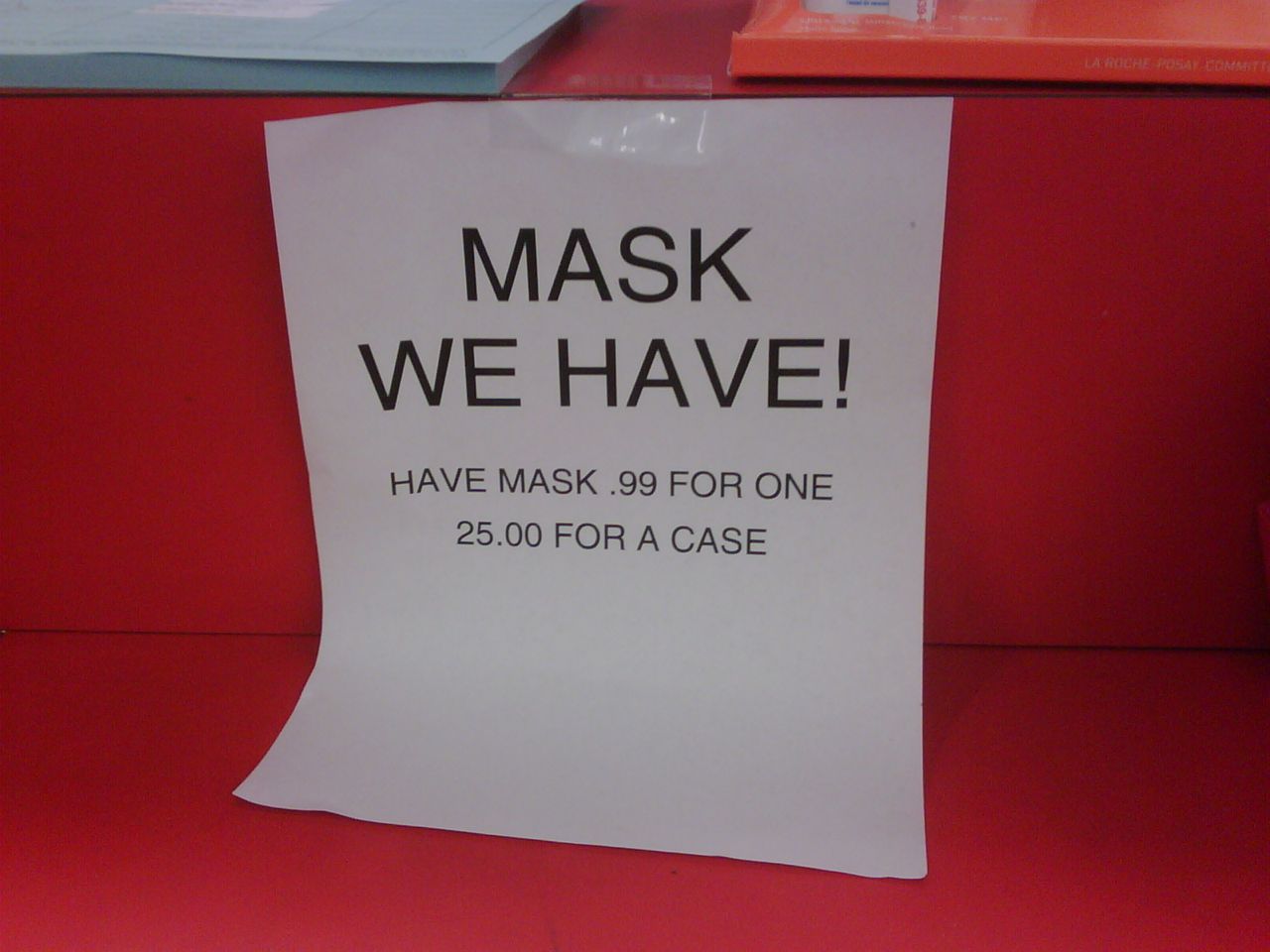
Mask We Have Fail (Updated)

Mask We HaveAs submitted to the English Fail Blog (I’ll link to it if they choose to publish it), this sign I saw in my local CVS drug store really made me scratch my head.

“MASK WE HAVE!” it says. “HAVE MASK .99 FOR ONE[,] 25.00 FOR A CASE.”

What mask[s]? And what language was this written in?

I am tempted to ask for a case of the mask they have [?], but on the other hand I’m a little afraid to find out what they’re talking about. Are these anti-swine-flu masks, or used Hillary Clinton Halloween masks, or Israeli gas masks? I’m so confused!

Updated 5/12/2009: This photo has been featured in the English Fail Blog here.

Scott Bradford is a writer and technologist who has been putting his opinions online since 1995. He believes in three inviolable human rights: life, liberty, and property. He is a Catholic Christian who worships the trinitarian God described in the Nicene Creed. Scott is a husband, nerd, pet lover, and AMC/Jeep enthusiast with a B.S. degree in public administration from George Mason University.