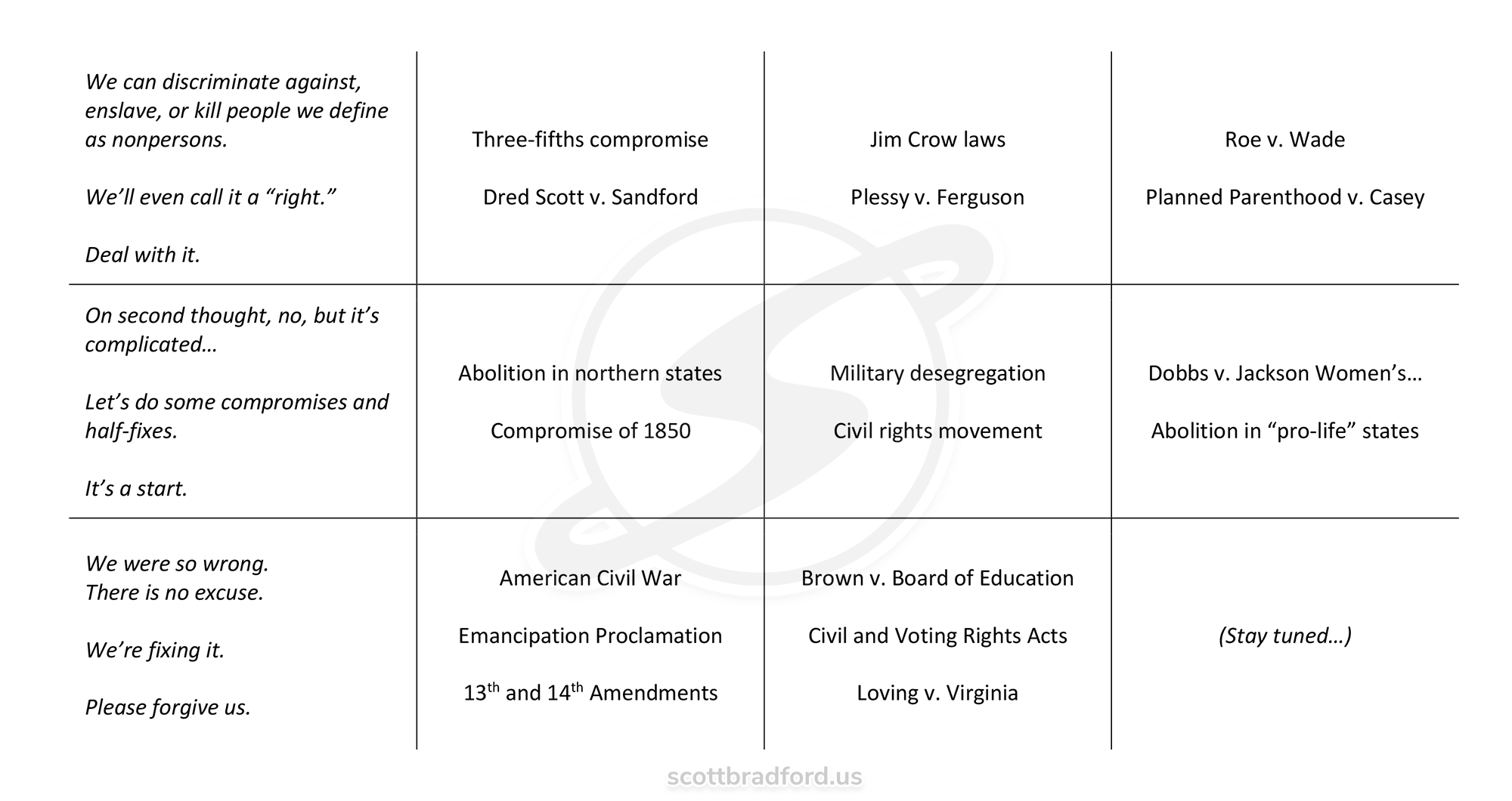

Supreme Court Overturns Roe v. Wade

The United States Supreme Court has overturned Roe v. Wade, the 1973 decision that legalized abortion-on-demand with minimal restrictions throughout the United States. It also overturned Planned Parenthood v. Casey, a 1992 decision that upheld Roe.

In the landmark case of Dobbs v. Jackson Women’s Health, the court ruled 5-1-3 that there was no justification for taking this issue out of the hands of state legislatures, and that the U.S. Constitution does not protect a so-called right to abortion. The effect of this ruling will be to return the issue to the states. It is likely that there will now be a patchwork of differing legal statuses for abortion across the United States, with some states imposing few (if any) restrictions and others essentially outlawing it.

The court has not ruled on the legality of abortion itself, which is a violation of the fundamental human right to life under natural law and must be prohibited in most cases by just governments. It does, however, open the door for state legislatures to reassert and protect this right.

The majority opinion in this case was written by Justice Samuel Alito, joined by Justices Amy Coney Barrett, Neil Gorsuch, Brett Kavanaugh, and Clarence Thomas. Justices Kavanaugh and Thomas each issued concurring opinions. Chief Justice John Roberts issued an opinion concurring only in the judgment. Justices Stephen Breyer, Elana Kagan, and Sonia Sotomayor issued a jointly-authored dissenting opinion.

Keith Johnston, Pixabay

I like baseball, in theory. But let’s be honest. The game is sort-of boring. Here are ten things we can do to fix that:

  1. Use a football. Preferably deflated.
  2. Ten bonus points every time you hit the scoreboard.
  3. Automatic three-outs if you catch the ball in your mouth.
  4. Disputes over balls vs. strikes settled by a standardized best-of-three game of rock-paper-scissors.
  5. Each team can release five cats onto the field at any point during the game.
  6. Each team can designate one inning where the other team must wear blindfolds.
  7. For one randomly selected inning, the floor is lava.
  8. If there are 0 or 2 outs, the runner must run counterclockwise. If there is 1 out, the runner must run clockwise. Running the wrong way is an automatic out.
  9. Once per game, each team can declare a Calvinball.
  10. Five innings. Just five. Please. That’s plenty.

Share to:

Send to:

Virginia Major Party Primaries, 2022

Public primary elections for the Democratic and Republican parties will be held on June 21, 2022. Off on a Tangent makes recommendations to party primary voters in each contested state- and federal-level primary race in Virginia, as well as those for Loudoun County local offices.

Political parties are private organizations that should not have any official standing in our political system. But Democratic and Republican primaries in Virginia are managed by the state and funded by taxpayers.

The purpose of a party primary should be for that party’s members to choose their nominees, but Virginia has an “open primary” system where any registered voter may vote in any one (but not more than one) primary each year.

South Riding Board of Directors, 2022

South Riding Proprietary

The South Riding Proprietary is a homeowners’ association (HOA) that acts as a de facto local government for the South Riding community in Loudoun County, Virginia. At the proprietary’s annual meeting on May 24, 2022, two seats on the Board of Directors are up for election. Members of the board serve three year terms. South Riding property owners may cast votes by attending the annual meeting in person, submitting a paper proxy vote by mail, or submitting an electronic proxy vote on the Proprietary’s web site.

Under the Proprietary’s bylaws, at least 10 percent of South Riding property owners must cast votes to achieve a quorum. Without a quorum, the Board of Directors cannot seat new members or perform any official work. If a quorum is not achieved, the meeting will be recessed for up to a month, and, when resumed, the quorum requirement drops to only 5 percent. The meeting may then be repeatedly recessed and resumed until the 5 percent quorum is achieved.

Two candidates appear on the director ballot: former Director Michael Hardin and incumbent Director Steve Pasquale. Property owners may vote for up to two candidates, and may write-in other names if desired.

Compulsory HOAs are perpetuated by the disclosures (i.e., covenants) that owners must accept when purchasing property in an HOA neighborhood. Among these terms is a requirement that owners will include the same disclosures when selling their property later. This has the effect of creating permanent de facto private governments with responsibility for shared community services like the maintenance of common areas and private streets, trash services, snow removal, community pools, playgrounds, and parks. But most HOAs—ours included—claim various other authorities that violate homeowners’ property rights.

These claimed authorities violate Article 1, Section 11, of the Constitution of Virginia, which guarantees that citizens may not be deprived of their property without due process of law (paragraph 1) and states that the right to private property is fundamental (paragraph 3). They also violate similar protections in the Fifth Amendment to the U.S. Constitution.

Until the South Riding Proprietary’s board promises to repeal all unconstitutional regulations and stop all extralegal civil enforcement, I recommend that South Riding property owners abstain from the Board of Directors election and deny the board a quorum.

Scott Bradford is a writer and technologist who has been putting his opinions online since 1995. He believes in three inviolable human rights: life, liberty, and property. He is a Catholic Christian who worships the trinitarian God described in the Nicene Creed. Scott is a husband, nerd, pet lover, and AMC/Jeep enthusiast with a B.S. degree in public administration from George Mason University.