Best Buds (Sorta)

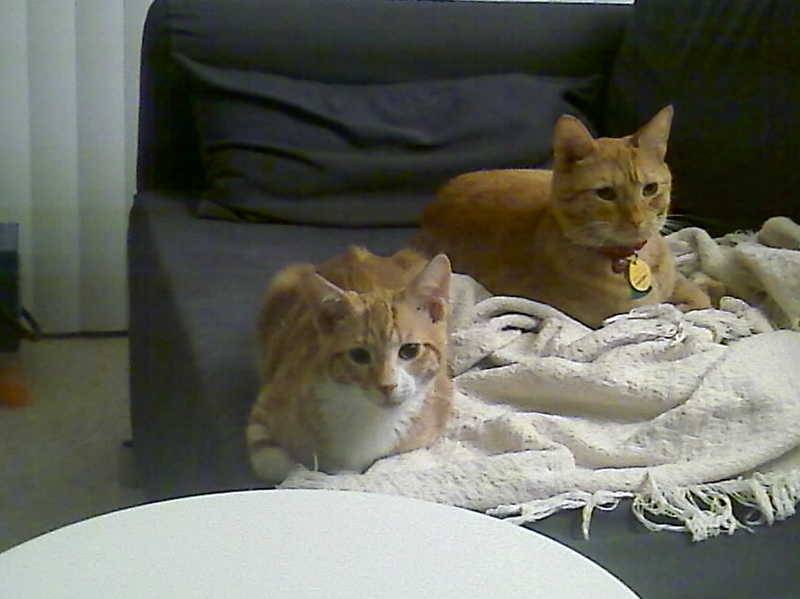
Last I talked about Vincent, our new cat, I mentioned that Mei Mei didn’t much like him and hissed and spit at him every time he walked by. Thankfully, that didn’t last long. While Mei Mei still isn’t particularly amused with the new addition, she tolerates him and (dare I say it) might even be starting to like him. If nothing else, at least she has stopped being a little devil cat when he’s around. That was starting to get old.

They even play little chase games now and then, where one will chase the other across the apartment before the other turns around and chases the first one back. It’s pretty funny.

Final 2008 Presidential Debate TONIGHT

The final formal Presidential debate between Senator John McCain (R-AZ) and Senator Barack Obama (D-IL) will be held tonight at 9pm EDT. This is the last of three scheduled general election debates between the two major-party candidates. Third-party candidates are excluded from participation.

Tonight’s debate will be held at Hofstra University in Long Island, New York, and will be moderated by CBS News Chief Washington Correspondent Bob Schieffer.

I strongly recommend that all Americans watch this debate, as it is the last Presidential debate between now and the November elections. For unfettered coverage, I recommend watching the debates on C-SPAN rather than any of the commercial broadcast and cable news outlets.

Episcopal Church Continues to Fracture

I have written some before about the moral crisis facing Christianity in the United States and elsewhere as each denomination and, indeed, each individual Christian must choose between transient, worldly values and transcendent, Godly morality. The U.S. Episcopal church, in its open endorsement of sinful sexual behavior, has become a key battlefield between these two values as its more Godly congregations abandon the denomination. These breakaway congregations, including many in Virginia, have found themselves in an interesting legal predicament regarding the ownership of church property.

According to the Washington Post, court rulings in Virginia are continuing to support the stance of the breakaway congregations in opposition to the Episcopal dioceses. More interesting, the movement of faithful U.S. Anglicans away from the ‘official’ Episcopal Church structure is growing. Two U.S. Episcopal dioceses have left the denomination, as have hundreds of individual congregations nationwide. Two more dioceses will vote on secession next month.

While the U.S. Episcopal Church represents the most visible clash of worldly and Godly values in Christian churches today, this battle effects all Christians and it is likely to get worse. The United Methodist Church, of which I have been a long-time member, teeters on the brink of following in these Episcopalian footsteps. Other churches and denominations are in similar positions. Faithful Christians must band together to defend the consistent moral values of our religion in the face of widespread moral relativism.

Partial Bank Nationalizations to Begin

As the 700 billion dollar economic bailout begins to take effect, it’s worth looking at what the government actually intends to do with that money. The first 250 billion dollars is about to enter the economic system, and the government—under the leadership of President George W. Bush’s (R) Treasury Secretary, Henry Paulson—is going to use much of it for a forced partial nationalization of our banking system.

The government can use the money for a number of things, including buying ‘bad debt’ from private banks (which was much of the initial intent). That’s socialist enough in nature for my tastes, but the government’s revised bailout allows it to make ‘equity investments’ in many private banks—perhaps hundreds of them. That will begin soon with 9 ‘top’ banks. We still don’t know how big each of these ‘equity investments’ will be, but let’s not speak in euphemisms. An ‘equity investment’ means you are buying part of the bank. Yes, the government of the United States will soon own parts—possibly large parts—of the U.S. banking system, and will offer those banks increased benefits and/or responsibilities in return (as compared to wholly-private banks).

The U.S. government has very limited authority under the Constitution for owning or managing banks. By ‘limited authority’ I mean it has absolutely no such authority whatsoever. The existence of the Federal Reserve is debatably Constitutional since the federal government does indeed have a right to produce money, though the Reserve arguably grossly oversteps that limited purpose, and that’s pretty much it. We are on the verge of one of the most blatantly unconstitutional acts of economic interventionism in U.S. history, and we as citizens must be mindful of this dangerous slide toward socialism.

Meet the Repo God

I was driving home the other day and saw a tow truck towing a Nissan Xterra, and I had to chuckle when I saw the tow truck’s license plate. Yes, ladies and gentlemen, you are looking at Virginia’s ‘REPO GOD’.

Unfortunately the photo quality isn’t too high, so I blew up the plate. It’s still not crystal clear, but take my word for it :-).

I’m pretty sure this is a repossession-in-progress too, since they’re likely not towing the Xterra correctly (its drive wheels are on the ground, and that’s usually a no-no) . . . that probably means it was a ‘hurry up and take it before the psuedo-owner notices and we’ll fix it later’ kind of deal.

Scott Bradford is a writer and technologist who has been putting his opinions online since 1995. He believes in three inviolable human rights: life, liberty, and property. He is a Catholic Christian who worships the trinitarian God described in the Nicene Creed. Scott is a husband, nerd, pet lover, and AMC/Jeep enthusiast with a B.S. degree in public administration from George Mason University.