
So, I’m not a car guy. I’m the guy who takes his cars to the dealership (not a garage!) and pays the service department to do whatever they recommend be done on the assumption that they know better than I do. All-in-all, I’ve probably shelled out thousands more than I should have over the years. That said, Melissa and I just laid out a lot of money for our upcoming move, so I was not looking forward to the bill I figured was coming when our 2002 Mazda Tribute wouldn’t start correctly this morning (nor, for that matter, the hassle of having it towed to the dealership).
NASA Climate Data Miscalculated . . . Badly
1998 was not the warmest year on record in the United States, contrary to nearly a decade’s worth of it being reported as such. The error in NASA’s climate data, due to a variation of the Y2K bug, apparently mixed a lot of things up. With correct data now available, it turns out that the warmest year on record in the U.S. was . . . 1934! In fact, five of the ten warmest years on record were before World War II. Doesn’t this raise questions about the ‘global warming’ meme, since the data it relied on was grossly miscalculated?
- 1998 No Longer the Hottest Year on Record in USA (Watts Up With That).
- Blogger Finds Y2K Bug in NASA Climate Data (DailyTech Science Blog).
Do Not Incinerate the $800 Piano
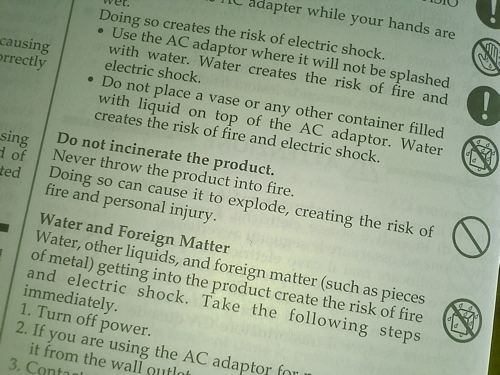 Melissa was going through our manuals (we have a stash, especially for our more expensive stuff), and found this gem on the product warnings page for her full-size Casio digital piano. Yes, for those of you who were planning to throw your full-size digital piano into a fire, you should be aware that there is a risk of the piano exploding.
The Misguided Art of Government BS
On Fox 5 morning news this morning, a reporter interviewed the Virginia Department of Transportation (VDOT) chief engineer about bridge safety, in light of the apparently-spontaneous Interstate bridge collapse yesterday in Minneapolis, Minnesota, that killed at least four and injured more than 60 commuters. The reporter asked (paraphrased), ‘Given the Minneapolis bridge was inspected in 2005 and 2006, should we be worried about the validity of our bridge inspections?’ The useless reply from VDOT was (also paraphrased), ‘We inspect over 11,000 bridges in Virginia annually, and our inspection process is reviewed by the federal government. Bridges in Virginia are safe.’
Attorneys, Investigations, and Moral Consistency (Updated: Gonzales Resigns)
On December 7, 2006, seven United States Attorneys were dismissed by President George W. Bush (R). This has spun into a controversy because many political opponents of the president believe the attorneys were fired for political reasons. Frankly, it doesn’t matter. Even if they were fired for political reasons, the president can fire his appointees for any reason he sees fit—whether political, personal, performance-related, or silly (e.g., ‘he wears green ties too often’). Further, under Executive Privilege, the president and his staff can refuse Congress’s requests that they explain themselves—internal affairs of the Executive Branch are none of Congress’s business.
Scott Bradford is a writer and technologist who has been putting his opinions online since 1995. He believes in three inviolable human rights: life, liberty, and property. He is a Catholic Christian who worships the trinitarian God described in the Nicene Creed. Scott is a husband, nerd, pet lover, and AMC/Jeep enthusiast with a B.S. degree in public administration from George Mason University.