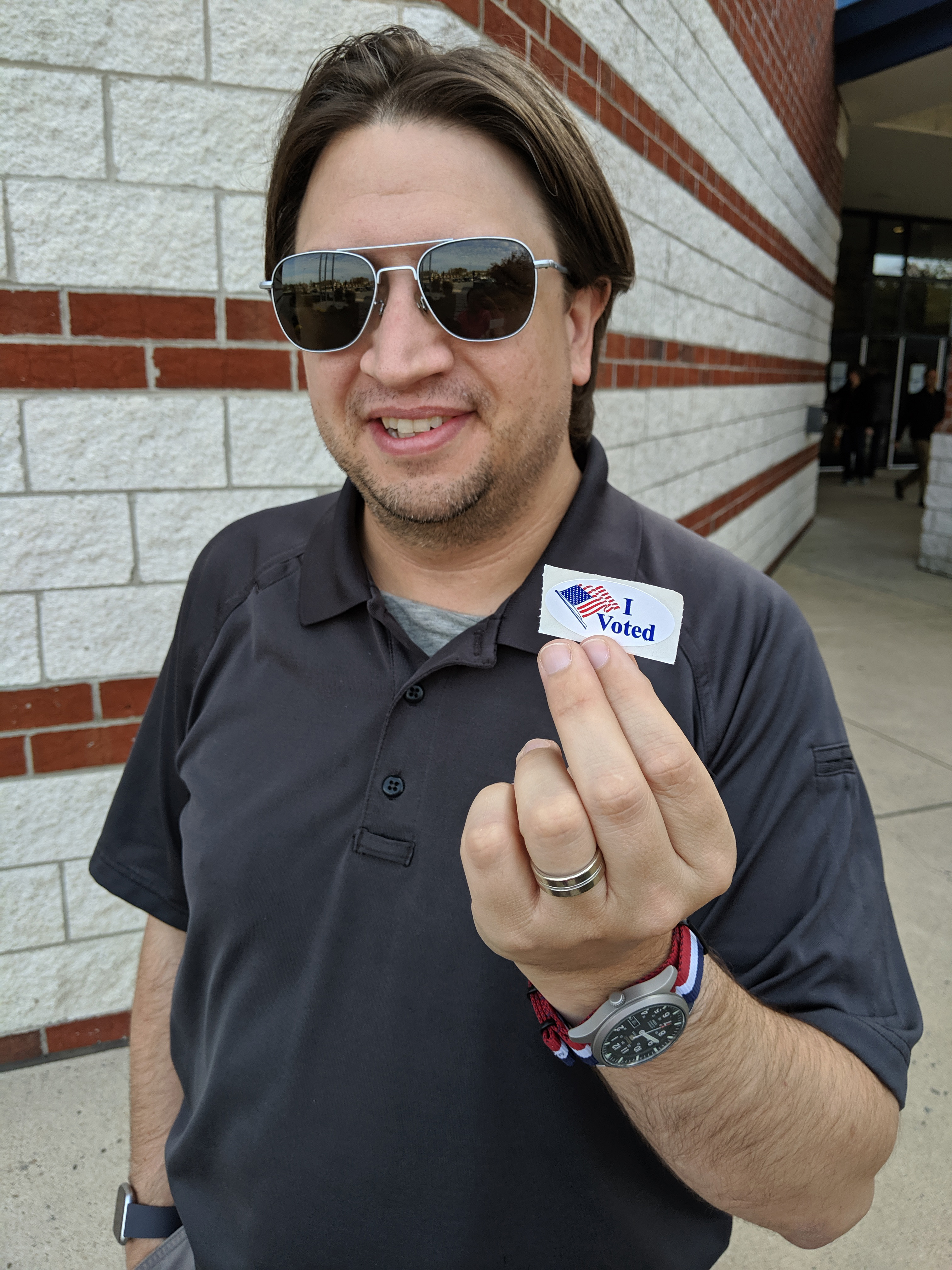
I voted this morning at my polling place in South Riding, Virginia. If you are a U.S. citizen who is eligible to vote, and elections are being held in your locality, you should go to the polls today too.
There are many important races on the ballot today. In Virginia, our entire state Senate and House of Delegates are up for election, as are many local boards of supervisors, school boards, and local constitutional officers like sheriffs and commonwealth’s attorneys. By some measures, these are more important to our day-to-day lives than the high-profile national elections in other years.
Take the time to research the candidates and issues on your ballot and make informed choices. Don’t let anybody tell you that your vote doesn’t matter. Don’t let anybody tell you that your choice is wrong. No informed vote is a wasted vote.
And let’s respect one another. I’ve made my choices—and I encourage you to read my reasons why. You are free to make yours. I may not agree with you, but as long as you have seriously considered your choices, I respect them. I hope you’ll offer me the same courtesy in return.
Please come back to Off on a Tangent this evening for live results from the races that I am following.
The Virginia General Assembly is composed of two houses, the Virginia House of Delegates and the Virginia Senate. Members of the House of Delegates serve two-year terms, and members of the Senate serve four-year terms, elected at a two-year offset from our gubernatorial elections. This year, both houses are standing for election.
British colonists established what is now called the General Assembly in 1619 at Jamestown, where it was called the House of Burgesses. It moved to Williamsburg in 1699, and then became the General Assembly in 1776 when the American colonies declared independence. It moved to Richmond when that city became the state capital in 1780.
The Virginia General Assembly is the oldest legislative body
in the western hemisphere.
Article VII Section 5 of the Constitution of the
Commonwealth of Virginia establishes that each local government must be
governed by an elective body. In Loudoun County, this body takes the form of a
Board of Supervisors, which has responsibility for all local legislation,
budgeting, and appointments. It operates under the authorities and limits set
forth by the Virginia General Assembly.
The board is composed of nine members, all of whom serve
concurrent four-year terms on the same election schedule as the Virginia
Senate. The chairman is elected in a county-wide at-large race, and the
remaining eight members are elected by voters from each of the eight named
county districts. Currently, the Republican Party holds a majority of six
seats, and the Democratic Party holds three seats.
Chairman
The Chairman of the Loudoun County Board of Supervisors is
the leader of the board and the highest local elected official.
Article VII Section 4 of the Constitution of the
Commonwealth of Virginia establishes several elective local offices that must
be filled in every city and county. These offices are Commonwealth’s Attorney,
Sheriff, Commissioner of Revenue, Treasurer, and Clerk of the Circuit Court.
Those elected to these offices serve four-year terms, except
for the Clerk of the Circuit Court who serves an eight-year term. Elections are
typically held in the same year as Virginia Senate elections. This year in
Loudoun County, all these offices except Circuit Court Clerk are up for
election.
Commonwealth’s Attorney
In the race to serve as Loudoun County Commonwealth’s Attorney, Buta Biberaj (D) and Loudoun County Chief Deputy Commonwealth’s Attorney M. Nicole Wittmann (R) are vying for an open seat. Incumbent Commonwealth’s Attorney Jim Plowman (R) is not seeking reelection.
The Loudoun County Commonwealth’s Attorney is responsible for
investigating and prosecuting crimes in the county, including felony,
misdemeanor, traffic, and juvenile offenses. Commonwealth’s attorneys serve a
four-year term.
Scott Bradford is a writer and technologist who has been putting his opinions online since 1995. He believes in three inviolable human rights: life, liberty, and property. He is a Catholic Christian who worships the trinitarian God described in the Nicene Creed. Scott is a husband, nerd, pet lover, and AMC/Jeep enthusiast with a B.S. degree in public administration from George Mason University.
X
Site Information
Off on a Tangent Website 26.0 “Sarah”
Theme: 26.0.83
Plugin: 6.0.165
Scribentes veritatem ab anno Domini MCMXCV
(Writing the truth since A.D. 1995)
Official Time:
Keyboard Shortcuts
Just type these sequences on the keyboard, or enter them in the search bar!