Meeting “Weird Al” (Briefly)

Meeting "Weird Al"
Meeting “Weird Al”

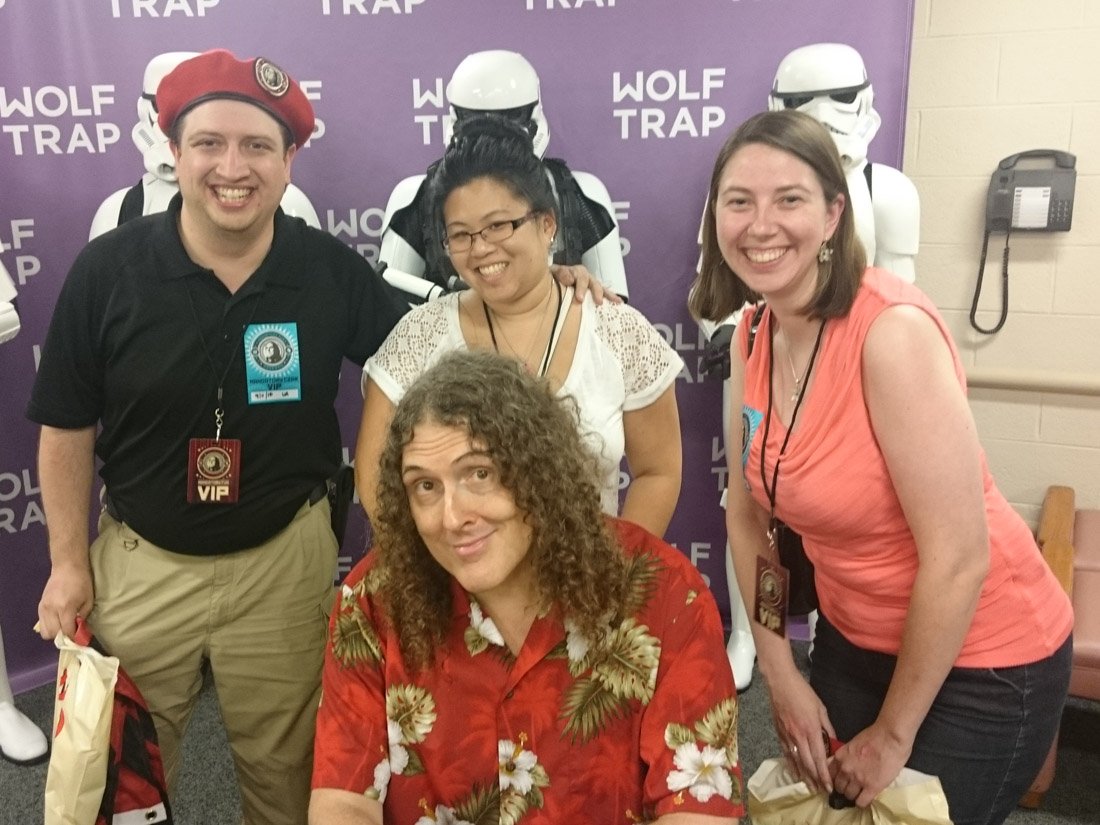
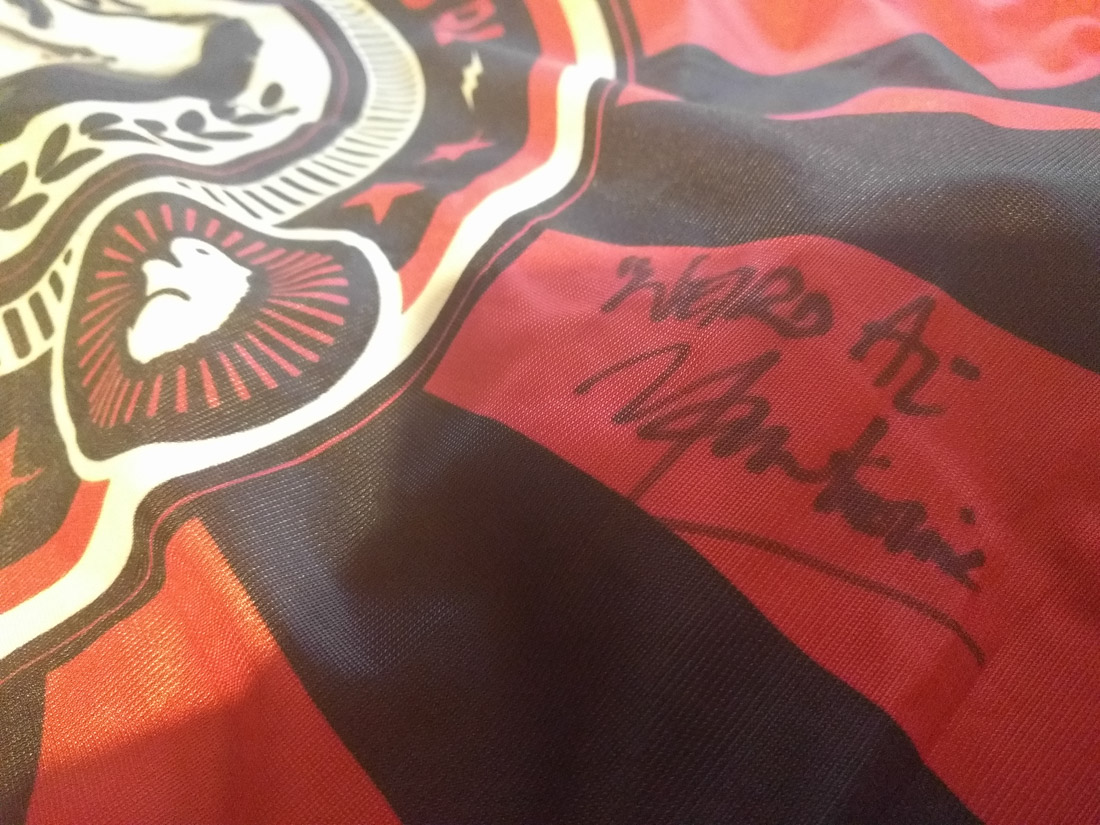
I met “Weird Al” Yankovic last Sunday.

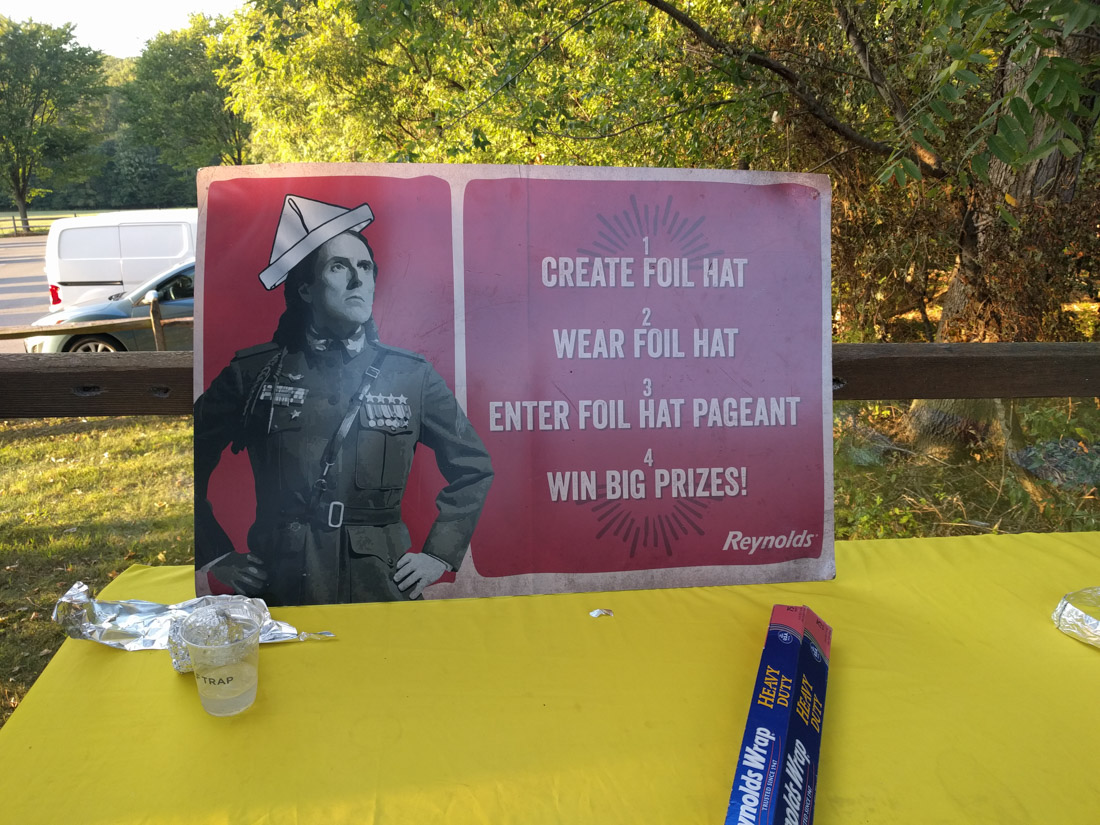
My sister, Kristen, invited Melissa and me to join her at his “Mandatory World Tour” performance at Wolf Trap National Park for the Performing Arts in Vienna, Virginia. Our VIP tickets included seating close to the stage, a gift bag, admission to a pre-show party, and—best of all—a chance to meet the man himself.

If you have never been to a “Weird Al” concert, I suggest you remedy that as soon as possible. He and his band put on an amazing and hilarious show. They perform his most well-known parody songs, always perfectly capturing the sound and style of the original, while going through constant costume changes and interacting with props (and the audience). During breaks for costume changes, video clips of “Weird Al’s” weirdest stuff—television and film cameos, clips from his own shows and videos, and more—plays on the screen.

He also puts a few interesting twists on his songs now and then, most notably in an acoustic set near the concert’s mid-point. That’s why, when I met him, I suggested that he do a live album. His response, without missing a beat, was something like this: “We’ve done a couple of live DVD’s, and if you look away from the TV that’s just like a live album!”

Indeed.

2016 Presidential Bill of Rights Scores

In August, I proposed a system of scoring political candidates (and especially presidential candidates) according to their level of support for the specific provisions of the Bill of Rights. Now that the list of Virginia presidential candidates is set, I have reviewed each of them according to that system and assigned scores.

The details of the scoring methodology are not repeated here. If you are interested in a more detailed treatment of the score components, you can refer back to that original post. You can also take a look below the chart for some notes that explain some of the scores, especially those that are based on assumptions rather than explicit statements by the candidates.

It is possible that these scores will need to be adjusted as the election season goes forward based on new candidate positions and statements. If that happens, the post will be labeled with a ‘last modified’ date and a description of the changes will be added at the end of the post.

As I noted on the original post, the only good/acceptable score is an A+ (100%). Because the President of the United States is sworn to protect and defend the constitution, he or she must comply with every single one of its provisions. Scores of A and B (80-99%) are bad. Scores of C and D (60-79%) are really bad. Scores of F (0-59%) are really, really bad.

2016 Endorsement and Election Plans

Vote Button

Since 2004, I have published political endorsements—and an occasional non-endorsement—on Off on a Tangent for every election in which I am eligible to vote. This year will be no different. In September (exact dates to-be-determined), I will be posting endorsements for four Loudoun County bond referendums, two Virginia constitutional amendments, Virginia’s 10th District in the U.S. House of Representatives, and President of the United States.

In addition, on the evening of November 8, I will continue my tradition of providing live election night coverage. This will include detailed results for those races, and a liveblog with information about these and other newsworthy races around the country. For the presidential race, I will be providing an electoral college count (with color-coded map) and also detailed results specific to Virginia.

As in the past, I will use my own proprietary method for making election calls. Usually I make calls roughly around the same time that the major media outlets do, but occasionally I beat them to the punch. And occasionally I hold-out longer than the media if I don’t think the data supports a call. My method has only failed once . . . and even then, it didn’t really fail.

Lastly, I want to mention a small (but important) change to Off on a Tangent policy. My previous policy with regard to endorsements was to review candidates in the following order: 1. Incumbents (if any); 2. Major party (Republican and Democratic) candidates, alphabetized by last name; 3. Third-party and independent candidates alphabetized by last name.

This ordering was not satisfactory in some cases. It unfairly gave preference to the Republican and Democratic parties, which are private organizations that ought to have no official standing in our political system. I have revised the policy to order candidates based on expected performance instead of party affiliation: 1. Incumbents (if any); 2. Major candidates, alphabetized by last name; 3. Minor candidates, alphabetized by last name. Any candidate expected to receive five percent or more of the popular vote in a particular race will be categorized as a major candidate, and any candidate expected to receive less than five percent will be categorized as a minor candidate.

In practice, this won’t be a big change; in most races only Republicans and Democrats poll at five percent or higher. But in several recent (and upcoming) races, Libertarian candidates have managed to break that threshold. When they (or others) do, I will include them in my coverage and endorsements on even-footing with the other major candidates.

Political Candidates and the Bill of Rights

The Bill of Rights
The Bill of Rights

When a new President of the United States is inaugurated, he or she swears an oath to “preserve, protect, and defend the Constitution of the United States.” So when we evaluate candidates for that office, one of the key questions we should ask is this: If elected, will they keep their oath?

In this essay, I propose a method for scoring political candidates according to their level of support for the specific provisions of the Bill of Rights. I plan to apply this proposed scoring system to the 2016 presidential candidates in the near future, and to continue improving and using the system in future election cycles.

While a candidate’s level of support the Bill of Rights is not the only thing we should consider when we go to the polls, it is becoming more and more important. Many politicians now govern in a manner that is openly hostile to the text and intent of the Bill of Rights, and contrary to the rights of the people they wish to represent.

It is up to us to start paying more attention, and demand that our elected officials do what they swore to do.

Hiroshima and the Laws of War

Hiroshima Aftermath
Hiroshima Aftermath

Earlier this month, the world recognized the seventieth anniversary of the atomic bombings of Hiroshima and Nagasaki, Japan, by the United States military during World War II. And back in May, President Barack Obama (D) participated in a wreath laying ceremony at the Hiroshima Peace Memorial. Both events brought the 1945 atomic bombings back to the fore, and ignited a renewed debate about whether they were justified.

The answer is no. They were not.

I’m a patriotic American. I’m normally inclined toward a positive view of American foreign policy, and especially toward the actions of our military. But part of why I am a patriotic American is because the United States has been, more often than not, a moral actor on the world stage. In the recent conflicts in Iraq and Afghanistan, for example, we went to great lengths to reduce the likelihood of civilian casualties, and consistently obeyed the laws of war. When it was discovered that some soldiers were violating these principles—like the prisoner abuse at Abu Ghraib in Iraq—we prosecuted and punished them.

War is a regrettable reality of human existence, but it is incumbent upon warring nations to act according to some basic norms. Among these is an understanding that only military targets may be targeted, and that all parties must make every reasonable attempt to minimize civilian casualties. When one of the belligerent nations violates these norms, it does not authorize the others to do the same. ‘Two wrongs do not make a right.’ The principle of ‘total war’ that took hold on both sides during World War II was not, and is still not, morally defensible.

Scott Bradford is a writer and technologist who has been putting his opinions online since 1995. He believes in three inviolable human rights: life, liberty, and property. He is a Catholic Christian who worships the trinitarian God described in the Nicene Creed. Scott is a husband, nerd, pet lover, and AMC/Jeep enthusiast with a B.S. degree in public administration from George Mason University.