
Reset the Net

Reset the Net

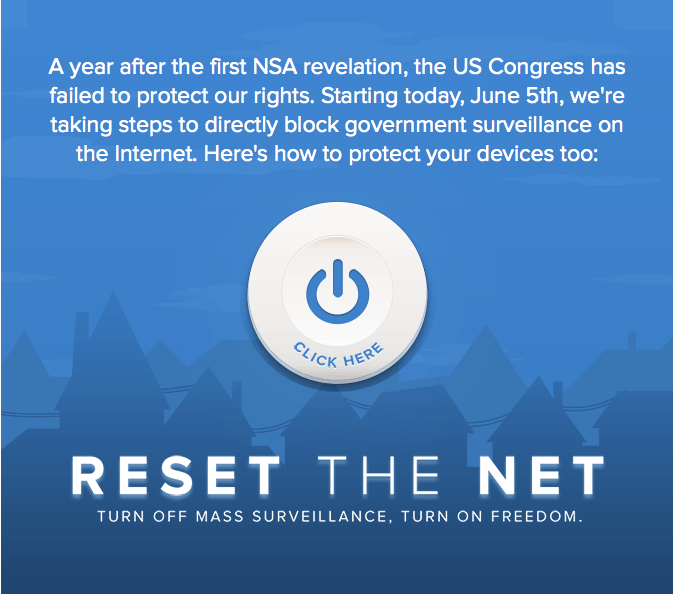
One year ago today, thanks to Edward Snowden, we first learned that the U.S. National Security Agency (NSA) was engaged in a massive domestic surveillance program. The program collects information about everybody—whether or not they are suspected of any wrongdoing—in a sort of worldwide ‘fishing expedition’ that plainly violates our Fourth Amendment right to be free from unreasonable search and seizure. It targets countless innocents, including citizens of the United States at home on American soil, which is impermissible except after a war-time suspension of the Writ of Habeas Corpus and a formal imposition of martial law—as I have explained before.

Despite an intense public outcry, the United States Congress declined to terminate the illegal program. A bill that would have de-funded the NSA’s broad domestic surveillance program (without affecting the NSA’s ability to execute duly-issued search warrants or perform legally-acceptable international surveillance) failed 205-217 in the House of Representatives. I have posted a list of the 217 Congressmen who violated their oath of office, and each and every one of them deserves to be thrown out of office in November.

Today, the NSA continues collecting everybody’s phone records, and continues monitoring everybody’s Internet activities. We haven’t been able to stop them through the courts or the political process (yet), but we can still take steps to improve our security and protect our privacy from those who would invade it—and not just the NSA, but also hackers, Internet providers, and others who might have an interest in watching what you’re doing. The Internet has built-in security features that can help protect us, but we have to make an effort to start using them!

Off on a Tangent is proud to join with Fight for the Future, the Electronic Frontier Foundation, the American Civil Liberties Union, the Freedom of the Press Foundation, Google, Mozilla, and countless other organizations and web sites that are working to Reset the Net. We are improving privacy protections, directing visitors to useful privacy tools, and generally ‘making noise’ about civil liberties, Internet freedom, and the right to be secure in our “persons, houses, papers, and effects.”

Here on Off on a Tangent, as part of today’s world-wide campaign, I am taking an important step to help protect your privacy. From now on, all content on this site will be served over a secure HTTPS connection. What this means is that somebody snooping on your activities—whether they be the NSA or your run-of-the-mill cyber-criminal—won’t be able to see anything more than that you visited the IP address (and possibly the domain name) associated with my site. They will not be able to see what particular pages you visited, or what particular content travels back and forth between you and me. I encourage you to use HTTPS connections everywhere you possibly can as you move around the Internet; the HTTPS Everywhere browser plugin can help automate it for you. More advanced users may also want to consider secure proxy services that add an extra layer of privacy and security.

Questioning a Bit of the ‘Cosmos’

Cosmos: A Spacetime Odyssey

I really like Cosmos: A Spacetime Odyssey, which is a documentary series on Fox that features eminent astrophysicist Neil deGrasse Tyson. It does an excellent job of communicating, in a clear and understandable way, the cutting edge of what science has revealed about world and the universe . . . and, perhaps just as important, it communicates the sense of awe and wonder about our existence that drives so many of our scientists to probe into the unknown. It is a worthy successor to Cosmos: A Personal Voyage, the classic 1980 documentary featuring the late astrophysicist Carl Sagan.

Up until the most recent episode, my only complaint about the new series was its oversimplified presentation of the Galileo Galilei affair. It was a typical, secularist, ‘church bad, science good,’ kind of take. I’m not making apologies for the Catholic Church’s behavior at the time, which was horribly misguided and wrong, but there was more to it than ‘evil church stands against science.’ Nicolaus Copernicus—who first developed the heliocentric model that Galilei helped refine and confirm—suffered no such repercussions from the church, and in fact was much more strongly criticized by Protestants than by Catholics. Copernicus was himself a Catholic [and possibly a priest, although historians are divided on whether he was ever ordained]. His book, De revolutionibus orbium coelestium, was only censored by the church during the Galileo affair—more than seventy years after publication—and only until a few sentences indicating complete certainty could be revised or omitted, after which it returned to publication with the church’s imprimatur.

Regardless, I do have to raise some issues the most recent episode, “The World Set Free,” which focused primarily on carbon dioxide (CO2) and climate change.

In one segment, Tyson explained that permafrost in the arctic is melting due to human-caused global warming, which then releases the carbon stored in that permafrost from the remains of ‘animals and plants that lived thousands of years ago.’ This release then causes a CO2 feedback loop and worsens climate change. Okay, sounds reasonable. I’m with you. Except . . . most of the plants and animals buried in the permafrost must have gotten there when it wasn’t permafrost, right? A few species of plants and animals are able to survive on permafrost, true, but not many. The quantity of carbon that Tyson implied would be present would, I assume, have required a thriving ecosystem leaving huge quantities of carbon behind, which would mean that what’s melting now is stuff that, at some point in Earth’s relatively recent history, wasn’t permafrost at all. And that would indicate to me that the Earth has recently been as warm (or warmer) than it is today. Perhaps there is some other scientific explanation for this, but Tyson didn’t address it . . . which left his astute viewers to wonder about the apparent contradiction and, perhaps, begin to examine the credibility of the other assertions in the episode.

Net Neutrality Needs Your Support

As more and more Internet service providers (ISP’s) begin to discriminate between different types of Internet traffic—undermining the very principles that made the Internet what it is—it is more important than ever that you contact your congressional representatives and the Federal Communications Commission (FCC) and encourage them to support Net Neutrality policies and legislation. In particular, please encourage the FCC to classify ISP’s as common carrier telecommunication services.

I have written about Net Neutrality before—here is a good review from 2009. As I pointed out there, this issue is one of the rare ones where increased federal regulation is both constitutionally permitted and necessary to prevent abuse. It is unfortunate that many politicians, particularly on the Republican side of the aisle, don’t seem to understand how essential Net Neutrality is to the future of the Internet and to our national economy. A neutral net gave birth to Google, YouTube, Facebook, and so many other scrappy startups that later became economic powerhouses. Let’s not ruin a good thing.

It would be illegal for power companies to limit what you choose to use electricity for. It would be illegal for phone companies to degrade the quality of tech support calls to companies that didn’t want to pay an ‘enhanced service fee.’ ISP’s are stewards of an essential utility infrastructure that is not much different from those provided by power and phone companies. They must be held to these same kinds of standards. We cannot permit ISP’s to pick and choose what kinds of Internet traffic they will carry unfettered, which they will restrict or slow down, and which they will block entirely.

Please watch this excellent video from CGP Gray, and take some time to contact the FCC and your elected representatives.

Fifth Amendment Forgotten; Lerner Found in Contempt

IRS Headquarters (Joshua Doubek [CC-BY-SA-3.0])
IRS Headquarters
(Joshua Doubek [CC-BY-SA-3.0])
The United States House of Representatives voted 231-187 today to find Lois Lerner—former Director of the Exempt Organizations division of the Internal Revenue Service (IRS)—in contempt of Congress.

In May 2013, Lerner publicly acknowledged that the IRS had been targeting conservative 501(c)(4) organizations for abusive investigations and unreasonable delays in recognizing their tax exempt status. This is one of the many serious scandals to rock President Barack Obama’s (D) administration. Lerner, for her part, apologized for the targeting, which she blamed on low-level employees at the IRS’s office in Cincinnati, Ohio. When called before a congressional committee, Lerner chose to invoke her Fifth Amendment right not to self-incriminate.

When government officials lie and commit crimes, I am tough on them. I advocated the appointment of special prosecutors to investigate and charge both former Attorney General Alberto Gonzales (R) and current Attorney General Eric Holder (D) with perjury. I supported the decision to find Holder in contempt of Congress for refusing to provide subpoenaed documents to investigators.

But I don’t support finding Lerner in contempt of Congress. Holder committed a crime when he lied to Congress (under oath), and when he refused to produce documents that had been duly subpoenaed. Lerner, however, committed no crime when she invoked her Fifth Amendment rights.

Obama should appoint a special prosecutor to investigate the IRS abuses—and Lerner, if appropriate. The people responsible for trampling citizens’ rights in this case and all others should be impeached or prosecuted. But we can’t fight civil liberty abuses by violating others’ civil liberties. Conservative 501(c)(4) groups, and phone and Internet users, and everybody else who has had their liberties threatened by this administration deserve the full protection of the Bill of Rights . . . but so does Lois Lerner.

The argument being put forth by some congressional Republicans is that, because Lerner talked about the IRS abuses in public, she has somehow waived her Fifth Amendment protections. I don’t even know where to begin with this. Lerner can choose to answer some questions and not others, or refuse to answer any questions at all, and her previous statements on the topic—in or out of Congress—have nothing to do with it.

What the IRS did was wrong—a serious violation of Americans’ civil liberties. Finding somebody in contempt of Congress for the ‘crime’ of invoking her Fifth Amendment rights is an equally serious violation of an American’s civil liberties. If Republicans want to be taken seriously as the defenders of the Bill of Rights, they can’t pick and choose which amendments they will support and which ones they will ignore. Either all of our enumerated rights are worth defending, or none of them are.

The Ugliest Cars of the 2014 Model Year

Back in 2013, I said that the auto industry seemed to be recovering its collective sense of style. The major new introductions and redesigns for 2013 generally weren’t bad, and that remains true in 2014. That said, a lot of ugly cars are still on the market—mostly older designs that, like zombies, have carried-on long past their expiration date.

There are, however, a few changes this year. The Nissan Murano CrossCabriolet was excluded from the 2013 list because the 2012 model was still on sale and a new one had not been announced. We were hoping that meant it was discontinued, but no such luck . . . a 2013 version did eventually come out, and now a 2014 model as well, so it returns to the list. This results in the Kia Soul dropping off the end of the list. In addition, as my tastes evolve, I have shuffled the list’s order. Some designs start looking [slightly] better with time; some start looking worse.

The criteria for inclusion is the same it has always been. I don’t include models that aren’t sold in the United States. I don’t include models that sell in low volume (and volume is defined completely subjectively based on how many I see on the highways in the Washington, DC, metropolitan area). I don’t include exotic, military, or special-purpose vehicles—so no super-cars, tanks, or postal trucks. I also don’t include vehicles reserved exclusively for the commercial market, such as the repulsive Ram Promaster.

This is based entirely on my personal opinion of what looks good and what doesn’t. I encourage your comments—whether they be nominations of ugly cars I may have missed, or impassioned defenses of the ones I didn’t. And if you own one of the cars on this list, well, don’t take it personally.

Scott Bradford is a writer and technologist who has been putting his opinions online since 1995. He believes in three inviolable human rights: life, liberty, and property. He is a Catholic Christian who worships the trinitarian God described in the Nicene Creed. Scott is a husband, nerd, pet lover, and AMC/Jeep enthusiast with a B.S. degree in public administration from George Mason University.