Yet Another ‘Storm of the Century’

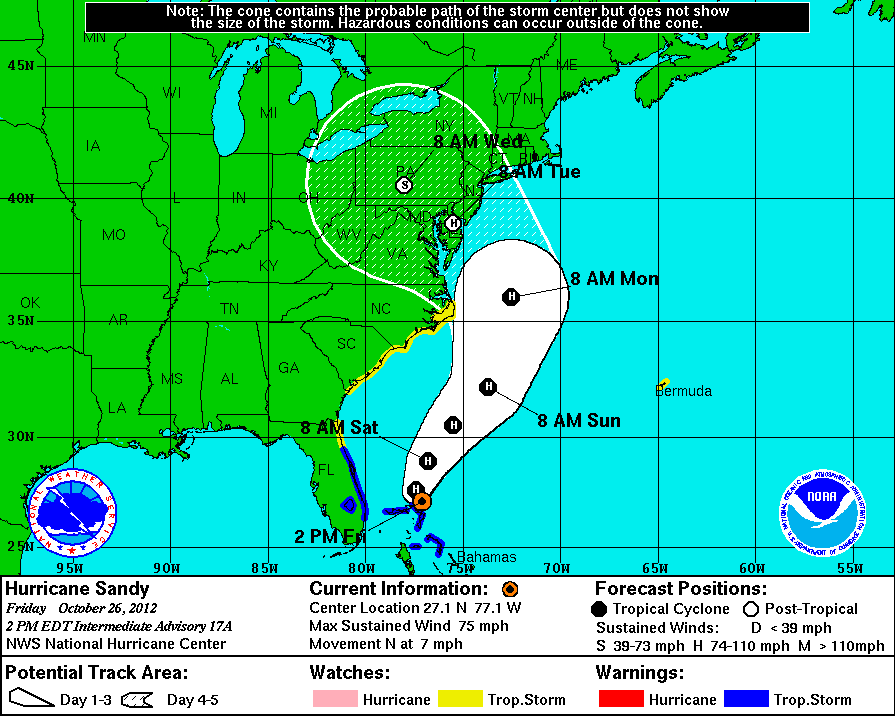
NHC Forecast, 2pm Friday

Hurricane Sandy, currently centered just north of the Bahamas, is already being billed as a catastrophic storm of the kind that only hits once every hundred years. I might believe the hyperventilating media if they hadn’t already labeled quite a few storms with the same kind of hyperbole over the last decade. As I posted on Facebook this morning, “We’re twelve years into the century and I think we’re on our fourth or fifth ‘storm of the century’ so far.”

I don’t mean to characterize Sandy as an innocuous, run of the mill storm. It isn’t. Sandy is forecast to merge with a cold front and slam the east coast hard with gale-force winds and an impressive deluge of rain. We should expect widespread coastal flooding, and those of us further inland should expect flash floods, downed trees, power outages, and even accumulating snow (at higher elevations). A similar confluence of Hurricane Grace with a cold front in 1991 came to be known as the ‘Perfect Storm‘ and caused over two hundred million dollars in damage and killed thirteen. Thirty-foot waves lashed the coast, destroying hundreds of homes and inundating roads and buildings.

The ‘Perfect Storm’ happened twenty-one years ago, but in the mean time the east coast has been hit by plenty of other major weather systems. I personally remember the Washington, D.C., metropolitan area getting hit hard by Hurricane Fran in 1996, Hurricane Isabel in 2003, and Hurricane Irene in 2011. We had the ‘derecho’ storms this last summer and countless other severe thunderstorms, even some that produced tornadoes. We had the Blizzard of 1996, the Blizzard of 2003, and the repeated ‘Snowpocalypse’ blizzards of the 2010-2011 season. Across the United States you’ll find regular outbreaks of tornadoes, river flooding, droughts, blizzards, and major hurricanes.

None of this is out of the ordinary. If it seems like wacky weather is happening more often, it’s mostly because we’re more connected with the rest of the country (and the world) than we have ever been before . . . and because the television news outlets think they have to breathlessly cover every storm as-if it’s the end of the world. I guess it’s good for the ratings. But the reality is that weather patterns in the U.S. remain about the same as they’ve been for at least the last three hundred years. The fact that we’re all still here is proof that we can survive it.

So if you live in the path of the storm, take appropriate precautions. If the local authorities order an evacuation, get out of there. But let’s not engage in useless hyperbole and exaggeration. It’s a bad storm; it will probably cause damage, and maybe even a handful of deaths and injuries. But it’s not the apocalypse. Batten down the hatches, and I’ll see you on the other side.

Moving Toward a Complete Electoral Projection

Back in August I launched the Off on a Tangent election widget on the home page, which includes a projected electoral map for the presidential race. I have been making regular updates as new poll data comes in, but I have so-far erred on the side of certainty and stability. I’ve only made changes to my projection when they are supported by very solid data. Generally I have only colored a state red or blue when reliable, nonpartisan polls consistently indicate that one candidate is ahead in that state by a margin greater than the margin of error. As of earlier today, Off on a Tangent had Obama ahead in the electoral college by 237-206, with 95 electors—those from Colorado, Florida, Iowa, Nevada, New Hampshire, Ohio, Virginia, and Wisconsin—still listed as ‘swing states.’

With the election just over two short weeks away, I am making a change to my methodology. Rather than erring on the side of certainty and stability, I will now be erring on the side of completeness. In other words, I will be less cautious when I decide to color a state red or blue and will only leave a state gray if the polls there are too erratic or unreliable to discern a clear trend. Because many states are still polling within the margin of error, this means you should expect more instability in the electoral count as some shift one way or the other. My hope is that the Off on a Tangent projection on the day before the election will be a close, complete prediction of the race’s outcome.

After applying this new methodology, Off on a Tangent currently projects that Obama is still narrowly ahead in the electoral college vote by 253-248, with 37 electors—those from Colorado, Iowa, New Hampshire, and Ohio—still too close to call. Again, these numbers are likely to be quite volatile over the remaining weeks until the election. I will review and adjust them at least once per day until then.

The electoral map will remain available on the Off on a Tangent home page and (with some more detail) on the Off on a Tangent election site until the night before the election. On election day, I will clear the maps and they will reflect the live results as they come in on election night.

More Evidence that Journalism is Dead

Tuesday night’s ‘town hall’ style presidential debate between President Barack Obama (D) and former Governor Mitt Romney (R-MA) didn’t break much new ground . . . which is typical for debates these days. Romney put in a solid performance, though he did not appear as confident as he had in the first debate. Obama came across as more smooth and comfortable and edged-out Romney for a narrow win, in my opinion.

But the real stand-out of the evening was the ‘moderation’ (and I use that term loosely) by CNN’s Candy Crowley—which was easily the most biased, unprofessional performance by a presidential debate moderator in the twelve years I’ve been watching.

As the debate kicked into gear, Crowley repeatedly gave Obama the last word even on questions that went to him first. When Romney objected, she tersely told him that the debate ‘doesn’t work like that,’ and once even ordered him to take his seat. By the middle of the debate, the CNN running clocks indicated that Obama had been given more than five extra minutes of speaking time—although Crowley did narrow this gap to about three minutes by the end. She completely disregarded the agreed-upon rules of the debate, interjecting her own follow-on questions (instead of leaving the questioning to the town hall audience) and refusing to enforce any semblance of order or time limits. And most egregiously, Crowley became a direct participant in the debate at least two times—both of which on Obama’s side.

First, she defended the president against Romney’s claim that the administration did not characterize the Benghazi consulate attack in Libya as a terrorist attack until two weeks after it happened. Although Romney’s wording was imprecise, and could be labeled ‘wrong’ if you interpret it in an overly-literal way, his main thesis was exactly correct and Crowley’s ‘correction’ was, at best, misleading. Indeed, she very quickly began walking it back in interviews after the debate concluded. Second, she editorialized about Romney’s flip-flop on assault weapons bans. Crowley was right—Romney has changed positions on this topic—but in a town hall style debate it is up to the audience or the opposing candidate to levy that kind of criticism. And even if that kind of questioning was appropriate in this debate, how come only Romney found himself on the receiving end?

It’s a well-established fact that the vast majority of journalists consider themselves ‘liberals’ (or, more accurately, ‘progressives’) and tend to support Democratic Party candidates. As such, Republican Party candidates usually find themselves at a bit of a disadvantage in media-moderated debates. No big deal. But a professional journalist who took her job seriously would at least try to be fair, adhere to the rules she had agreed upon, give the candidates equal time, and refrain from inappropriate editorializing . . . even if for no better reason than to maintain an appearance of objectivity.

Crowley’s performance offended me, not because I’m ‘conservative,’ but because I still adhere to the old-fashioned notion that good journalism is important, and that journalists should hold themselves to the highest standards of fairness, objectivity, and honesty.

Guilt is a Good Thing

Every once in a while, I run across the claim that Christianity—and Catholicism in particular—is a faith that leads its adherents to live their lives riddled with guilt. I hear it most commonly from former Catholics who have either moved to other Christian denominations or have fallen away from religious practice altogether. “I left the Catholic Church,” many of them say, “because I could no longer stand the guilt.”

This seems to imply something very novel: that we should rarely or never experience guilt. If we were perfect, or close to it, that might be true . . . but we aren’t. One of the central tenets of the Christian faith is that human beings are flawed, broken creatures with an innate tendency toward sin. In other words, we do bad things. This is why it makes little sense to condemn Christianity for its adherents’ and leaders’ hypocrisy; our faith is possibly the only one in the world that openly admits it is full of imperfect, sinful hypocrites. The Church isn’t a temple for the saints, but a hospital for the sinners. When we fall short, we have (or should have) some self-awareness about it. A good Christian knows he isn’t perfect, but is trying to move steadily in that direction. He’s trying to overcome his sins, but to do this he must be aware of them. He must know right from wrong, and this knowledge will surely lead him to feel guilty when he does something in the latter category.

We expect this kind of self-awareness from others all the time. When somebody wrongs us, we want them to feel bad about it and apologize. To use an extreme example, consider a murderer standing trial. If he shows remorse—sorrow and guilt for what he has done—he is likely to receive a more lenient sentence than if he un-repentantly claims that the victim deserved it. We recognize a lack of guilt in this case as a sign that the murderer is a sociopath, and deserves the worst that the court can offer him. We recognize an honest expression of guilt, on the other hand, as a first, tentative step toward possible redemption.

Third-Parties and the Presidential Debates

The presidential debates in the United States have become a joke, or perhaps they were always a joke. I can’t remember the last time I actually learned anything about any candidate in a debate—at least not at the general election stage. (I’m not particularly interested in the primary debates, since I’m not a member of any party.) They always end up being a tedious litany of memorized lines and catch phrases. The formats are bland, strictly controlled, and designed to prevent the candidates from actually having to think on their feet and demonstrate leadership skill. The reason is simple: the Democratic and Republican parties, through their jointly-managed Commission on Presidential Debates (CPD), manages the process for their own mutual benefit.

The duopoly also artificially limits participation by anybody other than the ordained Republican and Democratic party candidates. Obviously you can’t let everybody from every state ballot into the debates, but there’s no reason to exclude those candidates who have managed to make their way onto enough state ballots that they could theoretically attain the necessary 270 electoral votes and win election. In this election, that would include President Barack Obama (D) and former Governor Mitt Romney (R-MA), as well Libertarian Party candidate Gary Johnson and Green Party candidate Jill Stein. Each has earned the right to participate.

Although the United States has long-since settled into a stable two-party system, and it will likely remain that way, there is no valid reason to exclude third-party participation in the presidential election process. Don’t forget that our two-party system doesn’t necessarily have to be ruled by the specific two parties we have today. It was once the Democratic-Republicans and the Federalists. The Democratic-Republicans gave way to the Democratic Party, and the Federalists gave way to the Whigs and then to the Republicans. Republicans and Democrats have since been seriously challenged by third-parties two times: the Progressive (or ‘Bull Moose’) Party under Theodore Roosevelt in 1912, and the Ross Perot candidacy in 1992, which later morphed into the Reform Party.

Those challengers were unsuccessful and their parties soon died-out, but there is no reason that some future third-party—or even one of the few we have now—couldn’t eventually supplant the Republicans or Democrats (or both) if those parties continue to fail to adapt as the electorate changes. The presidential election process should not be manipulated so as to artificially prevent that from happening. We aren’t going to become a European-style multiparty system any time soon, but we have to allow for the natural progression of the two-party system we have. The Republican and Democratic parties should not be permitted to declare themselves the permanent national duopoly and exclude everybody else from any possible chance of succeeding them. That is anti-democratic, and un-American.

And if the third-parties are really as ‘fringe’ as the duopolists claim they are, then there is nothing to be afraid of. As President Woodrow Wilson (D) once said, “The wisest thing to do with a fool is encourage him to hire a hall and discourse to his fellow citizens. Nothing chills nonsense like exposure to air.”

Scott Bradford is a writer and technologist who has been putting his opinions online since 1995. He believes in three inviolable human rights: life, liberty, and property. He is a Catholic Christian who worships the trinitarian God described in the Nicene Creed. Scott is a husband, nerd, pet lover, and AMC/Jeep enthusiast with a B.S. degree in public administration from George Mason University.