Relics: Body and Soul

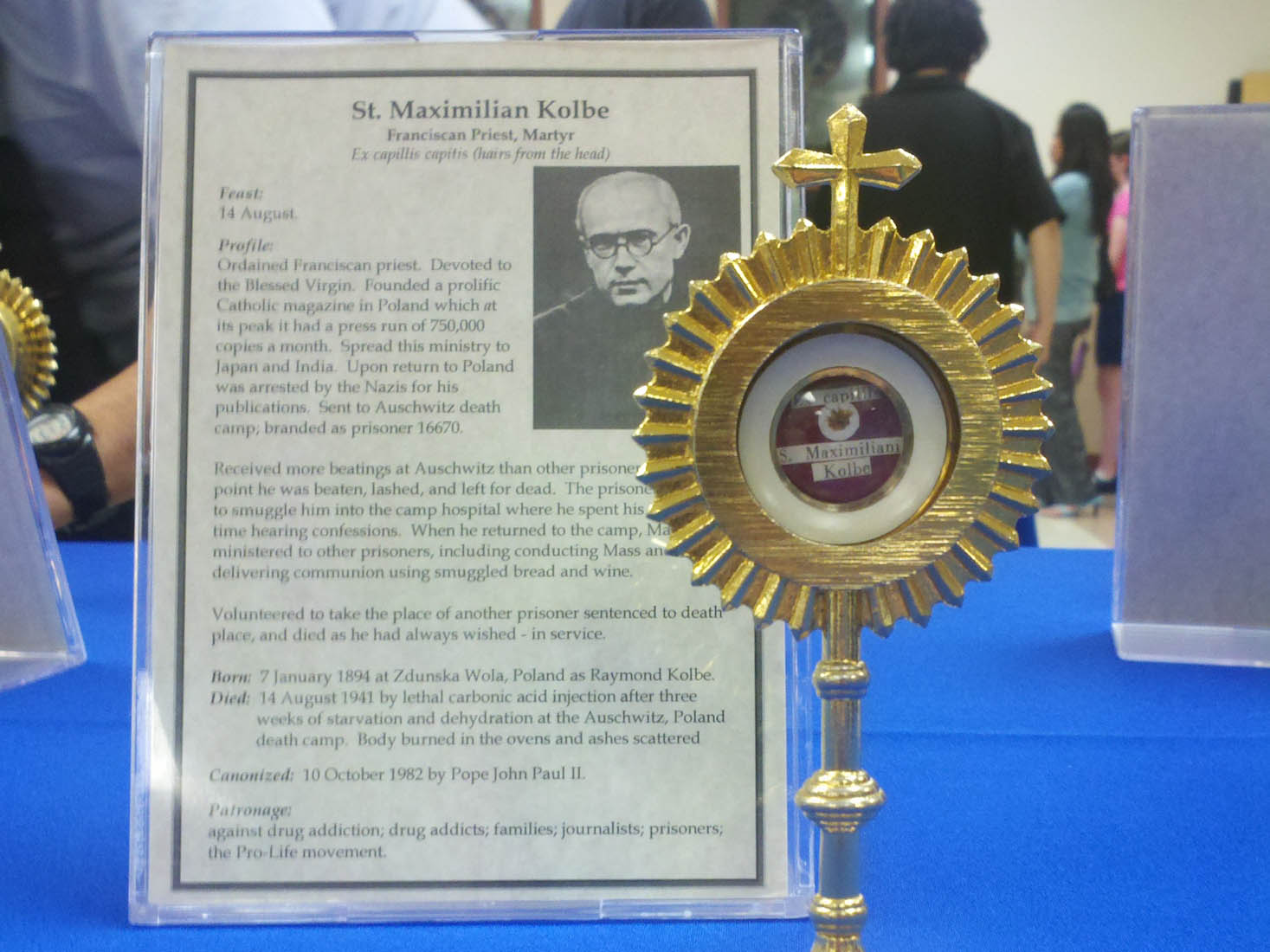
Relic of St. Maximilian Kolbe

Christianity, properly practiced, is a faith rooted in both spiritual and physical things. We recognize the fundamental truth that, as human beings, we are both body and spirit, flesh and soul. These days it is trendy to attempt to divorce the two. The materialist sees the world as only matter, and rejects the notion of a soul, spirits, and even God himself. At the other extreme, many modern spiritualists (of various stripes) see matter as inherently flawed or illusory, and seek a higher plane of ‘true,’ transcendental spirituality.

But I am not merely a body, nor am I merely a soul. I am both. And as Christians, we believe that while these two elements of ourselves separate in death, they will be reunited once more at the end of time—the ‘resurrection of the body’ professed in our most ancient creeds.

Many of our beliefs reflect this body/soul duality. This is especially evident in the Sacraments, each of which are composed of physical and spiritual elements. Baptism is a spiritual seal, but is expressed with water and words. Confession is a spiritual cleansing, but we have to state our sins aloud and receive a verbal absolution. Body and soul. Flesh and spirit.

The veneration of the saints follows this same pattern. Part of the veneration of the saints is learning about their lives, following their good examples as faithful, dedicated Christians, and engaging with them through prayer. But in addition to these spiritual elements, we also have physical relics of the saints. They are not ‘good luck charms’ or false idols, but conduits through which God chooses to work in the world.

We know from Holy Scripture that God works miracles through the bodies and property of his most faithful followers. Our Jewish forebears record in 2 Kings 13:20-21 that a man was brought back to life after coming in contact with Elisha’s bones. In the New Testament era, we see in Acts 19:11-12 that the apostle Paul’s “handkerchiefs and aprons” were brought to the sick and they were healed. God works through his saints during their earthly lives, and continues to work through them even in their deaths. This was recognized in the early Christian church, which venerated martyrs and saints from the very beginning.

In Catholic tradition, we recognize three classes of relics. First-class relics are any items directly associated with Christ’s life (e.g., pieces of the true cross), or the physical remains of a saint (e.g., bone fragments, hair). Second-class relics are items that a saint wore or used regularly (e.g., a cloak, a crucifix, a book). A third-class relic is an object that has been touched to a first or second class relic, which makes it possible for millions of Catholics to have their own relics for private veneration and prayer. The photograph above is of a first-class relic of my own Confirmation saint, Saint Maximilian Kolbe, whose feast day happens to be today. It is a small piece of hair from his head. This relic was part of an exposition of sacred relics that visited my parish last month, and I was able to touch my own Saint Maximilian medal to it, which makes it a third-class relic.

The physical act of touching one of my belongings to a small piece of Saint Maximilian Kolbe’s body means nothing, if you are a materialist or a spiritualist. To the materialist, anything and everything Maximilian Kolbe was terminated when he died, there is no God to keep his spirit alive, and my medal underwent no discernible change. To the spiritualist, you can unite yourself directly with any spirit you wish, and physical objects would only get in the way of a true transcendental bond. But for us Catholics, recognizing that humanity is both body and soul united, the best spiritual bonds are those forged in a physical action.

Romney Selects Paul Ryan for VP

Former Governor Mitt Romney (R-MA), the presumptive Republican presidential nominee, announced this morning via his campaign smartphone application that he has selected Representative Paul Ryan (R-WI 1st) as his vice presidential running mate.

Ryan was first elected to the House of Representatives in 1998, and has served as the chair of the House Budget Committee since the Republican Party gained the house majority in the 2010 elections. In that role, he has been responsible for crafting Republican budget proposals to counter those proposed by President Barack Obama (D). Although neither party has brought forth any reasonable proposal to rein in deficit spending or move decisively toward a balanced budget, the Ryan budget plans are notable for being the only ones in recent history that even attempt to address the projected bankruptcy of Medicaid and Medicare.

This selection is likely intended to do two things for the Romney campaign:

First, Wisconsin is a ‘swing state’ that went for Obama in 2008, but could potentially move to the Republican column. Although the state tends to be center-left on social issues, it also tends to value fiscal responsibility and recently rejected a well-funded Democratic effort to recall Governor Scott Walker (R) over his deficit-busting policies. The state has voted Democratic over the last decade in-part because Democratic candidates that followed President Bill Clinton (D) have promised fiscal responsibility, while President George W. Bush (R) seemed to prefer an irrational policy of record-setting deficit spending. But the people of Wisconsin have proven that they are happy to vote for a fiscal-responsibility Republican like Walker or Ryan. Now that Obama has moved the Democrats firmly back into the fiscal irresponsibility column, setting his own record deficits far worse than anything Bush ever did, the Romney/Ryan ticket could lead to a Wisconsin reversal.

Second, fiscal-responsibility Republicans have not been particularly ‘fired up’ about the Romney campaign. Romney—who served as governor of a particularly left-wing state—has a record that seems more in-line with big-government Republican presidents like Theodore Roosevelt, Dwight Eisenhower, Richard Nixon, or George W. Bush. Ryan provides an important counterweight with a record of supporting limited government and rational budgets. This may increase involvement among fiscal-responsibility Republicans. He also provides an important counterweight to the argument that Republicans are not proposing any real solutions; Ryan is one of the only congressmen (from either party) who has bothered to craft a real, written budget of any kind in the last four years—let alone a budget that actually attempts to solve our spending problem.

God, Unicorns, and Spaghetti Monsters

I have discussed before the reasons I believe in God, and have repeatedly pointed out that no scientifically supported hypothesis on the universe yet proposed precludes the existence of God. There is one common atheistic retort that I have not yet addressed. ‘Well,’ says the atheist, ‘there is no evidence precluding the existence of unicorns either . . . so shall we believe in unicorns too?’

The most amusing variant of this argument is Bobby Henderson’s satirical deity, the Flying Spaghetti Monster (FSM), which he created as part of a protest against the teaching of intelligent design theory in Kansas schools. Henderson, writing in an open letter, demanded that his belief that the FSM created the universe be given equal time. Henderson’s point, shared by many in the atheist community, is that the burden of proof ought to lie with the person who makes an extraordinary claim, not with those who doubt that claim, otherwise any claim—no matter how absurd—would need to be held in equal esteem. As the brilliant Carl Sagan once put it, “Extraordinary claims require extraordinary evidence.”

In-and-of itself, this seems to be a perfectly logical philosophy . . . but it raises an important question. Which claims are extraordinary?

‘Obviously,’ continues our imaginary atheist, ‘the claim that the universe was created by a god is the extraordinary claim which must be supported by extraordinary evidence, and you have presented no scientifically valid evidence to support that claim.’ Okay, fair enough, except the claim that the universe poofed into existence out of nothing, as espoused by Stephen Hawking and others, is an equally extraordinary claim, and is equally unsupported by extraordinary evidence.

What To Do With Metro?

The Washington Metropolitan Area Transit Authority (WMATA), informally known as Metro, operates the rapid transit rail system in the Washington, D.C., area—and they do it very, very poorly. I have a long list of complaints about the system. Here are just a few: The fares are the highest among comparable systems in the U.S., the service has a very limited reach and has not expanded at an acceptable rate, existing service is spotty and unreliable, employees are generally uneducated and unhelpful, station maintenance is woefully poor, a high percentage of system escalators and elevators are always out of service, a high percentage of rail cars have climate control malfunctions at any given time, communication with customers—when it happens at all—is usually inaccurate and misleading, the almost-daily system delays are under-reported and inaccurately reported (e.g., a one-hour delay is reported as a twelve-minute delay), the fare system is unnecessarily complex and confusing, etc., etc., etc.

These are long-standing problems, but just in the last month Metro’s mismanagement has repeatedly made the news.

On July 3, a Green Line train lost power and the over-three hundred passengers were made to wait more than a half-hour in the summer heat on un-ventilated rail cars. According to multiple passengers, the train operator finally instructed them to leave the train . . . but Metro, in a typical ‘blame the passenger’ move, claims that the passengers self-evacuated without authorization. Well, I would have self-evacuated after being forced to sit in a steaming hot rail car for more than thirty minutes against my will too. Even if Metro’s official story is true, the botched evacuation is the problem, not the passengers’ exercise of rational self-preservation.

Back From the Dead: Senate to Vote on ‘DISCLOSE’ (Updated)

Back in mid-2010, the U.S. House of Representatives brought forth and passed a law euphemistically called the ‘DISCLOSE’ act. It later failed in the Senate and did not become law . . . but now it is back from the dead. The Senate will be voting on it again this afternoon. It is imperative that you contact your Senators right now and ask them to vote against this dangerous, chilling, anti-liberty law.

Congress crafted ‘DISCLOSE’ in response to the U.S. Supreme Court’s ruling earlier in 2010 that the First Amendment means exactly what it says: “Congress shall make no law . . . abridging the freedom of speech, or of the press; or the right of the people peaceably to assemble, and to petition the Government for a redress of grievances.” By overturning certain parts of our campaign finance laws, the court restored the civil liberties of many interest groups that had previously been muzzled. But because a number of those interest groups often supported Republican candidates, the more unscrupulous congressional Democrats wanted to re-muzzle them as quickly as possible—with the support of President Barack Obama (D) and the Democratic party leadership in both houses of Congress.

Many Americans decry the sometimes-poisonous influence of money on our political process, and at first blush it sounds like a good idea to limit interest group spending in our elections. But consider, for a moment, exactly what an interest group is. If you join with two of your friends to raise money in support of a local school board candidate that you like, you are an interest group—albeit a small one. Or if you want to join with some of your neighbors to lobby your county board of supervisors for a traffic light, you are an interest group. What makes it so different when you join with a hundred, thousand, or even a million of your countrymen to support a candidate or to advocate on an issue? The reality is exactly what I said back in 2010: “Interest groups . . . are made up of people who willingly support those groups with their time and money. They aren’t some diabolical, nebulous enemy of our democracy; they are democracy.”

Scott Bradford is a writer and technologist who has been putting his opinions online since 1995. He believes in three inviolable human rights: life, liberty, and property. He is a Catholic Christian who worships the trinitarian God described in the Nicene Creed. Scott is a husband, nerd, pet lover, and AMC/Jeep enthusiast with a B.S. degree in public administration from George Mason University.