
Judge Rules Against Health Care Mandate

Judge Henry Hudson of the United States District Court for the Eastern District of Virginia ruled today that the federal government does not have constitutional authority to require citizens to purchase health insurance. This ruling invalidates the ‘individual mandate,’ a core provision of President Barack Obama’s (D) landmark Patient Protection and Affordable Care Act, which was signed into law in March of this year.

Hudson ruled, in part, that an “individual’s personal decision to purchase—or decline purchase—[of] health insurance from a private provider is beyond the historical reach of the U.S. Constitution. No specifically constitutional authority exists to mandate the purchase of health insurance.”

In this case, ‘Virginia v. Sebelius’ (3:10-cv-00188), the Commonwealth of Virginia—represented by state Attorney General Ken Cuccinnelli—argues that the individual mandate oversteps constitutional limits on the federal government’s authority. This is just one among many challenges to the health care reform act, including one suit being brought by Florida and nineteen other states against newly-mandated Medicare expansions.

The Obama administration is expected to appeal the ruling, and it is very likely that the constitutionality of the health care reform act’s most controversial provisions will not be fully settled until they are ruled upon by the U.S. Supreme Court.
Chrome OS and the Google Cr-48 Notebook

Google is one of the darlings of the technology industry and, since its now-ubiquitous search engine slaughtered its competition in the late 1990’s and early 2000’s, it has slowly but confidently branched out in to more and more Internet industries. Between Google Maps, Google Docs, Gmail, YouTube, Google News, Google Reader, and countless other properties, it’s a pretty sure bet that you spend a fair amount of your day on one or more of Google’s sites. Many—myself included—have begun using Google’s excellent Chrome web browser as their primary means of surfing the web, stealing market share from Microsoft Internet Explorer and Mozilla Firefox.

With it’s Linux-based phone operating system called Android, Google has now become a player in the OS universe. Android has seen broad success on a variety of manufacturers’ phones, including well-known devices from HTC and Motorola, and is widely considered to be the most plausible contender to unseat Apple’s iPhone juggernaut. But Android isn’t Google’s only operating system project. There is another.

First announced on July 7, 2009, Google has also been working on an operating system called Chrome OS. As its name implies, the actual ‘operating system’ here is practically non-existent—it is just a thin Linux-based layer between the computer’s hardware and the Chrome web browser. Basically, when you start up a Chrome OS machine, all you get is a browser window and the Internet. Anything and everything you do on a Chrome OS machine (with some very limited exceptions) is on the web.

On December 7, 2010—this past Tuesday—Google announced that it would distribute a limited number of ‘Cr-48’ notebook computers running a pre-release version of Chrome OS. Google’s intent is to get the operating system and a sort of ‘reference design’ notebook into real users’ hands for testing and feedback in order to polish-up the real products before they go on sale. Interested users were welcome to enter online for the chance to receive a free Cr-48 and, in return, all they had to do was agree to share their feedback with Google. I signed up on Wednesday morning, expecting to never hear from them again.

Immaculate Mary, Your Praises We Sing

Today, the Church celebrates the Immaculate Conception of the Virgin Mary. This is another of those inexplicable pinch-points between Catholics and Protestants, so let’s take a look at what we are really celebrating today and why.

The doctrine of the Immaculate Conception is one of those things that is very much misunderstood by many non-Catholics (and even by many Catholics). It is not the belief that Jesus was conceived in Mary’s virginal womb—that’s the doctrine of the Virgin Birth of Jesus Christ (it’s true, but it’s a different dogma). It’s also not some belief that Mary was conceived virginally like Jesus was; I’m not sure where that explanation comes from, but it’s completely false and yet depressingly common.

Mary was a human being—nothing more, nothing less. She had a mother and father who were married, had marital relations, and conceived her in the traditional way. Extra-Biblical writings from the early Church identify her parents as Anne and Joachim. The only thing that made Mary different was a grace (gift) from God: from the moment of her conception, she was protected from the stain of original sin. She was a pure vessel, spotless enough to carry God Himself in her womb.

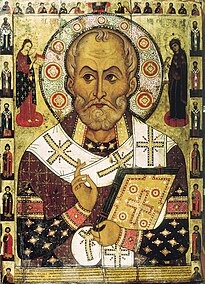
The Real Saint Nicholas

As much fun as it is to imagine Santa Claus as a jolly old man at the north pole with a toy-building shop, we should try to keep in mind the real man—Saint Nicholas—who inspired much of the Santa Claus tradition. Today is the Feast of Saint Nicholas in most Catholic and Orthodox traditions (some celebrate it on the 19th of December instead), and thus today is a wonderful time to meditate on the real ‘Jolly Old Saint Nick.’

Nicholas is among the early Christian saints, those who lived and worked in a unified Christian church during its first millennium. He lived from AD 270 until AD 346—more than 500 years before the great schism between east and west and well-over 1,000 years before the Protestant reformation. As such, he is recognized (to varying degrees) by pretty much all extant Christian denominations that still believe in the ‘communion of saints’ as professed in the Apostles’ and Nicene creeds.

His full titles are “Bishop of Myra, Defender of Orthodoxy, Wonderworker, [and] Holy Hierarch,” and his patronage is of bakers and pawnbrokers (oddly enough). He was a Greek who rose to the rank of Bishop in the then-Greek city of Myra, which is now known as Kale or Demre and is part of Turkey. He would often secretly leave gifts of coins or goods for people to find, and there are many tales of his generosity. Among these are stories of his paying three womens’ dowries so that they might be permitted to marry, saving prisoners who had been condemned to death, and more. Apparently he wished to remain anonymous in his gift giving; he did not seek fame or thanks, but just wished to serve God by doing good for people in need.

These and other stories of Saint Nicholas’s deep faith and generosity evolved into the Dutch folk legend of a gift-giving ‘Sint Nikolaas’ or ‘Sinterklaas,’ which then evolved into the western myth of Santa Claus. Of course, the Santa story mysteriously moves the saint from Greece to the north pole, changes him from an early Christian saint into a timeless fairy-tale character, and tries to make him into some kind of secular giver instead of the devout servant of God that he really was. Go figure.

I hope you will take some time to meditate today on the real man, the Bishop of Myra, Defender of Orthodoxy, Wonderworker, and Holy Hierarch . . . not the folk hero, drained of all spiritual meaning, that Santa Claus has become.

“O God, who adorned the blessed Nicholas thy priest with innumerable miracles, grant to us, we beseech, that by his favors and prayers we be freed from the fires of hell. Through our Lord Jesus Christ thy Son, who liveth and reigneth with thee in the unity of the Holy Ghost, O God, world without end. Amen.” – Sixteenth Century Prayer to Saint Nicholas

Speaking of Censorship . . .

Well, speaking of censorship, I just have to comment on the ongoing Wikileaks bruhaha. In case you haven’t been following, Wikileaks—a well known media organization that seeks to obtain and disseminate secret information from governments, companies, etc.—obtained and published a large number of secret cables from the U.S. Department of State. This followed hot on the heels of other releases related to the wars in Iraq and Afghanistan.

Obviously this is a huge embarrassment for the U.S. government, and now, since releasing the files, Wikileaks has been on the receiving end of a concerted effort to shut the site down. It has been attacked with ‘denial of service’ attacks (possibly initiated by our government), it has been exiled from various hosting providers and DNS services (particularly those based in the U.S.), and many of our Congressmen are clamoring to ‘throw the book’ at Wikileaks and its founder, Julian Assange. Some are even calling for him to be charged with treason—a charge that could possibly result in the death penalty.

I don’t much like Assange, and I don’t have any particular affinity for Wikileaks as an organization either. I’m all for transparency in government but, having said that, there is a legitimate interest in keeping some things secret for national security reasons. I think that media outlets should use some discretion. But we must put blame where blame is due: Wikileaks is a media outlet, and the United States has a long and storied tradition of free press. Media outlets are protected under U.S. law from prosecution for publishing leaked information. In other words, Wikileaks may have done something immoral, but it has not done anything illegal. Even if it had, it is hosted in Switzerland and is therefore not subject to U.S. law anyway!

Crimes were committed here. The people who stole secret information and gave it to Wikileaks have mishandled classified information; that is a crime, and the culprits should be charged and prosecuted. There might even be an argument for charging the leakers with treason, although I think that’s probably overkill. But Wikileaks, like other outlets that published information from these leaks (like, say, the New York Times), is immune from prosecution under our well-established First Amendment media protections.

One final point: Internet providers like Amazon.com that have exiled Wikileaks from their servers have every right to do so, but the government has no right to coerce them to—which I am sure is what’s really going on behind the scenes. Bear in mind that over the last several months our government has engaged in unprecedented domain name seizures and web site shutdowns (under the flimsy guise of copyright enforcement). Amazon.com and others know that the government can pull the plug on them in a heart-beat without any kind of due process these days (‘change’ indeed). It is therefore unlikely that these providers will stand firm if/when a government agency, ahem, encourages them to kick something like Wikileaks off their server.

The views expressed in this entry are mine and mine alone. They do not necessarily reflect the views of my employer, Web.com.

Scott Bradford is a writer and technologist who has been putting his opinions online since 1995. He believes in three inviolable human rights: life, liberty, and property. He is a Catholic Christian who worships the trinitarian God described in the Nicene Creed. Scott is a husband, nerd, pet lover, and AMC/Jeep enthusiast with a B.S. degree in public administration from George Mason University.