‘Don’t Ask, Don’t Tell’: Repealed

Yesterday afternoon, the U.S. Senate voted 65-31 to repeal the controversial ‘Don’t Ask, Don’t Tell’ policy that effectively prohibits openly homosexual persons from serving in the U.S. military. The U.S. House of Representatives passed the repeal legislation last week by a similarly strong 250-175 vote. Having now been passed by both houses of Congress, the bill proceeds to President Barack Obama (D) who is expected to sign it into law.

I have discussed my views on this policy before, first in April of last year and then again back in October of this year. Without restating everything I discussed in those pieces and many others on the broader subject of homosexuality, it is worth reiterating the basics for the benefit of any new readers.

First, morally and religiously speaking, homosexual activity is sinful. I emphasize the word activity because simply being homosexual is not, in and of itself, wrong or immoral. Prevailing opinion in both the scientific and mainstream theological communities is that the vast majority homosexual persons have not chosen their attractions, and that they were either born homosexual or developed that way early in life. As such, it would be grossly unfair (and immoral) to condemn them for it, or discriminate against them for it.

Having said that, being born with (or developing) a tendency to do something does not automatically make it moral to actually do it! The attraction is not a choice, however everybody (gay, straight, or other) chooses whether to act on their attractions, and those choices can be moral or immoral. As an example, a married straight man who chooses to follow his natural attractions to somebody other than his wife has also sinned, even though his action could easily be defined as ‘natural,’ ‘something we see elsewhere in the animal kingdom,’ ‘an inborn tendency,’ ‘part of the healthy spectrum of human sexuality,’ etc., etc. Why do so many demand that society affirm one action while condemning the other?

Speeding: The Law Must Change

I have a pretty clean driving record. I’ve been driving almost every day for over twelve years. If I had to guess, doing a bit a quick & dirty math, I’ve probably racked up over 200,000 miles total spread across eight cars. In all those miles, cars, and years, I’ve only been in two accidents—only one of which was legally my fault—and have only been charged with two traffic citations.

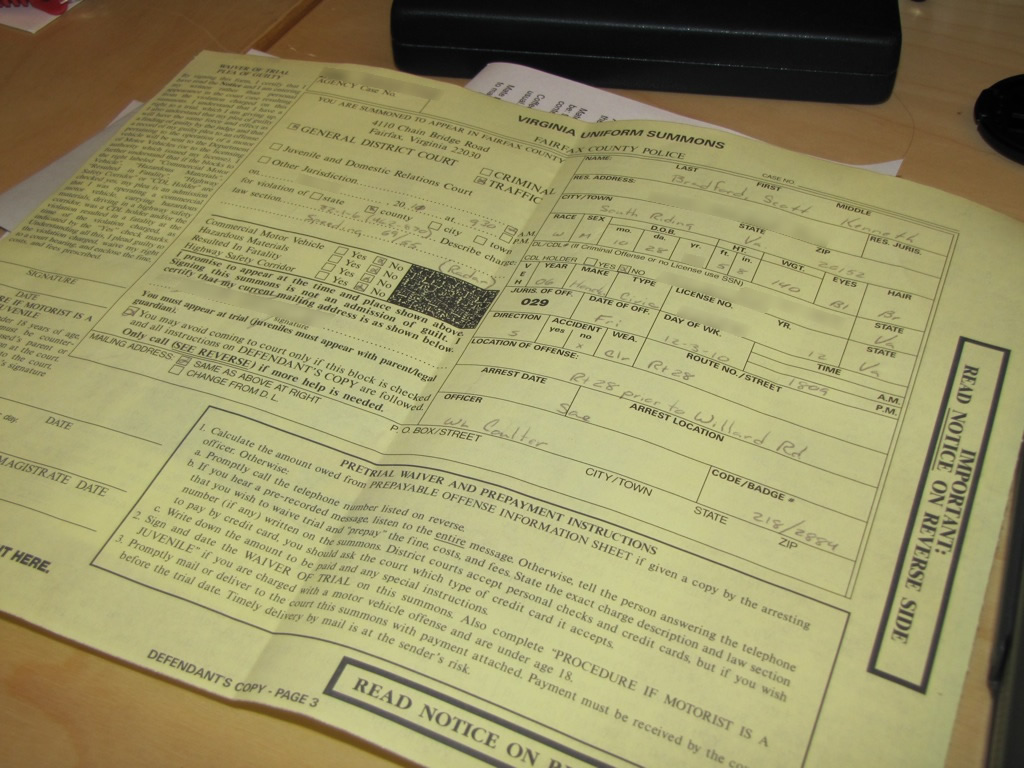
As you might expect, my two traffic citations were both speeding tickets. My first was some time around November, 2000 and was for 70-ish in a 55 zone in Greene County, Virginia, on U.S. 29 south. The second, visible at right, was over ten years later on this December 3 for 69 in a 55 zone in Fairfax County, Virginia, on state route 28 south.

So what happened to break my decade-long ‘no-ticket’ streak? I had left work and was heading south on route 28 to pick up Melissa. For most of its length in Loudoun and Fairfax Counties, 28 (‘Sully Rd.’) is a straight, multi-lane freeway built to (or exceeding) the U.S. Interstate Highway standards. It has three travel lanes in each direction, broad shoulders, and no traffic lights except in a couple isolated places where they haven’t been removed yet. The stretch I was on had no lights, and the prevailing speed is in the 65-70 miles-per-hour range. This speed is perfectly safe for wide freeways.

As I passed the U.S. 50 interchange I ended up ‘on my own’; much of the traffic around me had taken the exit and I was in a ‘pocket’ between cars ahead of and behind me. I was taking the next exit, Willard Rd., and I noticed as I approached the exit that a presumably disabled vehicle was sitting in the triangular area between the oncoming U.S. 50 traffic and the main route 28 lanes. In the evening darkness, I didn’t notice that the ‘disabled vehicle’ was a Police Interceptor trim Ford Crown Victoria until I was way too close for it to make a difference. Oops.

Support Wikipedia

Support WikipediaIt’s very rare that I ask anything from my readers (aside their attention). For most of Off on a Tangent’s history there have been no advertisements on this site and, during those periods where there was advertising, I kept it as minimal and un-intrusive as possible. I’ve only encouraged people to donate to things on very rare occasions.

Today is one of those rare occasions.

Wikipedia is an excellent, free online encyclopedia written by volunteer contributors around the world in many different languages. It has more articles than any print encyclopedia in history and, according to a number of studies, has higher average accuracy than those bygone printed monstrosities. It’s not perfect—because anybody can edit it, it does sometimes fall victim to abuse and vandalism—but overall it’s a reliable source of information on almost any subject. On average, I use it several times daily for everything from getting musician/band discographies to historical study to religious research to biographical research and more. I’ve probably learned more from Wikipedia over the years than from any other source (including my schools).

Like Off on a Tangent, Wikipedia is not advertising supported. The vast array of servers that keep Wikipedia available instantly to millions upon millions of contributors and users are kept running by a small, lean team of employees, and the entire operation is funded only by donations. Their goal for 2010 fundraising is $16m, and today they are woefully short of that goal at $9m.

So if you, like me, use Wikipedia all the time, please consider sending them a donation—even a small one—to make sure they’re still here into the indefinite future as a completely free (and ad-free) source of knowledge and learning. You can make a donation via PayPal or credit card through its parent organization, the WikiMedia foundation.

Judge Rules Against Health Care Mandate

Judge Henry Hudson of the United States District Court for the Eastern District of Virginia ruled today that the federal government does not have constitutional authority to require citizens to purchase health insurance. This ruling invalidates the ‘individual mandate,’ a core provision of President Barack Obama’s (D) landmark Patient Protection and Affordable Care Act, which was signed into law in March of this year.

Hudson ruled, in part, that an “individual’s personal decision to purchase—or decline purchase—[of] health insurance from a private provider is beyond the historical reach of the U.S. Constitution. No specifically constitutional authority exists to mandate the purchase of health insurance.”

In this case, ‘Virginia v. Sebelius’ (3:10-cv-00188), the Commonwealth of Virginia—represented by state Attorney General Ken Cuccinnelli—argues that the individual mandate oversteps constitutional limits on the federal government’s authority. This is just one among many challenges to the health care reform act, including one suit being brought by Florida and nineteen other states against newly-mandated Medicare expansions.

The Obama administration is expected to appeal the ruling, and it is very likely that the constitutionality of the health care reform act’s most controversial provisions will not be fully settled until they are ruled upon by the U.S. Supreme Court.

Chrome OS and the Google Cr-48 Notebook

Google is one of the darlings of the technology industry and, since its now-ubiquitous search engine slaughtered its competition in the late 1990’s and early 2000’s, it has slowly but confidently branched out in to more and more Internet industries. Between Google Maps, Google Docs, Gmail, YouTube, Google News, Google Reader, and countless other properties, it’s a pretty sure bet that you spend a fair amount of your day on one or more of Google’s sites. Many—myself included—have begun using Google’s excellent Chrome web browser as their primary means of surfing the web, stealing market share from Microsoft Internet Explorer and Mozilla Firefox.

With it’s Linux-based phone operating system called Android, Google has now become a player in the OS universe. Android has seen broad success on a variety of manufacturers’ phones, including well-known devices from HTC and Motorola, and is widely considered to be the most plausible contender to unseat Apple’s iPhone juggernaut. But Android isn’t Google’s only operating system project. There is another.

First announced on July 7, 2009, Google has also been working on an operating system called Chrome OS. As its name implies, the actual ‘operating system’ here is practically non-existent—it is just a thin Linux-based layer between the computer’s hardware and the Chrome web browser. Basically, when you start up a Chrome OS machine, all you get is a browser window and the Internet. Anything and everything you do on a Chrome OS machine (with some very limited exceptions) is on the web.

On December 7, 2010—this past Tuesday—Google announced that it would distribute a limited number of ‘Cr-48’ notebook computers running a pre-release version of Chrome OS. Google’s intent is to get the operating system and a sort of ‘reference design’ notebook into real users’ hands for testing and feedback in order to polish-up the real products before they go on sale. Interested users were welcome to enter online for the chance to receive a free Cr-48 and, in return, all they had to do was agree to share their feedback with Google. I signed up on Wednesday morning, expecting to never hear from them again.

Scott Bradford is a writer and technologist who has been putting his opinions online since 1995. He believes in three inviolable human rights: life, liberty, and property. He is a Catholic Christian who worships the trinitarian God described in the Nicene Creed. Scott is a husband, nerd, pet lover, and AMC/Jeep enthusiast with a B.S. degree in public administration from George Mason University.