Switching to BOINC

I’ve never made much of a big deal of it, but for many years I’ve donated my spare computer power to Stanford University’s Folding@Home project. Folding@Home is one of many distributed computing projects that harness the power of thousands (or even millions) of personal computers to solve complex problems—creating a sort of donation-based super-computer. The Folding@Home project is dedicated to researching protein folding and mis-folding as it relates to a number of serious human diseases like Alzheimer’s, ALS, Parkinson’s, certain cancers, and more. The more we understand about protein folding the more we’ll understand about the causes of these diseases and, potentially, the closer we are to finding cures. You can see my Folding statistics here.

For literally years now, I’ve been hoping that Folding@Home would switch to the BOINC platform. BOINC, designed and maintained by the University of California at Berkeley, isn’t a distributed computing project of its own but rather a platform upon which other projects can do their work. The cool thing about BOINC is that you can split your computing power between different distributed computing projects; you aren’t tied-in to just one of many worthy causes. Well, after a lot of patient waiting, I don’t think Folding@Home is ever coming to BOINC . . . so I switched to BOINC without them.

The two computers that I have running 24/7 at home—a home network server and a desktop—are now running BOINC when they’re not doing other things, and I’ve shut down their Folding@Home clients (since they can’t coexist peacefully without a lot of bothersome configuration). I’m splitting my time (roughly-equally) between human disease research and astronomical research. These are the projects to which I’m currently donating some of my spare computer time (and the rough percentage I’m donating). You can also see my stats (which are still very young) here.

  • Einstein@Home (12.5 percent): Processes data from gravitational wave detectors to find and analyse pulsars, stars, and black holes.
  • SETI@Home (25.0 percent): One of the oldest distributed computing projects; analyses data from radio telescopes in an effort to find possible signals from alien intelligence.
  • Rosetta@Home (25.0 percent): Analyses proteins in an effort to understand how they relate to human diseases (similar to the Folding@Home project).
  • SIMAP (12.5 percent): Another protein study project to identify similarities and relationships between different proteins.
  • World Community Grid (25.0 percent): A ‘meta project’ sponsored by IBM that researches many human diseases like cancer, malaria, muscular dystrophy, AIDS, and protein diseases like Alzheimer’s. In addition, some of the time goes towards clean energy research.

Anyway, if you have a desktop computer that you leave on all/most of the time, you might want to install one of these applications. They just run in the background and you’ll never even notice them, but the time your computer isn’t doing anything else will be spent doing some good. If you have a little more time to spare, you can set up a BOINC manager and split your time among many projects like nerdy people do ;-).


Amazon Kindle 2 E-Reader

Overview

I wrote back in April about why I didn’t have an e-reader, even though I’m a fairly avid reader. Then, two months later, I ordered an Amazon Kindle 2. The only thing that really changed in those two months was the Kindle’s price, which dropped precipitously from $250 to a much more reasonable (but still a bit high) $190. I still went back and forth over whether a single-use device was really worth that much, but I eventually gave in. Had it dropped to $150, there probably wouldn’t have even been an argument.

I chose the Kindle over the competitive Barnes & Noble Nook, which has a WiFi-only model for $150, because Amazon’s larger selection of books and the Kindle’s always-there 3G ‘Whispernet’ together seemed to justify spending an extra $40. The Nook’s main advantages are its color touchscreen, located below the nearly-identical-to-the-Kindle e-ink display, and that it runs the open-source Android operating system and is thus more hackable. The touchscreen was neat, but I found it unnecessary (and surprisingly laggy) when I tried it out. I’m not particularly interested in hacking on an e-reader either, since the built-in software in both the Kindle and Nook are quite sufficient for reading . . . which is the whole point of the device. Having said that, the Nook is a fine device and a worthy competitor to the Kindle.

Sony also offers a line of e-readers but, in typical Sony style, they seem to look good on paper and perform poorly in reality. They lack the slick integration with the online stores offered by the Kindle and Nook and, worse, every time I’ve tried to use one in a store it’s been broken. Not the way to sell a product, guys. Between the Kindle’s arrival in July and today, Amazon has discontinued the Kindle 2 and replaced it with a new model at the same price and has also introduced a cheaper WiFi-only version at $140 (both currently available for pre-order). They also sell a grossly-overpriced Kindle DX for $380.

The Freedom of Conscience

People of faith—whatever their faith—have a right to live their lives in accordance with their religious beliefs. Likewise, religious organizations (that are made up of those people of faith) have a right to operate in accordance with their beliefs as well.

You don’t have to like what those beliefs are, but if a religious group believes—for example—that unmarried cohabitation is immoral, then that religious group is under no obligation to provide its services (whatever they are) to an unmarried cohabiting couple. Cohabitation should not be criminalized, since government generally has no place legislating private morality . . . but neither should it be illegal for private religious organizations to refuse to endorse and support unmarried cohabitation. Each law would be just as wrong as the other, as they both take freedom away from the individuals to follow their conscience.

It’s the same when we talk about homosexuality. Even if you are the most pro-gay rights person in the world, you should find it appalling that governments think it’s acceptable to force religious organizations to, say, provide adoption services to gay couples when it runs counter to their beliefs. Homosexual activity should not be criminalized . . . but, once again, neither should it be illegal for private religious organizations to act in accordance with their beliefs. The gay-rights activists’ moral views on homosexuality have no more or less validity in the public sphere than devout Christians’ moral views on it, and government has no right to declare either view to be invalid.

If a religious group and its adherents believe homosexuality to be sinful, they have a fundamental right to refuse to provide services—like adoption—to gay couples. You don’t have to like that Catholic adoption agencies won’t adopt children to gay couples any more than a devout Catholic has to like governments legalizing gay marriage. If you don’t like it and don’t agree with it, you don’t have to use Catholic adoption services. You have no right, simply because you disagree with the Catholic position on the issue, to demand that Catholic organizations follow your moral beliefs instead of their own.

Laws that require religious groups to follow the state’s dictates on conscience are undeniably unjust and immoral, no matter how much you or I might agree with the ideas behind those dictates. We have a right to decide for ourselves what is morally acceptable and what isn’t. When the state starts to demand your adherence to their ideas of right and wrong—on whichever side—beyond the most basic fundamental civil liberties (like rights to life, liberty, and property; free speech; free press; right to keep and bear arms; etc.), then the state has become despotic and the people are no longer free.

With each passing year, our western societies move further and further down this path. How long before it becomes a crime even to think that something is morally wrong if the state has decided it isn’t?

Three More Random Photos

Yes, I know, I’ve been slacking again on my posts. Sorry about that. Here are another three random photos to tide you over until I can write a bit more real content ;-). First, a baseball game at Nationals Park. Second, a funny ad at Sheetz for a pork sandwich. Finally, the most lonely parking space in the lot.

Three Random Photos

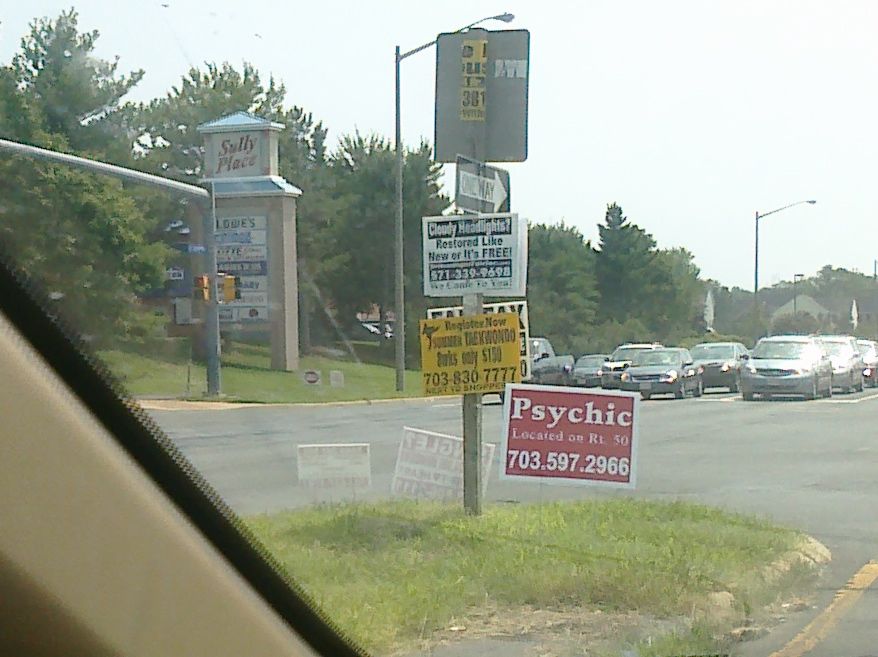
Three random photos: First, a sign for a psychic that states ‘Located on Rt. 50.’ U.S. Route 50, however, is a highway that runs the 3,008 miles from Sacramento, California, to Ocean City, MD and there is no indication of where on rt. 50 we should go (maybe we’re supposed to by psychic too). Second, Melissa cuts open a box that clearly states ‘do not cut open.’ Third, a glamor-shot of my favorite keyboard.

Scott Bradford is a writer and technologist who has been putting his opinions online since 1995. He believes in three inviolable human rights: life, liberty, and property. He is a Catholic Christian who worships the trinitarian God described in the Nicene Creed. Scott is a husband, nerd, pet lover, and AMC/Jeep enthusiast with a B.S. degree in public administration from George Mason University.