
Metro Continues to Fail

The Washington Metropolitan Area Transit Authority (WMATA) has got some explaining to do. According to yet another damning report on MetroRail that appeared in The Washington Post yesterday, the apparently failure-prone ‘fail safe’ Automatic Train Protection (ATP) system is again at the center of the report.

Metro has a two-layer system designed to prevent trains from slamming into one another. First, Automatic Train Control (ATC) usually runs the trains automatically and makes sure that trains don’t enter a ‘block’ (circuit) occupied by another train. If ATC is off and the trains are running manually, or if ATC fails, the secondary ATP system [supposedly] kicks-in and cuts power to a train entering an occupied block.

The problem is that both systems rely on a single, non-redundant network of track circuits. If a track circuit fails, both ‘layers’ of the protection system evaporate into nothingness. This is how the collision happened in June; both layers of the ‘fail-safe’ system got bad data from one bad track circuit and, because there was no independent backup, people died.
‘Submission’ is a Dirty Word

Writing for Catholic Exchange, Pat Gillespie tells a wonderful anecdote about three runaway teenagers that visited his family some years ago and, in a broader sense, how irrationally opposed our western society has become toward the ideas of authority and submission. We all expect others to behave in accordance with societal norms or social standards, and yet we chafe at the idea of following those very norms when we disagree with them for our own selfish reasons.

I’m as guilty as anybody in this respect. As my parents can surely attest, I began to test the authorities in my life early. I tested my family, I tested my schools, and I tested my governments. I still do some of this today in the form of respectful dissent and (in rare instances) civil disobedience. In my younger days, however, my disobedience (while sometimes valid and justified) was too often just my annoying the authorities for no other reason than that they were authorities. This is fairly normal and expected for teenagers, but many adults in western society seem to have never grown out of this phase. Gillespie summed it up in his piece, talking about the three runaways:

I’m sure they took for granted that the world would continue to function according to laws and standards that make community and social life possible, but I don’t think they saw any personal responsibility in making that work by any submission to authority on their part.

Hallway Roadblock

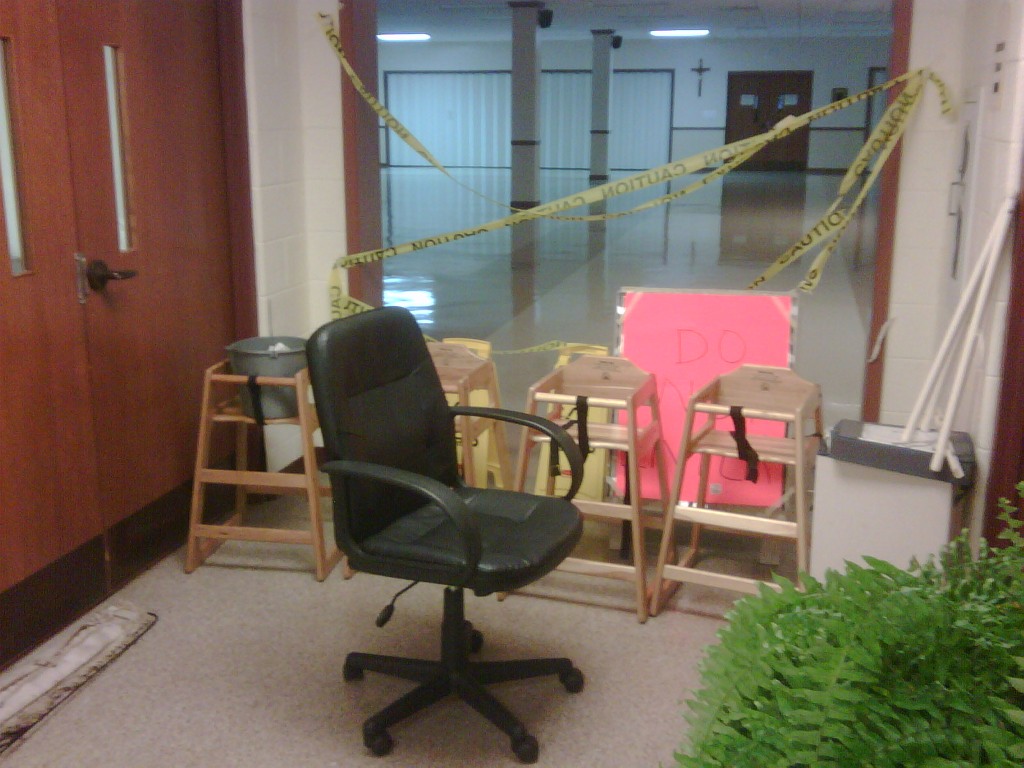
roadblockIt’s one thing to put up a sign to discourage somebody from entering a room. It’s another to put up some caution tape and a sign. It’s quite another to put up caution tape, a sign, an office chair, and four high chairs. I think somebody wants to make sure people stay out of the fellowship hall!

Hey, if you’re going to do something, you might as well do it all the way.

The only thing missing from this scene is some kind of guard animal. I’d have liked to have seen a bunch of angry parakeets, rabid wombats, poisonous geckos, wiggly earthworms, or something like that as a second layer of defense.

Or at least a couple more office chairs! Come on!

Legitimate Dissent and Media Bias

I lament the continued lack of civility and decorum in our political discourse. As long as I have operated this web site, I have condemned childish, immature forms of protest—blocking streets, heckling, shoe throwing, etc.—while encouraging civil, rational protest, dissent, and discussion. For much of President George W. Bush’s (R) two terms, the radical fringe on the left engaged all kinds of crazy, distasteful, obnoxious protests against the War in Iraq and the greater Global War on Terror. I have never once condemned opposition to these wars (even though I personally support them), but I condemn off-hand obstructing traffic, interrupting speeches, and so on.

There is a right and wrong way to protest. There is a proper time and place. Asking tough questions at a ‘town hall’ style forum is perfectly acceptable; interrupting a speech with heckles is not. Arranging a public protest in Washington, DC, with the foreknowledge of police and government officials (so they can warn the public and everybody can plan their commutes) is just fine; laying down in the road and blocking traffic (as anti-war protesters did on the Key Bridge some years ago) is not.

Whether these protests are ad-hoc or pre-planned, supported by political parties or ‘grass roots’, organized or spontaneous . . . none of this changes the basic rules of civility and courtesy that should govern our actions in the political sphere. People should express their views publicly and loudly, no matter how controversial, but they should do so in a way that respects others.

Sotomayer Confirmed to Supreme Court

Sonia Sotomayer has been confirmed by a 68-31 majority of the United States Senate to become the next Associate Justice of the United States Supreme Court.

Sotomayer was President Barack Obama’s (D) first Supreme Court nominee, and was confirmed by similar margins in the Senate compared to the previous two nominees. Chief Justice John Roberts was confirmed in 2005 by a 78-22 vote and Associate Justice Samuel Alito was confirmed in 2006 by a 58-42 vote. Both Alito and Roberts were nominated by President George W. Bush (R).

Sotomayer is ethnically Puerto Rican, making her the first Hispanic Supreme Court justice, and she is only the third woman to serve on the court. Sotomayer will be sworn in by Chief Justice Roberts on Saturday morning and will begin hearing cases with the rest of the court in September and October.

Scott Bradford is a writer and technologist who has been putting his opinions online since 1995. He believes in three inviolable human rights: life, liberty, and property. He is a Catholic Christian who worships the trinitarian God described in the Nicene Creed. Scott is a husband, nerd, pet lover, and AMC/Jeep enthusiast with a B.S. degree in public administration from George Mason University.