
Home Shopping: Offer Made!

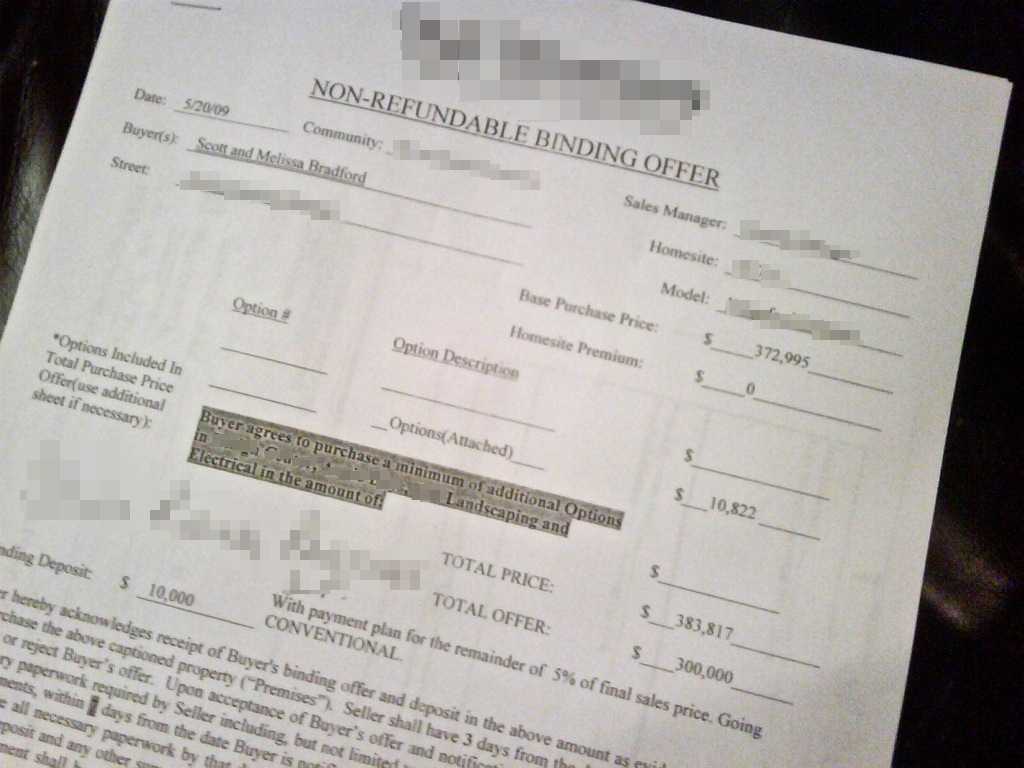
offerlettertownhouse-lot2townhouse-lot1I mentioned a few days ago that Melissa and I had found a yet-to-be-built townhouse that is in a reasonable price range (at least, by Northern Virginia standards) and were working with a Realtor and a sales manager with the builder to see if we could make it work with our finances. Well, things are proceeding. We have put in an offer to purchase the house for $300,000 (again, by NoVA standards, that’s very cheap for a new townhouse).

The offer, if accepted, would be very generous on the builder’s side. They would accept about 2/3 of the down-payment initially with the rest due at closing (which looks like it’ll be in October/November), would cover virtually all of the closing costs, and pay for our mortgage insurance. The monthly payment would work out to be roughly $1,800, which is only $400 more than our little two-bedroom apartment’s rent.

If the offer is accepted as-is, we’re committed. If the offer is not accepted, the builder would make a counter-offer and we would (hopefully) negotiate something we can all live with. Of course, if the builder won’t give enough for everything to work out with our finances, we’ll have the option to walk away. We’re only committed if the offer is accepted as-submitted.

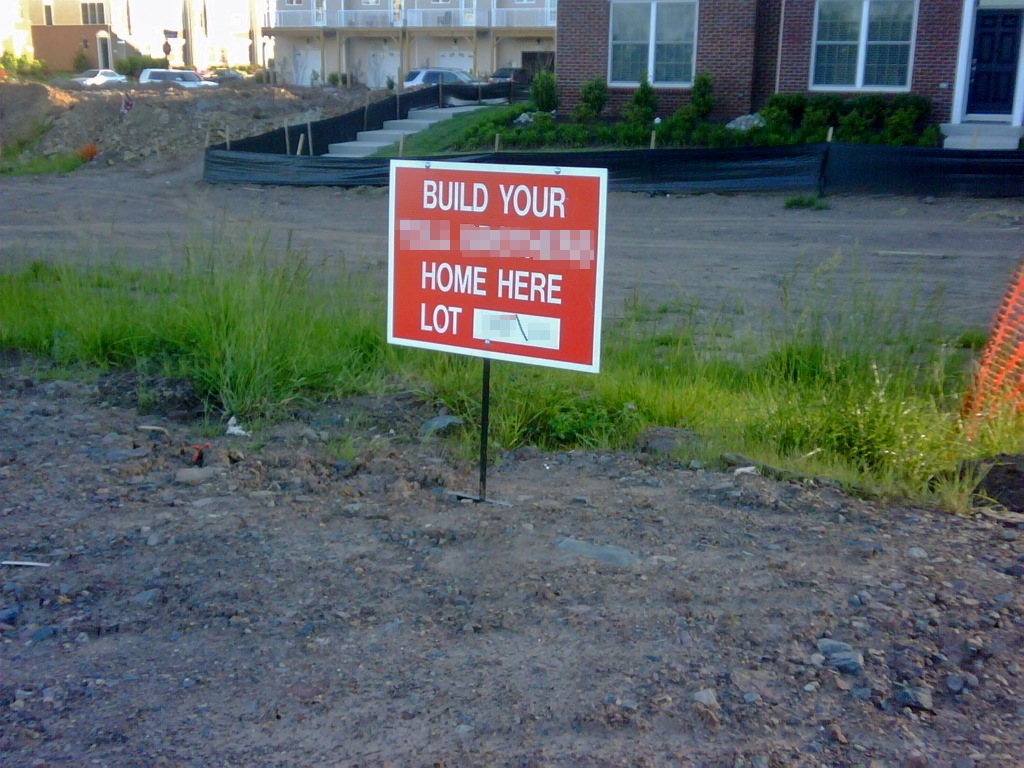
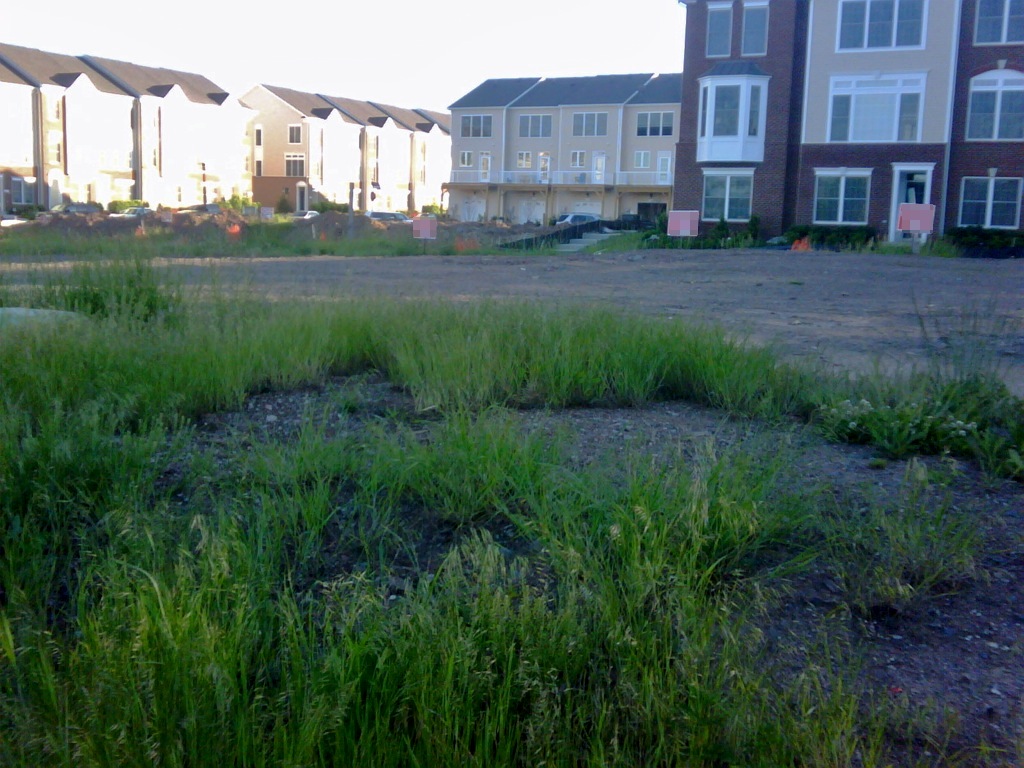
The previous entry, of course, shows the artist’s conception of what the house will look like and a floor plan. The pictures here are the offer letter, the empty lot where the house will be, and the sign marking the property. We should know whether it’s ours within a week or so.

Firefox Add-on Roll-Call

(Note: This is the third major revision of the Firefox Add-On Roll-Call, which originally appeared on this site on April 16, 2008.)

The web browser in which I do most of my web surfing is Mozilla Firefox. I find it to be a fast, stable browser and it works on all major operating systems (and even a bunch of non-major ones). Lately I’ve been running the Firefox 3.5 beta, which is stable, faster than its predecessors, works on almost every web site I ever visit, and does a good job of visually integrating with your chosen OS (whether Mac, Linux, or Windows).

One of the coolest things about Firefox though is its extensibility. There is a vibrant universe of browser add-ons for Firefox that change its look, enhance its functionality, and more. Most of these add-ons work on all operating systems that Firefox works on, so I can create a similar browsing environment quickly and easily on all the three major platforms (all of which I use nearly-daily). The list below is my ‘must have’ add-on list, so be sure to give these a look as you spec-out your own copy of Firefox.

Note that some of these add-ons might not be formally set up to work in test releases of Firefox, like the Firefox 3.5 beta I am using. As such, you may need to disable compatibility checking to use them in unreleased versions of the browser. I have had virtually no compatibility problems with these add-ons in Firefox 3.5 beta.

Apple Drops the Ball, Again

I am becoming increasingly unhappy with Apple. Don’t get me wrong, Mac OS X is still an excellent operating system, and Apple computers are still high quality machines. But with Linux distributions growing ever-more easy to use, and Microsoft coming to its senses with its upcoming Windows 7, and the average computer user becoming more knowledgeable, Apple could very easily lose all of the gains it has made in the last decade if they are not careful.

One way for Apple to lose support among one of its key user groups—nerdy power users like myself—is to drop the ball on major security vulnerabilities. No operating system is completely secure, but it is incumbent upon the creator of an operating system to repair identified security issues in a timely manner.

Last year, Apple was the only major operating system maker that failed to release a patch on a worldwide coordinated ‘patch day’ to resolve a major security hole that affected all platforms. Every major Linux distribution, every current Unix builder, and even Microsoft patched their systems against that DNS bug on the same day. Apple, though made aware of the issue at the same time as everybody else, left their users un-patched for well over a month against one of the most computer serious security issues since the advent of the Internet.

Now, word is coming out that a bug in Java technology that leaves computer users at risk from hackers remains un-patched by Apple in Mac OS X more than nine months after the issue was discovered, and long after the Java systems on every major Unix, Linux, and Windows system have been patched. Not cool.

It is only a matter of time before Apple’s inexplicable negligence with these kinds of security issues results in a major virus making the rounds in the Mac OS X user community, which will slaughter Apple’s reputation for security and stability. I hope the folks in Cupertino are taking note.

The Notre Dame Controversy

Over the last several weeks and months, one of the largest national controversies has been—by some accounts—the most perplexing. President Barack Obama (D), a noted supporter of abortion rights and the destruction of embryos for research, delivered the commencement address and received an honorary degree from the University of Notre Dame in Indiana, a Catholic university.

By all accounts, the address Obama delivered yesterday was gracious, reasonable, and well-delivered. He called for supporters and opponents of abortion rights to find common ground, and to work to reduce the number of abortions in the United States. He called for a ‘sensible conscience clause’ which would allow religious doctors to refuse to provide treatments like abortion that are incompatible with their beliefs. Traditional Catholics have been up-in-arms though about Obama even being invited, since his beliefs run so afoul of Catholic doctrine, and many traditional Catholic students of the university sat-out the event.

So what’s the big deal?

First, Notre Dame is a Catholic university. It professes a Catholic identity. Many students who go there choose the school because it theoretically provides a more moral, less worldly environment as compared to secular schools. That is not to say that it shouldn’t expose its students to opposing viewpoints, but simply that it should present those worldy views in a proper moral context. As a Catholic institution, it must adhere properly to Catholic church policy. Like federal agencies must follow federal law, Catholic agencies must follow Catholic law. The United States Conference of Catholic Bishops (USCCB) wrote in their 2004 document “Catholics in Political Life“:

House Shopping Update

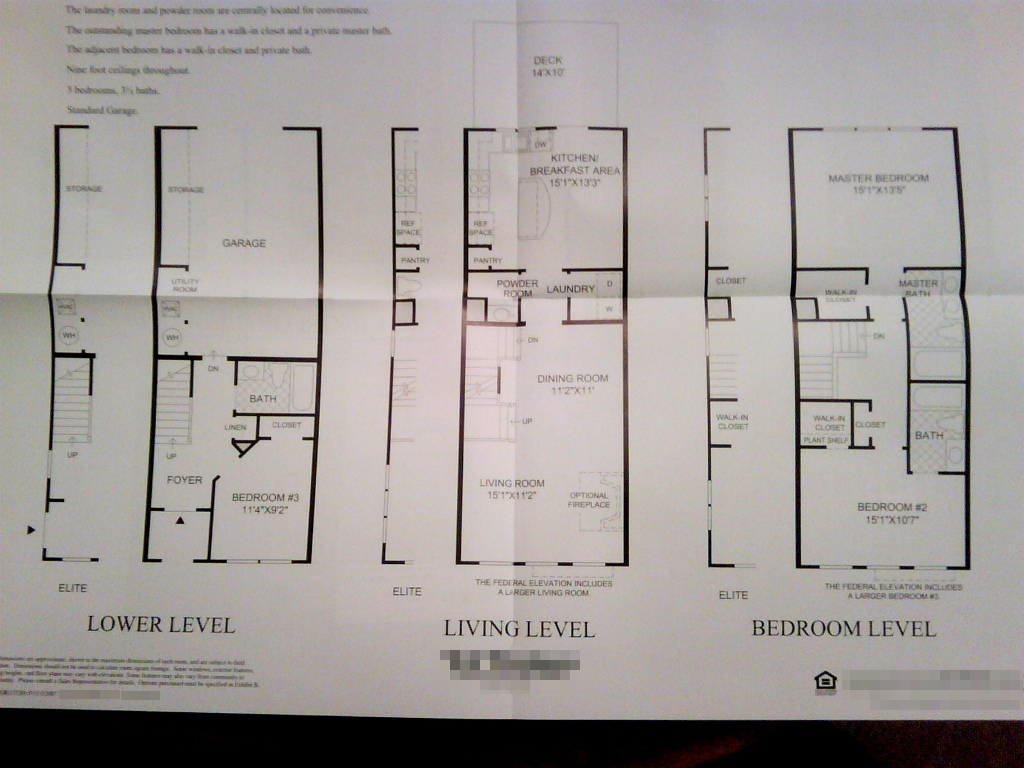
townhouse1townhouse2So, I mentioned a little while ago that Melissa and I—in light of the ‘horrible’ economy presenting some of the best home-buying opportunities of a lifetime—are looking at possibly buying a house later in the year. Working with a Realtor, we’ve found a townhouse which is not yet built (scheduled delivery in October/November, just after our lease runs out) and happens to be in our price range. It has three bedrooms, 3 1/2 bath, 1-car garage, wouldn’t extend my commute . . . much, and is in a nice neighborhood.

It’s, of course, way too early to get our hopes up. We are working with the Realtor and builder to see if we can get something figured out that works with our current financial situation. It might work out, it might not. But, at this point, it looks fairly promising.

Forgive the poor cell-phone-camera pictures, but the pictures are an artist’s conception of the building (the one we’re looking at is the 2nd from the right) and the floor plan. The garage is in the back of the house, and the front door actually opens up on a grassy courtyard . . . or, at least it will once they build it. Exciting times!

Scott Bradford is a writer and technologist who has been putting his opinions online since 1995. He believes in three inviolable human rights: life, liberty, and property. He is a Catholic Christian who worships the trinitarian God described in the Nicene Creed. Scott is a husband, nerd, pet lover, and AMC/Jeep enthusiast with a B.S. degree in public administration from George Mason University.