
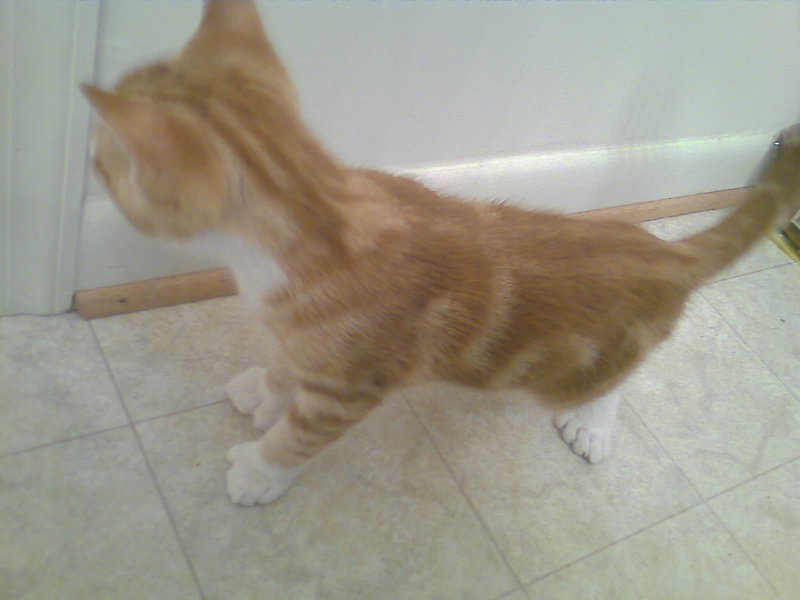
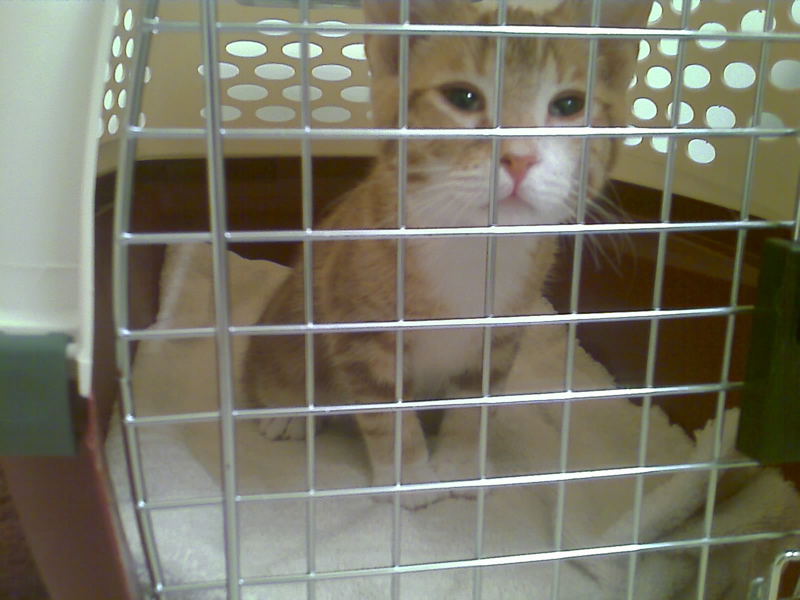
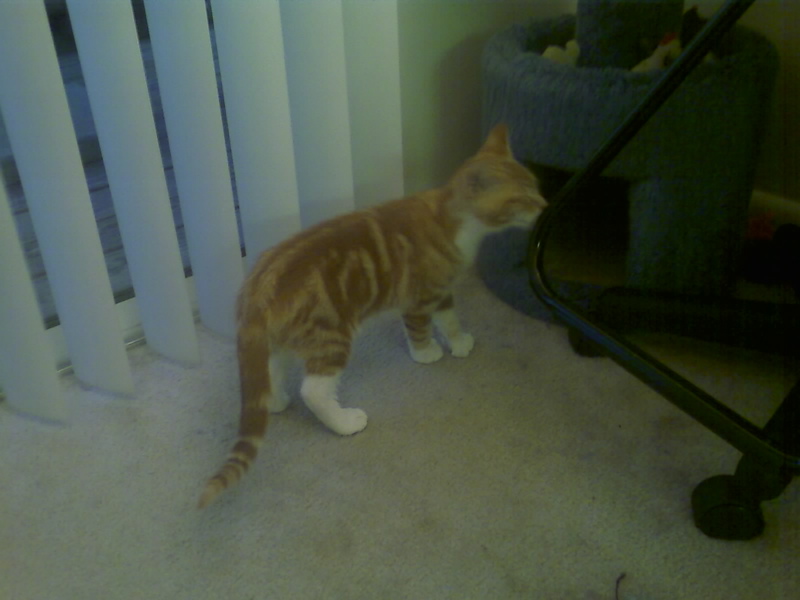
 So, uh, I’m not really sure how this happened but Melissa and I (mostly Melissa) got a new cat today. His name is Mittens Vincent. He has a somewhat-rare deformity where the ‘thumb’ of his paw is down where the other ‘fingers’ are instead of further up the leg like on most cats.
I’m still trying to compute how a trip to Men’s Wearhouse to return my tux turned into an adoption trip to the Petsmart next door, but it did.
Anyway, Mittens Vincent—aside from his neat little paw deformity—is your average male orange tabby with white highlights on his feet and belly. He’s about four months old, so he’s still just a kitten. Hopefully, Mei Mei will pick up a slight maternal instinct toward him with a little time . . . but right now we’re just trying to convince Mei Mei that the newcomer is not Satan and need-not be hissed at every time they see one another.
(Update: My wife informed me this morning that ‘Mittens’ was not likely to be his permanant name. Then I found out this evening that he will be called Vincent. The entry has been updated.)