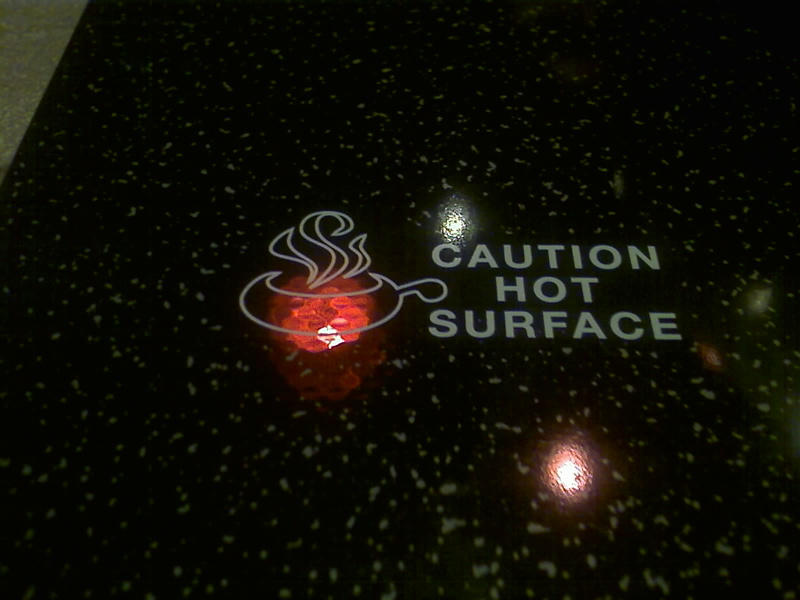
Caution: Hot Surface

So, Melissa wanted to do some ‘Restaurant Week’ thing where you go to fancy, expensive restaurants and pay slightly-less fancy, slightly-less expensive prices. We went to the Melting Pot this evening, which is a fondue chain with a location right down the road in Reston.

It was pretty good, for fondue. Personally I love fondue as a home dish, but I’m not sure I get the point of paying to cook your own food. It was a nice evening out though, and I have to admit it was very good, fancy fondue.

We also got warned about 50 times total not to touch the clearly-labeled hot surface in the middle of the table. Funny, the printed warning, red light, and common sense didn’t give it away. Got to love living in a litigious society. There were no warnings printed on the other hot object at the table, pictured.

Flawed Concept: Security Through Annoyance

Electronic security is important. Like we have grown to accept intrusive airport security as part of a valid effort to protect travelers from getting blown up by Islamic fascists and other terrorists, we have also grown to accept passwords, PIN numbers, verification codes, CAPTCHAs, and more in the name of electronic security. In this Internet age, you are more likely than ever to be a victim of credit-ruining identity theft. These inconveniences help to protect you.

Electronic security is also important for the government and businesses. Having worked on Department of Defense web sites, one of which including private (though non-classified) information, I’m well aware of the precautions taken on the systems side. DoD sites have to pass the Defense Information Assurance Certification and Accreditation Process (DIACAP), be compliant with the DoD Public Key Infrastructure, and more. When you combine all of this with web browsers and servers that support SSL encryption and rational user account/access policies, it’s pretty tough for bad guys to get information they shouldn’t have access to.

The problem is that increasing security—at least when it directly inconveniences the user—comes with diminishing returns. Extreme security requirements (like those often mandated in government settings) often result in a less secure technological infrastructure.

Taking a Nice Little Vacation

As many of you are probably aware, I’ve been employed for some time as a Web Content Manager on Department of Defense web sites. With a couple of diversions here and there, including an unceremonious work stoppage in the first week of this February due to contractual goofiness and some more-recent diversions, that’s been What I Do™ since August 2004. The contract I’ve been working on most all that time ended Friday, and the new award was given to a different company.

The new project I’ll be taking on starts with a training period on the 25th, so I’ve got a nice, empty, unexpected vacation week. That’s especially nice, since I like to have a little breathing room to decompress between jobs/projects. It’ll also give me a chance to do some biking when there are fewer people out on the trails, and maybe goof around with some web site stuff and watch some DVDs. It’ll be a nice change of pace to have a week with essentially nothing to do, especially after spending the last five-months-or-so completely swamped on an understaffed team.

Anyway, other than that it’s mostly just your average stuff. I finally got Melissa to join me on a bike ride today (just a short, easy one to start her off with ;-)) Been doing a lot of reading. All-in-all things are going pretty well!

Share to:

Send to:

Fear Mongering on the ‘Fairness’ Doctrine

In a shameless example of fear-mongering, some Republicans—including Robert McDowell, a member of the Federal Communications Commission (FCC)—have been trying to create a tenuous, fictional link between net neutrality and the fairness doctrine. In reality, the two are essentially polar opposites. Net neutrality is the doctrine that nobody—not the government, and not Internet providers—has a right to control how businesses and individuals choose to use the Internet. The fairness doctrine was an unconstitutional requirement withdrawn by the FCC decades ago that media outlets using the broadcast spectrum (i.e., television and radio) grant ‘equal time’ to all sides of issues of public import.

That sounds good, and I’m a big fan of presenting all sides of an issue, but members of the media (whether print, television, radio, or Internet) have a right to publish whatever they want however they want. If the New York Times wants to be wacky left-wing, they can. If Fox News Channel wants to be right-wing, they can. You can read or watch whatever you want, and you can switch to a competitor if you don’t like the ‘slant’ of a particular media source. It’s not the government’s place to require any media outlet to add or remove any content—especially political content—from their programming.

I’m surprised to see guys like McDowell going to these desperate lengths to defend an indefensible position that companies should be able to turn the Web into a giant toll-road for the benefit of phone and cable companies, but linking with the fairness doctrine—a concept that most thinking people revile—seems fairly shrewd. Except it’s not.

It turns out that the fairness doctrine, despite its historic chilling effect on the political media and unquestionable unconstitutionality, is surprisingly well liked. According to a recent Rasmussen poll, 47 percent of Americans want to see this onerous requirement re-applied to radio and television. Only 39 percent oppose it. Thankfully a smaller number want to see this doctrine applied to the Internet . . . but an incredible 31 percent of Americans think that my blog should have to dedicate equal time to all sides of an issue. In other words, if I write 389 words against the fairness doctrine, I would have to write 389 words in favor (or publish somebody else’s 389 words in support). Ludicrous.

So it’s definitely right to oppose the fairness doctrine, but trying to link it with net neutrality is nothing but baseless fear-mongering.

The views expressed in this post are mine and mine alone. They do not necessarily reflect the views of my employer, Web.com.


A ‘Frankenrobot’ With a Biological Brain

A fascinating story came across the AFP wires today—scientists at the University of Reading have created an experimental robot, and the robot’s ‘brain’ (which would normally be a computer processor) is between 50,000 and 100,000 mouse neurons.

The short explanation is that they put a bunch of mouse neurons in a nutrient-rich liquid with a bunch of electrodes attached (they aren’t actually sitting on the robot, but communicate with it through a wireless link). Sensors on the robot send signals to certain electrodes with stimulus (e.g., if the robot runs into a wall a certain electrode will fire). The neurons, in turn, can sent signals out to other electrodes which instruct the robot (e.g., a particular electrode will make the robot drive forward).

When they first set this up, nothing seems to happen. After about 24 hours though, the neurons start organizing themselves and testing out their environment. Within a week they’re showing brain-like activity, and soon after they start sending signals to the robot and getting stimulus in return. Over time, the ‘brain’ starts to learn and exhibit behaviors (and they actually have a few different ‘brains’, each of which exhibits its own unique behaviors).

The idea is to understand how brains work, which—despite all our scientific research—is largely a mystery. This experiment sets up a simple, small brain out of actual neurons and studies how it arranges itself, how it learns, and so on. What’s amazing about it, if you ask me, is that a bunch of neurons in a petri dish hooked up to electrodes actually does things. It’s slightly unsettling really, but the ‘cool’ factor overwhelms the ‘unsettling’ factor for me.

Scott Bradford is a writer and technologist who has been putting his opinions online since 1995. He believes in three inviolable human rights: life, liberty, and property. He is a Catholic Christian who worships the trinitarian God described in the Nicene Creed. Scott is a husband, nerd, pet lover, and AMC/Jeep enthusiast with a B.S. degree in public administration from George Mason University.