
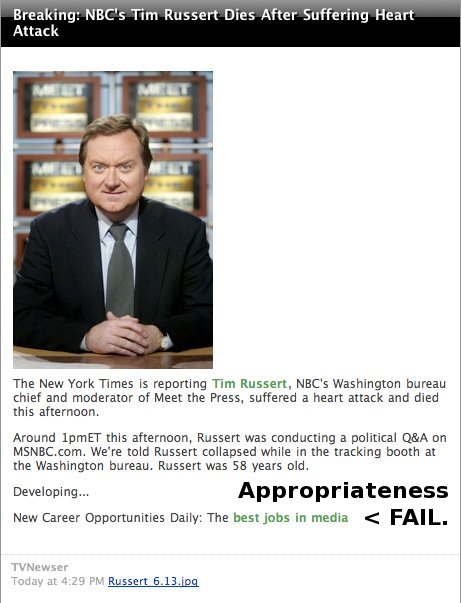
Tim Russert Dead at 58

While I get much of my news these days from the Internet, it is not because I have anything against television news in principal. If the TV networks would produce worthwhile news shows, I would probably watch them. Most TV news shows today, however, are vacuous, shallow, and incredibly biased.

One of the few bright spots was Meet the Press hosted by Tim Russert. I was not a religious viewer—mostly because of religious commitments on Sunday mornings away from the television—but I always liked the show. Russert, though you can find with some research that he was a Democrat, rarely-if-ever let his personal biases show through to his lines of questioning. Politicians, whether their name was followed by an R or a D, got tough questions from Russert . . . but they got fair questions. There were no hit-pieces, no zingers, no yelling, and no interrupting. Russert simply asked a question, and gently pried until he got a real answer. Watching Meet the Press usually resulted in the viewer learning something about the politician who was being interviewed, unlike the mindless regurgitation of talking-points you usually get from interview shows.

Tim Russert, 58, one of the very few respectable newsmen left in the industry, died yesterday. He collapsed at NBC’s studios in Washington, DC, while recording voice-overs for this Sunday’s episode of Meet the Press, suffering from a sudden coronary thrombosis caused by rupturing cholesterol plaque. He was rushed to the hospital, but doctors were unable to revive him. Russert is survived by his wife, Maureen Orth, and son Luke.

June 17 is Firefox Download Day 2008

I mentioned a couple weeks ago about Mozilla’s intent to set a world record for the most software downloads in a day with the upcoming launch of the Firefox 3 web browser. Well, the date has finally been set. Firefox Download Day 2008 (and the associated final release of Firefox 3) will be on June 17—next Tuesday.

Mark your calendars. This will be a great, free way for you to support an excellent open source software project and, while you’re at it, download a great web browser. I’ve been using the betas and release candidates of Firefox 3 for months now; this thing is rock solid.

Islam: A Religion of Peace?

Two years ago, I embarked on a journey of religious study. My goal was, on some ‘gut’ level, to prove to myself that the major world religions weren’t all that different from one another. I had a grand goal of gaining a deep understanding of world religions—starting with the three major Abrahamic religions—with a feeling that I would come away with some central, universal morality that held it all together. This journey took me through the Hebrew scriptures (a.k.a., the ‘Old Testament’) of Judaism and Christianity, a synopsis of the Jewish Talmud, the Christian scriptures (a.k.a., the ‘New Testament’), and the Abdullah Yusuf Ali translation of Islam’s Qur’an.

Of those, none disappointed more than the Qur’an. Having had Muslim acquaintances, and having taken an introductory class in world religion while I was in college that spent considerable time on Islam, I had heard how beautiful and amazing the Qur’an was. It is so perfect and beautiful, some say, that it absolutely must be divinely inspired. Well, I can’t speak for the original Arabic (since I don’t read Arabic), but the translation—generally regarded as a good, solid, accurate translation—was unimpressive both in structure (repetitious and shallow) and in its teachings (which lack a clear moral structure but do, indeed, encourage spreading the religion by the sword—an instruction not present in the central doctrines of either Judaism or Christianity, though Christianity has done it at times in its history anyway).

What is worse is that the more I learn about Islam—its history, its core teachings, how those teachings are put into practice, and what mainstream Islam’s vision of the future entails—the more distasteful I find the religion on-average. I set out in my research to like Islam more, not less, but it’s not working out that way. Even in the United States, many private Islamic schools teach their students to embrace a culture of violence, anti-Semitism, and murder (all the while repeating ad-nauseum to the outside that Islam is a religion of peace). Sooner or later we have to ask ourselves if Islam is a peaceful religion that can coexist with the rest of our society, or if it is a threat to civilization and freedom as we know it. The more I research it, the more I suspect the latter.

Tipping: A Silly Tradition, But Do It Anyway

It is customary to tip most people who do stuff for you. Waiters and waitresses are an obvious example, but you’re also supposed to tip doormen, valets, maids, delivery folks (pizza, etc.), and more. Since tipping is customary in these situations, you should do it. People in most of these jobs are grossly underpaid, wage wise, since their wage structure assumes that tips will make up the difference. In many cases, the federal and state minimum wage laws do not apply (or, at least, do not apply in full) to people who can be reasonably expected to receive tips.

Having said that, I think we should stop making tipping customary. It’s an annoying, largely useless tradition. When I pay the bill at a restaurant, I have paid for the food, the wages of those who cooked it, and the wages of those who served it. The way it should work is the actual, list price of restaurant food should be increased (say, 15 percent), servers’ wages should be increased to a fair amount for the job they do (minimum wage or higher), and the whole tipping process should dissolve into oblivion. Good service is a reasonable expectation, and the way to punish bad service should be to report it to the manager (so the server, if bad service is a pattern, can be terminated). If we really don’t want to let go of the silly tradition, then permit tipping in cases of exceptional service (say, a going rate of 5 percent) but it should never be expected or necessary.

I Hate Hot Weather . . .

 . . . but I especially hate hot weather indoors. My employer is located in a building ‘managed’ by Cambridge Asset Advisors L.P., and it seems to be the only building in the country that has an air conditioning system but isn’t maintained in a moderately comfortable state by the building managers. As a small protest, my office white board now has the OSHA recommended temperature range (68-76º Fahrenheit) and, just below it, the current office temperature. Today, it’s 80.1º Fahrenheit in my office—4.1 degrees above the temperature range OSHA recommends. Given that Cambridge has been aware of temperature issues in this building for more than two years now, I figured it was time to call them out on their gross incompetence.

Scott Bradford is a writer and technologist who has been putting his opinions online since 1995. He believes in three inviolable human rights: life, liberty, and property. He is a Catholic Christian who worships the trinitarian God described in the Nicene Creed. Scott is a husband, nerd, pet lover, and AMC/Jeep enthusiast with a B.S. degree in public administration from George Mason University.