
Another One Bites the Dust

One by one, the bygone technology greats are dying off. There was an impressive string of die-offs in 2009, with the Encarta encyclopedia, CompuServe service provider, and GeoCities free web hosting all shutting down. More recently we lost Palm, and it looks like we might be on the verge of losing BlackBerry too. These services, and others, were the tech titans of their time—either because they were really great, or at least because they were pioneers that laid the groundwork for better things to come. With better vision, better management, and better luck, they could have become the Wikipedias, Googles, Facebooks, and Apples of today . . . but instead they foundered, languished, and died.
And now we say farewell to the Winamp media player—one of the earliest MP3 jukeboxes to hit the Windows PC and a real pioneer in digital music. AOL, née America OnLine, officially shut Winamp down on December 20, although they might have fired their web site managers too early because Winamp.com and the players’ download links are all still live today. Grab it while you still can.

Winamp’s real glory days ended about the same time that the U.S. government shut down the Napster file sharing service [on tenuous legal grounds]. The player lived on with occasional updates . . . and I would argue that it was still one of the best media players on the Windows platform right up until the end. It was Apple that really revolutionized digital music with the iPod and iTunes, even though that honor could just as easily gone to Winamp if AOL had managed it properly after taking over in 1999.

With iTunes preloaded on every Mac, and an improved Windows Media Player preloaded on every Windows PC, most computer users didn’t see the need for Winamp anymore . . . but I liked it, and many other music lovers with expansive MP3 collections did too. I used iTunes for a good long time, but as my collection got bigger (and Apple’s software quality took a depressing nose-dive) I made the switch to Winamp. It served me very well right up until the day that AOL announced its demise, at which point I moved to MediaMonkey—a similarly no-frills, down-to-earth, powerful music management application that chews through thousands and thousands of tracks without a hitch.

Life goes on, but Winamp is another one of those products that will continue to bring back fond memories, even long after it’s gone to the great bit-bucket in the sky.

HealthCare.gov: Still Not Working (For Me)

HealthCare.gov—the U.S. government’s web site that is meant to facilitate health insurance sales under the Affordable Care Act (‘ObamaCare’)—went live, at least in a sense, on October 1. I decided to give it a shot a week or two later and see what it would cost to insure myself under President Barack Obama’s (D) signature law. I didn’t get very far.

It’s old news now that the site didn’t work properly for the vast majority of visitors, and it didn’t work right for me either. So I waited a few more weeks. The media kept telling me that it was getting better every day, and, sure enough, my second attempt let me get all the way through the application process . . . only to fail at the very end with a cryptic, nonsensical error. Oh well.

Then I tried again a couple of days later, and the site told me that it was unable to verify my identity. Funny, the government usually has no problem verifying my identity. The Internal Revenue Service accepts my identity when I send them my taxes. The Federal Communications Commission accepted it when I got my General Mobile Radio Service license. The Social Security Administration sends me estimates of how much money I will get if the system is still working when I retire. The Transportation Security Administration lets me get on planes. The Federal Bureau of Investigation approves my firearm purchase every time I go through the National Instant Criminal Background Check System. I’ve been through a Department of Defense background check too. The Department of Education happily accepts my student loan payments.

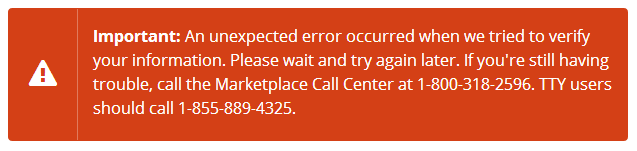
But HealthCare.gov—which is supposedly ‘fixed’ now for the ‘vast majority’ of users—still can’t figure out who I am, and it still won’t let me proceed through the identity verification step. An unexpected error occurred. It gives me the option to call the ‘Marketplace Call Center’ to try and work through the issue, and occasionally I get an inexplicable screen telling me to call the Experian help desk—a private credit rating bureau—because, you know, the government needs Experian’s help to figure out who I am.

Anyway, I don’t feel like sitting on hold for six hours to satisfy my idle curiosity. Maybe this time next year, when the employer mandates kick-in and we all get dropped from our employer plans, the site will let me see what plans I’m eligible for. In the mean time, this is about all that the new and improved HealthCare.gov has to offer me:

Consistency and the ‘Nuclear Option’

Last Thursday, I sat in a hospital waiting room in Richmond, Virginia, while my wife was undergoing abdominal surgery. A bit after noon, my phone buzzed. It was a CNN ‘breaking news’ alert:

The Democratic-controlled Senate today voted to invoke the so-called nuclear option out of frustration over Republicans who have been blocking President Barack Obama’s nominees.

The controversial move is a rules change that could make a partisan environment even more divisive because it takes away the right for the Senate’s minority party to filibuster.

Under the old rules it took 60 votes to break a filibuster. The change now allows most filibusters of Obama nominees to be stopped with 51 votes—a simple Senate majority.

I could do without CNN’s amateurish characterization of the Democratic senators’ motivations, and a bit more context would have been welcome (although I do understand that news alerts must be brief) . . . but still, I got the point. The Democratic majority in the United States Senate managed to do exactly what a Republican majority considered doing in 2005, before being stymied by Senator John McCain (R-AZ) and the bipartisan ‘Gang of Fourteen.’

The ‘filibuster’ is an unusual nuance of the Senate rules that allows senators the privilege to speak as long as they want on any topic they want, and they can only be stopped by a vote of ‘cloture’—which requires a three-fifths (sixty-vote) super-majority. In practice, an individual senator can hold-up or stop a vote on a bill by simply talking, and talking, and talking . . . unless enough fellow senators can be convinced to vote to make him stop.

Virginia Senator Deeds Stabbed

Virginia Senator Creigh Deeds (D-VA 25th), the Democratic Party’s 2009 candidate for Governor of Virginia, was stabbed multiple times in the face and torso at his home in Bath County this morning. Deeds managed to walk to a nearby road where he was picked up by his cousin, who was coincidentally passing by at the time. He was airlifted to the University of Virginia Hospital and was listed for a time in critical condition, but he has since been upgraded to fair condition and is now expected to recover. According to a Virginia State Police spokesperson, Deeds was conscious and able to make statements to law enforcement officials.

Deeds’s son, Austin ‘Gus’ Deeds, was found at the home suffering from a gunshot wound and died at the scene. Police officials believe that Gus Deeds stabbed his father and then killed himself, and the assault is now being investigated as an attempted murder-suicide. The Richmond Times-Dispatch reports that Gus had been held yesterday on an emergency custody order, and was evaluated for mental health problems, but was released to family custody due to a lack of available psychiatric beds in the western Virginia region.

Governor Bob McDonnell (R-VA), who was elected in 2009 after facing Deeds in the gubernatorial race, described Deeds as an “exceptional and committed public servant” and has asked all Virginians to join in praying for him to make a complete recovery. Many other notable political figures, including Senator Mark Warner (D-VA) and Governor-elect Terry McAuliffe (D-VA), have made similar statements.

Election 2013 Results (Final)

Ballot Races
Virginia Governor
Ken Cuccinelli (R):45.22%
Terry McAuliffe (D):47.74%
Robert Sarvis (L):6.52%
Other:0.53%
Virginia Lt. Governor
E. W. Jackson (R):44.52%
Ralph Northam (D):55.10%
Other:0.37%
Virginia Atty. General
Mark Herring (D):49.88%
Mark Obenshain (R):49.87%
Other:0.25%
Virginia House, 87th
John Bell (D):49.34%
David Ramadan (R):50.26%
Other:0.40%
Ballot Issues
Loudoun Park Bonds
Yes:54.20%
No:45.80%
Loudoun Transp Bonds
Yes:68.07%
No:31.98%
Loudoun Fire Bonds
Yes:76.85%
No:23.15%
Loudoun School Bonds
Yes:67.56%
No:32.44%

Scott Bradford is a writer and technologist who has been putting his opinions online since 1995. He believes in three inviolable human rights: life, liberty, and property. He is a Catholic Christian who worships the trinitarian God described in the Nicene Creed. Scott is a husband, nerd, pet lover, and AMC/Jeep enthusiast with a B.S. degree in public administration from George Mason University.