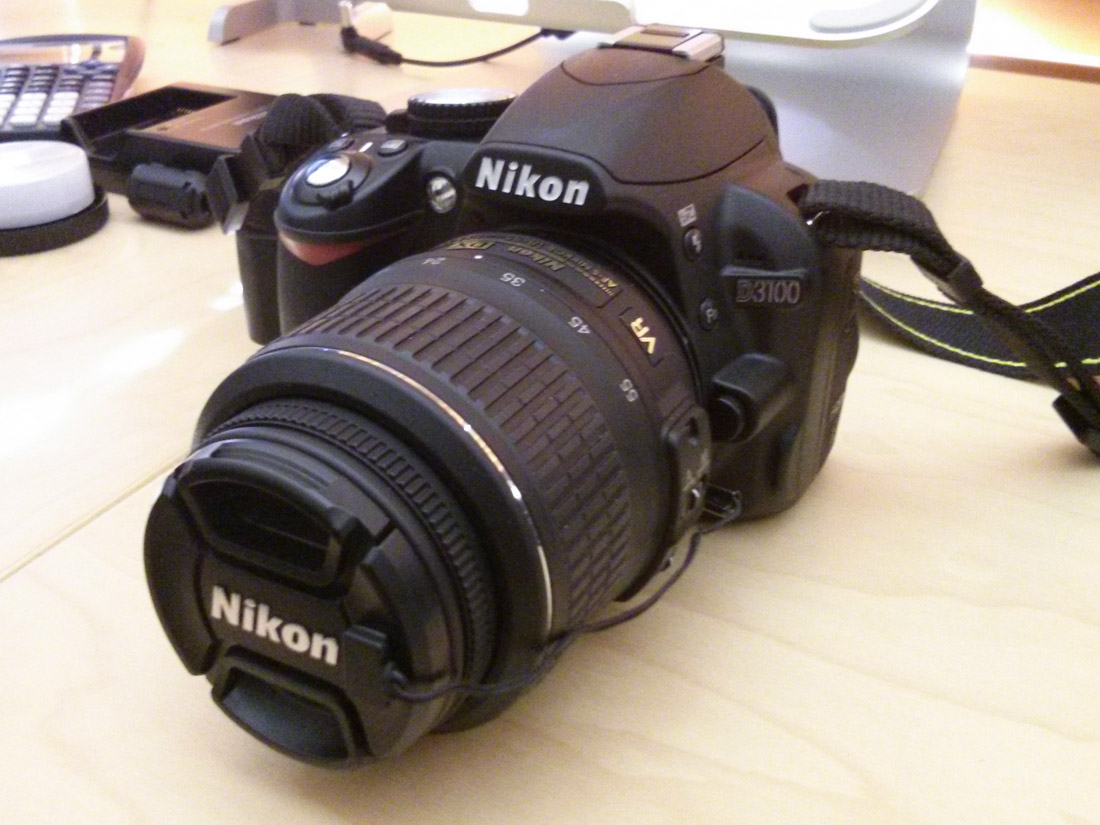
Nikon D3100 at Great Falls Park

Nikon D3100
Nikon D3100

For the last three years I’ve had a Canon PowerShot SX20 IS camera. Before that, when I wanted to take nicer photos than my smartphone could muster, I borrowed Melissa’s PowerShot S3 IS—a camera that I really liked, until it died with a sensor failure. I was borrowing it from Melissa often enough that it made sense for me to get my own camera, and since I liked the S3 and was comfortable with it, it was only natural that I get its successor, the SX20.

Both cameras were slotted into the Canon product line as ‘prosumer’ or ‘bridge’ models. They sort-of looked like full digital single-lens reflex (DSLR) cameras and had similar interfaces, but they used a slower (and smaller) sensor system, an LCD view-finder, and didn’t have an interchangeable lens. They also cost a lot less than DSLR’s, which was a big part of the decision process. I’m not a pro photographer, so spending a thousand dollars or more on a camera was hard to justify. The SX20 cost less than half as much.

It has served me well, but lately I’ve found myself longing for an upgrade—something with interchangeable lenses, faster auto-focus, a usable manual focus, and quicker image capture. Initially I considered one of the new compact mirrorless camera systems like the Canon EOS M or Nikon 1 Series, but I soon found that full DSLR cameras are available in the same price range. Entry-level DSLR offerings from both Canon and Nikon are available for less than five hundred dollars, which definitely wasn’t the case when I bought my last camera!

I decided on the Nikon D3100 with included 18-55mm lens, which was available on Amazon.com for less than $450. I’m partial to Nikon for SLR’s, but Canon fans can find a similarly priced EOS Rebel T3 package. I’m planning to sell my SX20, which is still in great condition, to recoup some of the cost.

Yesterday, Melissa and I went out to Great Falls National Park so I could try it out and start getting used to it. I’m satisfied with the results, generally speaking. I spent most of my time in automatic mode, since I am finding that I need to brush up on my technique and re-familiarize myself with f-stops and shutter speeds before I start doing anything advanced. I will also be upgrading the lens at some point (for something with a better zoom and manual-override) . . . but this one will do for the time-being. Read on to see a bunch of shots from my first outing with the new camera. Since I want you to really see how the camera performs, I’ve only done some minimal straightening and cropping. I’ve made no adjustments to the levels or anything else. Enjoy!

In Google We Trust?

Google Reader
Google Reader

Back in October 2009, I wrote a somewhat curmudgeonly post about how little I trust the ‘cloud’ for my important data. I like to control my own information. I like to know how my backups are executed and how they are stored. The major Internet service companies are pretty good about avoiding data loss, but I can’t trust them to be half as concerned about my stuff as I am.

After that 2009 post, I did slowly begin integrating ‘cloud’ services into my tech world. Since switching to Google Android as my mobile operating system, I embraced many Google services—Gmail, Calendar, Drive, and Reader. With my Windows 8 installs and Office365 subscription, I’ve also begun to adopt Microsoft’s SkyDrive service for ‘cloud’ storage, documents, and notes. I use Amazon’s Kindle services, ToodleDo todos, and miscellaneous other web-based applications.

But don’t think that I’ve stopped being paranoid! I back up my data from every last one of those services on a regular schedule. If a cloud service doesn’t provide some mechanism for back ups in standard, portable formats, I won’t use it. This process has come in very handy recently. With Google’s announcement that it was shutting down the Reader RSS service in July, I found myself needing to move a long list of RSS subscriptions to another service. I used Reader, in part, because it provided ways to export my subscriptions in an industry standard OPML format, and it had reasonably robust API’s for integrating with other services. As such, it was pretty painless to move to Newsblur—the Reader alternative that best met my needs.

Reader’s demise should serve as a reminder to all ‘cloud’ service users: Don’t trust the ‘cloud.’ Don’t trust Google. Don’t trust Microsoft. Don’t trust Apple. Don’t trust anybody to provide a permanent home for your data, because the service you rely on today might be gone tomorrow. It is incumbent on us, the users, to only use services that allow for data portability, and to make our own regular back ups. The only person who really cares about your data is you.

The Secret Code-Names of ‘Off on a Tangent’

I’m deep into the process of developing the next major update to Off on a Tangent, which has been taking up a fair amount of my free time (and is a big part of why I haven’t been posting very much the last couple of weeks). On top of that I’ve been working on two other web development projects—a major update for Melissa’s site, and another little project I’m working on (stay tuned).

Juggling these projects got me thinking about technology code-names. It is fairly commonplace in the tech industry that major projects in development get code-names, and they usually follow a pattern of some sort. For example, Microsoft generally uses the names of ski resorts for major Windows versions. Apple uses the names of large cat species for OS X releases. These names rarely become part of the public marketing of a product. Apple, which started including the cat names in their marketing beginning with Mac OS X 10.2 ‘Jaguar,’ is the major notable exception to this rule.

When I built my first web site, it didn’t have a code-name. In fact, it didn’t even really have a name. It was called Website 1.0, and I continued to refer to my site with little more than a version number through its eleventh iteration. Beginning with its twelfth version, the site picked up the Off on a Tangent moniker it has had ever since, although the version number is always there. You see it even today, tucked down in my footer: Website 23.0. If you peruse the sometimes-embarrassing old versions of my site, you’ll always find it (although sometimes it has been pretty well hidden).

Any of you who have followed Off on a Tangent for some time are probably aware of this. You are probably not aware that, in addition to the ‘public’ Off on a Tangent name and the now-traditional version number, I also refer to each major update of my site (since the eleventh version) with a private code-name while it is in development. For reasons now lost to the dark recesses of my memory, these names follow the pattern of . . . women’s names. I’ll let the armchair psychiatrists among you try to figure that one out.

So, without further ado, here are the code names I’ve used for each version of the site from the eleventh onward. I will update this post when new versions come around.

Syria and Chemical Weapons

During the First World War, the most fearful weapons on the battlefield were characterized not by explosive power, but by clouds of poison gas. First, French and German armies began using non-lethal tear gasses with catchy names like ethyl bromoacetate and xylyl bromide. Then the Germans began bombarding enemy trenches with chlorine gas that could kill hundreds at a time, and soon the British were responding with chlorine weapons of their own. The allied powers escalated to phosgene, an even more potent and deadly poison. The axis powers soon followed suit.

Finally, the Germans introduced mustard gas to the battlefield—a chemical that would cause your skin to burn, your eyes to sting, your lungs to bleed, and your mucous membranes to inflame. If you had received a fatal dose, you would likely languish for weeks in agonizing pain before finally succumbing to your wounds. If your exposure was less severe, you would likely survive . . . but only after an excruciating period of recovery, and you would likely be left permanently disfigured. Following the now-familiar pattern, the allies soon began producing and using mustard gas as well, and developed an even more ‘improved’ chemical called Lewisite. Fortunately, the great war came to an end before it could be deployed on the battlefield.

War is never a good or pleasant thing, but it is rarely worse than when chemical weapons are deployed in the battlefield. In the aftermath of the First World War, people all around the world wanted to make sure that poison gas would never be used again. The victorious allies immediately prohibited Germany from ever again using, manufacturing, or importing chemical weapons (Treaty of Versailles, Article 171). In 1925, representatives from thirty-eight nations signed the Geneva Protocol, which prohibited the use—but not the manufacture or storage—of chemical or biological weapons. Today, a total of 137 countries are party to this agreement.

Scott Bradford is a writer and technologist who has been putting his opinions online since 1995. He believes in three inviolable human rights: life, liberty, and property. He is a Catholic Christian who worships the trinitarian God described in the Nicene Creed. Scott is a husband, nerd, pet lover, and AMC/Jeep enthusiast with a B.S. degree in public administration from George Mason University.