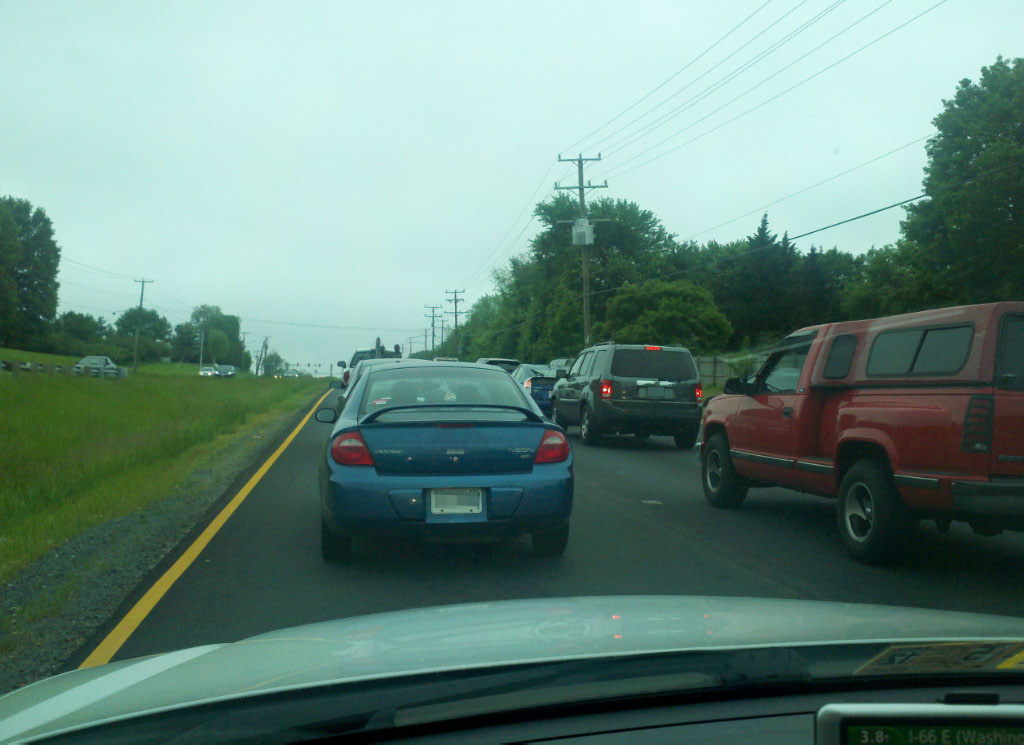
Saturday Traffic

Saturday Traffic in NoVA

It wasn’t that long ago that traffic in the Northern Virginia suburbs of Washington, DC, followed a pretty standard pattern. On weekday mornings, the backups headed toward the city. On weekday afternoons, they headed out of the city. On weekends, there wasn’t much traffic at all.

Not anymore.

Natural changes to the region’s character—namely, that many of us now live in one suburb and work in another—have largely eliminated the directional pattern. It is almost as common to find backups heading in the opposite direction they used to, or miring-up roads that don’t even head in or out of the city anyway. Once-innovative ideas like the shoulder-lane on Interstate 66, which were designed to give the ‘rush hour’ side an extra lane, now only serve to create artificial backups heading in the opposite direction where they have one less lane than they ought to.

In addition, decades of neglect and under-funding for the DC metro area’s transportation infrastructure have made it so, in some places, it is rush hour almost all the time. This photo was taken on U.S. Route 50 (Lee Jackson Memorial Highway) near Greenbriar this last Saturday. Saturday! Each year, this becomes more the norm. Our road network is now borderline insufficient for Saturday traffic, and it is so grossly insufficient for rush hour traffic that it would be comical if it didn’t have such astronomically high costs in fuel, pollution, productivity, and quality of life.

“Take mass transit,” I hear some of you say. Well, many of us would . . . if it were a viable option. As it is, there is no mass transit available at all where I live, and my office is only accessible by the Fairfax Connector bus system (which Fairfax County established after MetroBus failed to expand service into new suburbs). The MetroRail system was designed for the bygone paradigm of “work in the city, live in the suburbs,” and, as such, is useless for the vast majority of the area’s residents. We need a ‘spiderweb’ system layout, not a ‘hub and spoke’ layout, and the Washington Metropolitan Area Transit Authority (WMATA) has done basically nothing to expand its Metro bus and rail systems to meet our current needs. It is no wonder that their ridership, which has trended gently upwards, has increased at a mere fraction of the rate of the overall population increase.

I posit no solutions in this brief piece. I’m not even sure there is a solution anymore, short of a mind-boggling influx in money from the various levels of government involved—governments that cannot afford such an investment now anyway. It would cost billions upon billions upon billions of dollars to get our road and mass transit infrastructure caught-up to where they ought to be today, let alone get them ready for the future. As for big, notable projects like the I-95/395/495 mixing bowl, Wilson Bridge, and MetroRail to Dulles Airport? They are all far too little, and more than a quarter-century too late.

Descendant of William Bradford

After a ton of research, my father has confirmed an old family legend: we are descended from William Bradford, the long-time governor of the Plymouth colony. Bradford was one of the many Puritan Pilgrims who came over on the Mayflower to escape religious persecution in England. He is credited as the first civil authority to formally recognize the Thanksgiving holiday. We all learned the story in elementary school ;-).

Here is how we are connected (all credit to my father, who did all of the research):

  • Governor William Bradford (b. 1590: Yorkshire, England) married Alice Carpenter (b. 1595: Somerset, England).
  • Their son Maj. William Bradford (b. 17 Jun 1624: Plymouth, Massachusetts) married Mary Wood (Atwood) (b. 1645).
  • Their son Ephraim Bradford (b. 1685: Plymouth, Massachusetts) married Elizabeth Brewster (b. 1690: Kingston, Massachusetts).
  • Their son Simeon Bradford (b. 28 Aug 1729: Kingston, Massachusetts) married Phoebe Whiton (b. 17 Mar 1736: Plympton, Massachusetts).
  • Their son Hosea Bradford (b. Jul 1773: Springfield, Vermont) married Hannah Wheeler Eastman (b. 7 Jan 1784: Bucksville, Ohio).
  • Their son Lester Bradford (b. 17 Jul 1809: Duns Pattent, Canada) married Elvira Thayer (b. 16 Mar 1816).
  • Their son Elbert Newton Bradford (b. 10 Aug 1835: Olmstead, Ohio) married Annie J. Dougherty (or Griswold) (b. Feb 1846: New York).
  • Their son Walter Ernest Bradford (b. 19 Aug 1879: Yoncalla, Oregon) married Myrtle Perry (b. 1880: Tyler, Washington).
  • Their son Norvin Ernest Bradford (b. 8 Oct 1903: Tacoma, Washington) married Verna Novella Houk (b. 26 Sep 1910: Woodworth, North Dakota).
  • Their son, Leslie Gene Bradford (b. 6 Jan 1932: Yoncalla, Oregon) married Betty Lou Coleman (b. 3 Oct 1932: Salem, Oregon).
  • Their son, Kenneth M. Bradford married Melinda.
  • Their son is me.

Pretty cool!

Bin Laden’s Death: Three Things

One week ago, President Barack Obama (D) announced to the world that al-Qaeda terrorist mastermind Osama bin Laden had been killed in Pakistan. In the time since, we have witnessed three disturbing things, each deserving of some discussion. Here’s what I have to say about each:

Jubilation Over Death

First, beginning immediately after the announcement, we witnessed widespread jubilation and celebration in Washington, DC, New York City, and elsewhere. Of course, almost a decade after the September 11, 2001, terrorist attacks, we have every right to be happy to see one of its perpetrators brought to justice. I would be lying if I didn’t admit to feeling the same way. Celebration when an avowed enemy is vanquished is understandable, especially when that enemy is responsible (directly or indirectly) for the death of thousands of innocent people. Having said that, there is something naturally off-putting about the veneration of somebody’s death. Somebody as evil as bin Laden is still a human being with inherent, God-given worth . . . even if they have chosen to squander that worth.

We must be cautious in our jubilation, and we must evaluate the motives behind it. We must be careful to celebrate the good (a terrorist brought to justice; a criminal who can no longer commit violent acts) without celebrating the evil (a violent, senseless death of a human being). We should not be any more pleased by bin Laden’s death than we would’ve been had he been captured alive. The joy should come from the fact that bin Laden can’t spread his murderous philosophy anymore, not from his death.

New York Trip Photos

As you may have seen on Melissa’s site, she was the showcase designer at Asia Store in New York City on Friday. We went up via Amtrak from Manassas, Virginia, on Thursday and then took a cab from NYC Penn Station to the hotel in Soho. We walked down to Chinatown for some shopping and then to neighboring Little Italy for some dinner. On Friday, we went to the event on the Upper East Side and, afterwards, went back to Soho for some Chinese food.

We came back yesterday (Saturday) again via Amtrak, grabbed some dinner at Cracker Barrel, then made a quick trip to Ikea before heading home. We didn’t do a lot of sightseeing on this trip, since we were really only up there for a day (not counting travel days) and were busy with the Asia Store event anyway. I still took some pictures :-). Enjoy!

Understanding Sainthood

While somewhat overshadowed by the royal wedding in Britain (may God bless the happy couple!), there has been some media attention directed toward the beatification of Blessed Pope John Paul II. Unfortunately, as is often the case, the media reporting on this event has been riddled with inaccuracies and half-truths about the Catholic process of canonization and the theology behind sainthood. If you are interested in understanding sainthood, pay no attention whatsoever to what you have seen and read in the secular media.

First and foremost, almost every article refers in one way or another to the Catholic Church ‘making’ people Saints. Let us be perfectly clear on this: the Saints are Saints on their own merits and by the grace of God. The Catholic Church doesn’t make anybody a Saint; the Church simply recognizes certain Saints through the canonization process as being worthy of veneration by the faithful.

So what is a Saint? Put simply, Saints are people who have died and gone to Heaven. While the universal Church has recognized many thousands of people as Saints through canonization, there are likely many billions of other Saints who have not been recognized as such. We don’t ‘make’ anybody a Saint and, on the contrary, we know that there are countless Saints that haven’t been recognized as such by the Church. Sainthood doesn’t flow from the Church an Earth, but from God in Heaven. I wish that some of the reporters writing about these matters would take a five minutes off from studying Kate Middleton’s dress to read the first three paragraphs on the Catholic understanding of Sainthood at Wikipedia and report accordingly.

Of course, I don’t expect secular media outlets to endorse our theology on this—a theology that, despite its provenience in the very earliest days of Christianity, has since been rejected even by many Christians—but they could at least add a brief explanation of what we believe is happening. I seem to remember learning in Journalism 101 that accuracy and completeness were important parts of reporting. Shame. Read on for the truth about the history of the veneration of the Saints, and the process by which people are canonized today.

Scott Bradford is a writer and technologist who has been putting his opinions online since 1995. He believes in three inviolable human rights: life, liberty, and property. He is a Catholic Christian who worships the trinitarian God described in the Nicene Creed. Scott is a husband, nerd, pet lover, and AMC/Jeep enthusiast with a B.S. degree in public administration from George Mason University.