

House: Building Has Started!

house-framingI swung by the house we are buying yesterday and, surprise, they’ve started building it! There’s wood framing for the lower two floors already in-place. Presumably the third floor will follow later ;-).

Pretty much all of the [annoying, repetitious] paperwork [of questionable value] is done, except for a couple stragglers related to the financing which we hope to [finally] tie up very soon. Then it’s clear-sailing until closing in October or November, where I am told that they will present us with more paperwork than any single human being could possibly process and understand in a lifetime.

Go figure.

Anyway, it’s got its annoying aspects, but the whole process is still very exciting. I’ll be glad when it’s done though ;-).
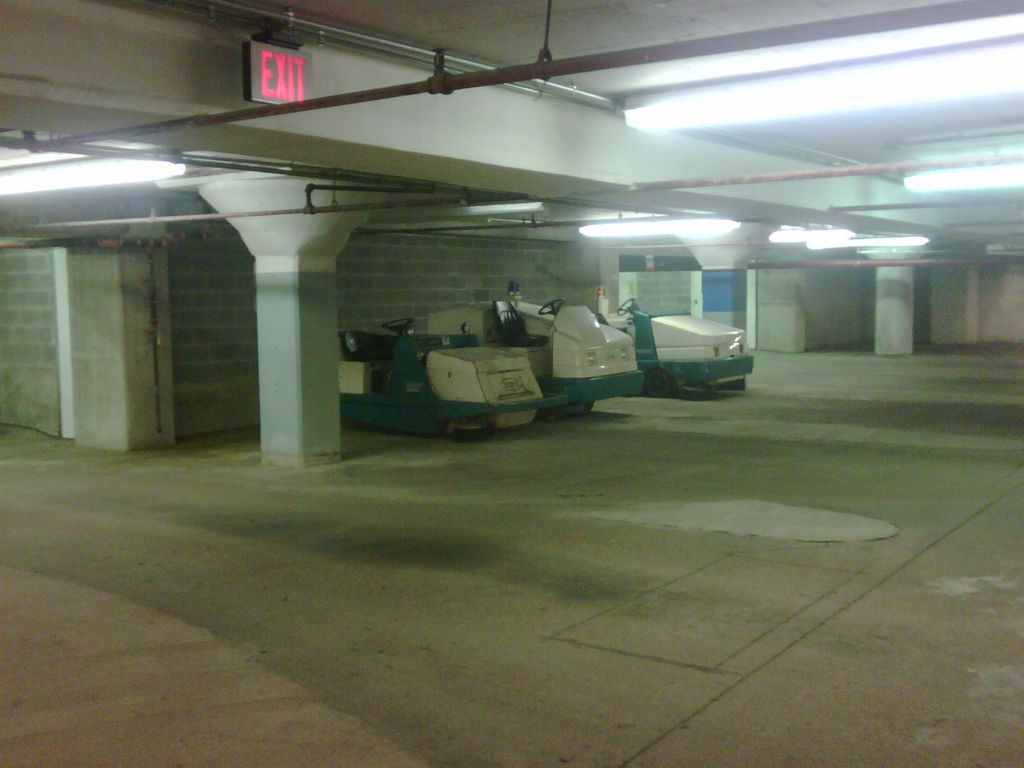

Parking Garage Zambonis

parking-zambonisThe Kennedy Center in Washington, DC, is a great venue for plays, concerts, and so on. It also has a nice parking garage right underneath, which is very convenient (considering that the Center is not really close to any Metro station, and Metro isn’t exactly worth the gamble right now anyway) . . . although, like most parking in Washington, it’s exorbitantly over-priced.

Regardless, in the Kennedy Center garage last week we spied these Parking Garage Zambonis. Of course, they aren’t really Zambonis—they’re some sort of garage cleaning rig—but for an ice hockey fan like myself the resemblance was obvious.

I find these kinds of things very funny. Maybe I’m weird.

The MetroRail System Is Not Safe

The Washington Metropolitan Area Transit Authority (WMATA) and their wayward MetroRail system just keeps looking worse and worse. In the aftermath of last month’s fatal rail collision, we keep learning all kinds of new and frightening facts. We learned that the track circuits are the only sources of information for MetroRail’s primary control system and ‘fail-safe’ backup . . . any first-year engineering student can tell you that having lives riding on ‘redundant’ systems that share a single point of failure is inexcusable. We learned that MetroRail had simply ignored the safety recommendations made by the National Transportation Safety Board (NTSB) after previous (thankfully non-fatal) collisions. We learned that the ‘flickering’ on the track circuit where the collision happened went on, either un-detected or ignored, for days before the accident on that section of track.

Following the incident, and continuing up until some time last week, WMATA/MetroRail officials insisted that all circuits in the system had been inspected since the accident and they were all operating properly except for the one where the collision happened. According to The Washington Post, these officials are either lying or have been misinformed by their staff (either way, inexcusable). Similar problems have been found in at least six—and possibly thirteen or more—of the critical track circuits throughout the MetroRail system. All indications are that Metro has a systemic problem on their hands, not an isolated incident. All those first-year engineering students could have seen this coming, of course, since complex ‘fail-safe’ systems built with single points of failure always fail sooner or later.

The NTSB already recommended that Metro put a backup train detection system in-place, and Metro has already claimed that nobody in the world has such a backup system. The problem is, um, many transit rail systems do have fail-safe backups. The BART system in San Francisco has many similarities with MetroRail since they were built around the same time with many of the same components and suppliers. The BART folks ran into a similar circuit flickering problem in the ’70s, and developed and implemented a fail-safe system then. It’s been working well for BART for about thirty years, so it’s a bit perplexing to hear Metro tell us no such system exists.

Enough. WMATA cannot continue to try and save face by lying to its customers and the taxpayers who fund its operations. Most importantly, MetroRail can’t continue to play games with the lives of its riders. They already have blood on their hands, as far as I’m concerned.

C&O Canal Wildlife

As I mentioned a couple days ago, I did a nice long bike ride on Saturday. This was my first ride on the C&O Canal Towpath since a ride with the Boy Scouts in my youth. The trail starts at mile-zero in Georgetown (a neighborhood in Washington, DC) and runs for a whopping 184.5 miles up the Potomac River along side an old canal. I didn’t ride the whole length, obviously, but rode out just a bit past mile 20 and back. It’s an unpaved trail, but it’s in very good shape and it’s a relatively easy ride. That’s why I was able to do 40 miles when my mountain bike rides are usually much shorter.

Anyway, the trail has some great views that I didn’t bother to get pictures of, especially around Great Falls (although there were way too many oblivious walkers blocking up the trail through there). I did, however, get some pictures of the wildlife. I’m a sucker for animals, I guess.

Oops: Climate Policies Making Things Worse

When I saw the article in my RSS feed reader, I thought it was a joke from The Onion. No, it was from The Washington Post.

Before CO2 (Carbon Dioxide) became Al Gore’s environmental boogy-chemical, the environmental exaggeration artists were focused on chlorofluorocarbons (CFCs). These chemicals were blamed for creating holes in the ozone layer. If you’re about my age (mid-to-late twenties) you probably heard a whole lot about this in elementary school. CFCs were emitted into the atmosphere by air conditioners, refrigerators, and all kinds of spray cans for hair spray, inhalers, etc. In 1987, the governments of the world signed the ‘Montreal Protocol’ and began to stringently limit CFCs.

Scientists developed an alternative called hydrofluorocarbons (HFCs), which have since become the norm for the aforementioned air conditioners, refrigerators, and spray cans, and CFCs have essentially been eliminated. But, guess what! HFCs are a greenhouse gas, and now we’re finding out that they are 4,400 times worse than CO2. Congratulations, HFCs: you saved our ozone layer, but now you will turn the Earth into a boiling hot mass of molten magma.

Or, perhaps you won’t do much of anything. After all, the science behind CO2 being responsible for global warming (or ‘climate change’, which is the new, vaguer term) is shaky-at-best. That’s a rant for another day.

Scott Bradford is a writer and technologist who has been putting his opinions online since 1995. He believes in three inviolable human rights: life, liberty, and property. He is a Catholic Christian who worships the trinitarian God described in the Nicene Creed. Scott is a husband, nerd, pet lover, and AMC/Jeep enthusiast with a B.S. degree in public administration from George Mason University.