Face 2 Face: Elton John & Billy Joel

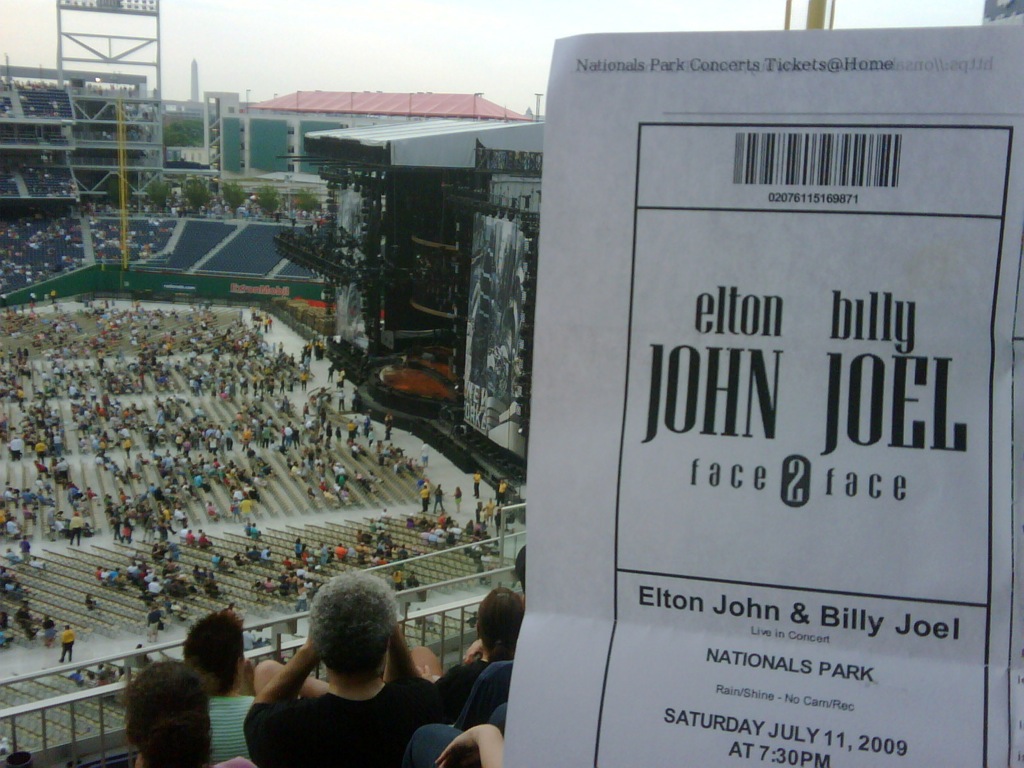
bjej-ticketMelissa and I had a great time last night at Elton John and Billy Joel’s ‘Face 2 Face’ concert at Nationals Park in Washington, DC. As you would expect, the two guys put on a great show. I had seen Billy Joel before (twice, in fact), but this was my first time seeing Elton John.

The show starts with the two performing several songs together on facing grand pianos. It was a little bizarre to hear Billy Joel singing a verse of ‘Your Song’ and Elton John singing a verse of ‘Just the Way You Are’, but it works somehow.

On the third or fourth song, Elton John stopped abruptly during the instrumental introduction because his sustain pedal was stuck, making all his notes run together. Some roadies come out and messed with it but couldn’t fix it, then Billy Joel came over and started messing with it too, but also couldn’t fix it. After a few minutes Elton left the stage (looking a bit upset). Billy goofed off for a minute or two playing snippets of random songs, and then after a few minutes launched into his solo set. Elton’s piano dropped back beneath the stage, presumably to be repaired or swapped.

In typical Billy Joel style, he called it a ‘true rock and roll f***-up.’

Enough Michael Jackson Already

I know, I know . . . Michael Jackson was an influential, talented man. I get it. He wasn’t exactly my favorite musician, but I liked him enough to have his Greatest Hits album in my collection and to have Billie Jean in my head for a solid week following his death. Despite the fact that his recent albums were mediocre-at-best, and his somewhat bizarre personal life, I was just as saddened by his death as any other rational person.

But the wall-to-wall media coverage, weeping fans, golden caskets, stadium-concert-funerals, and so on are a bit much.

If that wasn’t enough, look at the media grasping at straws today. At the moment, CNN’s web site has stories about whether the Jackson death probe will become a criminal matter, whether Jackson will be buried at Neverland Ranch, a supposed ‘intervention’ staged by the Jackson family years ago, and a doctor who had supposedly tried to fix Jackson’s nose. In addition, a poll inquires about where CNN.com readers think Jackson should be buried. After all, CNN.com readers should make that decision, don’t you think? No need to involve the family; Jackson is apparently CNN property now.

Meanwhile, the bankrupt City of Los Angeles—after spending millions of dollars on the Jackson funeral—has now decided that it shouldn’t have to pay for anything and is trying to recoup the money from Jackson fans and the bankrupt AIG insurance company that put on the show. Memo to Los Angeles: If you don’t want to pay for something, don’t pay for it.

Enough already.

Goodbye, CompuServe

It was only a couple of months ago that I said a fond farewell to Microsoft Encarta, and today I do the same for CompuServe. After more than thirty years, the CompuServe Information Service (CIS) was shut down by its parent, America OnLine (AOL), on July 1.

My family had CompuServe back in the early 1990s, initially on an MS-DOS machine and later on Windows. It was rudimentary by modern standards, but at the time it was pretty awesome (and it had already been around quite a while before my family joined up). CompuServe generally attracted a more knowledgeable crowd than AOL or Prodigy—it was less flashy, but seemed more powerful and professional than its ad-laden brethren. I remember how cool it was to be able to bring up weather maps on-demand, send emails, etc., even if those things took forever on our super-fast 9600 baud modem, and even if we were charged by the hour for them.

Of course, times changed. By 1996 the Internet was starting to take off, and proprietary networks like CompuServe struggled to stay relevant. Soon, CompuServe, AOL, and Prodigy were all offering access to the Internet in addition to their proprietary networks. Within a few years, techies had switched to cheaper Internet-only plans with services like Earthlink and Mindspring, while non-techies had largely gathered at AOL.

Prodigy shut down its proprietary network and became an Internet-only service in 1999 before being bought-out by SBC, which later became AT&T. CompuServe was bought by WorldCom in 1998, which immediately re-sold its CIS system and customers to younger competitor AOL (while retaining CompuServe’s network services division). Hemorrhaging members, CIS—against all odds—still operated until last week under the AOL umbrella separately of AOL’s own proprietary system.

Empowering the Federal Transit Administration

You may be surprised to learn that local transit systems are largely unregulated. When you fly, your aircraft is heavily regulated for safety by the Federal Aviation Administration (FAA). Your car is built according to detailed safety regulations put in place by the National Highway Traffic Safety Administration (NHTSA). Amtrak trains are similarly regulated for safety by the Federal Railroad Administration (FRA). These various agencies are charged with enacting rules that reduce the likelihood of accidents as much as possible, and for improving the chance of riders/drivers surviving accidents when they occur. As an example, NHTSA regulates lighting standards to ensure your car is sufficiently visible to other drivers, but it also requires the presence of seat belts, air bags, etc., to hopefully save your life in an accident (if you use them).

Local transit agencies like the D.C. area’s MetroRail, however, don’t have a true regulatory agency. There is a Federal Transit Administration (FTA), but it has been granted essentially no regulatory authority. They conduct safety audits and publish recommendations, but local transit systems are not compelled to follow those recommendations.

After an air crash, the National Transportation Safety Board (NTSB) investigates, discovers the reasons for the crash, and develops recommendations that will reduce or eliminate the possibility of the same thing happening again. Most of the time, the FAA enacts the NTSB’s recommendations and makes them requirements for airlines and aircraft manufacturers to follow in the future. This process has, most likely, saved thousands of lives and has made our air transportation system mind-bogglingly safe for passengers.

Former NTSB head Jim Hall wrote in today’s Washington Post about the recent deadly MetroRail crash and what might have prevented it. Metro bears primary responsibility, since they wantonly disregarded the recommendations of the NTSB and FTA after previous incidents. However, we need to empower the FTA with regulatory authority akin to that enjoyed by the FAA and NHTSA. If the FTA had the authority to require compliance with NTSB recommendations following the 2004 Metro crash, Metro would have been forced to comply and the incident last month probably wouldn’t have been quite so severe. But it goes further than that. An empowered FTA could have taken the track circuit ‘flickering’ experienced by San Francisco’s BART system in the 1970s and used that knowledge to develop more stringent redundancy requirements for track circuit systems. A truly redundant, properly engineered system would likely have prevented last month’s incident entirely.

Metro’s Epic Fail

I am absolutely disappointed in the Washington Metropolitan Area Transit Authority (WMATA, ‘Metro’). I’ve been disappointed in them before, and have criticized them before many times on this site, but their utter incompetence has now resulted in deaths. It’s long-past time for a complete re-do on the leadership of this transit system.

First, when I wrote about last week’s horrific MetroRail crash, I guessed that both the Automatic Train Control (ATC) system and it’s ‘fail-safe’ backup, Automatic Train Protection (ATP), used the same source of data to determine the location of other trains. My guess was, sadly, correct. The track circuit system that provides both ATC and ATP with information about the locations of nearby trains provides a single point of failure. Even those of us who aren’t transportation engineers can tell you that ATC and ATP should each rely on multiple, independent sources of data. A simultaneous failure of these two systems should be effectively impossible, but the system was under-engineered. There is no excuse for this.

Scott Bradford is a writer and technologist who has been putting his opinions online since 1995. He believes in three inviolable human rights: life, liberty, and property. He is a Catholic Christian who worships the trinitarian God described in the Nicene Creed. Scott is a husband, nerd, pet lover, and AMC/Jeep enthusiast with a B.S. degree in public administration from George Mason University.