Cat ON a Plaid Igloo

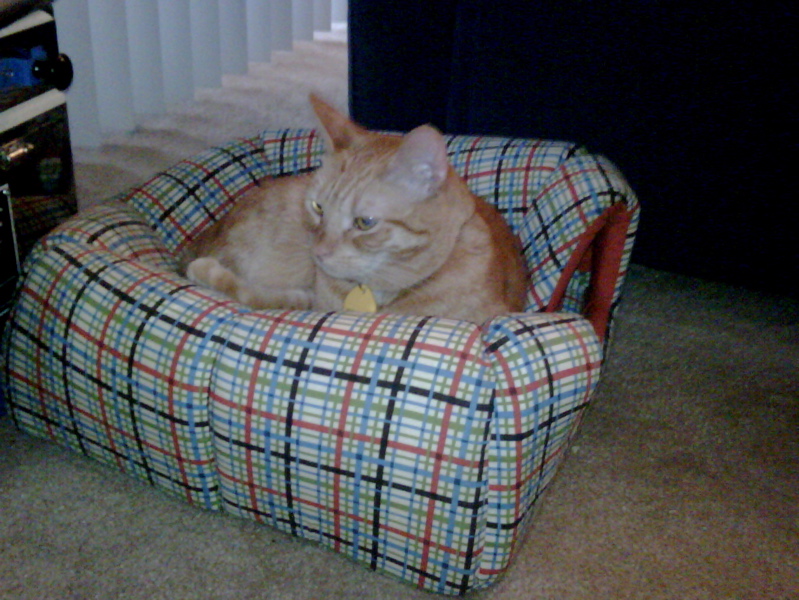
Cat ON a Plaid IglooBack in August, I posted a couple photos of our cat Mei Mei sitting in her new plaid igloo. A month later we somehow ended up with a second cat, and both of them trade off ‘ownership’ of the igloo (sometimes through violent coup-d’états).

But something curious happened along the way. They don’t like sitting IN the igloo anymore, they prefer to sit ON the igloo. At first I thought this was a fluke—it had gotten crushed in during one of their battles, and they couldn’t figure out how to open it up again and made-do on top. But no, it wasn’t that logical. I’ve opened it back up for them many times, and inevitably I come back an hour later to find one or the other of them sitting on top again.

Go figure.

Auto Bailout Good News/Bad News

Well, the bad news is that the ‘big three’ U.S. auto makers—Ford, General Motors (GM), and Chrysler—are being offered a $13.4 billion bailout by President George W. Bush (R). These loans would supposedly have to be paid back to the government, however I strongly suspect that will never happen since the companies liable to take this money (Chrysler and probably GM as well) are unlikely to survive until the due date of March 31. Congress never approved an auto bailout, so—in a real head-scratcher—Bush and his lackeys are taking this money out of the previously approved $700B financial bailout money. Apparently, once the Bush administration gets the money, they can do whatever they want with it regardless of what the bill approved by Congress actually said had to be done with it.

Using the $700B for what Congress approved it for would have been unconstitutional, but I’m not sure what Bush unilaterally deciding to use it for something else is. Do two unconstitutional acts make a constitutional one? Either way, I’m sure the founders are rolling in their graves over the last few months.

Regardless, there is a small silver lining. Congress already approved the waste of this money. The recipients might be new and unexpected, but there’s been no additional funds put toward socialist bailouts. In other words, we already knew this money was going to go to waste. I guess I don’t really care if it goes to waste on financial firms or auto firms, since they’re both equally undeserving. I’ve given up on trying to understand the constitutional basis for any of these bailouts, course changes, and outright lies perpetrated by Bush with the sign-off of a Democratic Congress. There isn’t any. They’re not even pretending to be bound by the Constitution’s limitations on government and separation of powers anymore.

I weep for the Republic.

Chrysler Closing All 30 Plants for One Month

Chrysler, the smallest of the three remaining U.S.-headquartered auto makers, has announced that they will be closing all 30 of their manufacturing plants for at least one month. I am particularly saddened by this and the other recent developments in the U.S. auto industry. I’ve owned one Chrysler product—a 1998 Chrysler Cirrus sedan—and it was a fine car. I bought it with about 22,000 miles on it, and drove it up into the mid-60,000 range. It had a few problems, but relatively minor ones given its age in years and miles. It was light-years ahead of my two preceding cars—both Mercury Sables (1988 and 1994) made by the Ford Motor Company. I also drove a 1978 Jeep J-10 ‘Honcho’ pickup, but it was made before Jeep (and its parent company, AMC) were purchased by Chrysler.

When I first started looking to replace our oldest car (an Oldsmobile Cutlass Ciera), based on a generally positive Chrysler experience, I looked at other Chrysler products. I looked at the Dodge Charger and the Stratus, and while they were each decent cars they were priced much higher than comparably equipped Honda Accords and Civics. Thus, the Hondas became our finalists and we eventually settled on the 2006 Civic (which Melissa still drives today). When we looked to replace our Chrysler with an SUV, I had been hoping to find a Jeep but their overpriced nature on the ‘used’ market (and questionable reliability) led us to the Ford-manufactured 2002 Mazda Tribute, which wasn’t bad, and then ultimately to our new 2008 Subaru Outback.

But I’ve had a Chrysler soft-spot for a long time. Their style and quality (for some models, anyway) during the late 1990s was great, and I was optimistic that the misrepresented ‘merger of equals’ that made DaimlerChrysler would make them even better. It didn’t. Despite a win with the Chrysler 300 and its brother the Dodge Charger, many of their other recent designs—particularly the horrible Chrysler Sebring—need a lot of work and they’ve diluted the Jeep brand with embarrassments like the Compass and the [salvageable] Patriot.

When Chrysler was brought back under American ownership as the new Chrysler LLC, I was again optimistic. A private owner—not beholden to shareholders or unions or, really, anybody but themselves—seemed like a wonderful opportunity for my favorite automotive underdog. But they missed every opportunity to break the abusive UAW contracts, and made small, incremental product changes but no major improvements. All-in-all, Chrysler LLC is failing (for no obvious reason) just like DaimlerChrysler and the previously-independent Chrysler did.

All that can save them now is Chapter 11, and even that isn’t a sure thing.

The Joys of Marriage: Virus Sharing

So the virus that Melissa caught from work last week has now set its sights on me. Thankfully, so far anyway, it hasn’t hit me too hard. I’m feeling pretty bad—sore throat, congestion, general bad feelings—but I’m still capable of functioning. I stayed home from work today, but mostly as a courtesy to my coworkers (I was, in fact, working from home most of the day). I have noticed no strong improvement or worsening through the day. I feel about the same right now (9pm) as I did when I woke up.

In Melissa’s case, this virus started weak and then hit hard. I’m hoping that an overdose of vitamin C and green tea (with a healthy addition of Nyquil—I need my beauty sleep) will hold it at bay in my case.

Of course, like usual, illness strikes at the most inconvenient time possible. There’s a lot to do as we approach Christmas, and a lot of last-minute things to get out of the way at work before everybody goes on vacation. Go figure.

I can’t really complain too much though. Last time Melissa was sick, I managed to slide through without catching it. I guess I was overdue ;-).

Share to:

Send to:

Made In America

I was chatting with Melissa this weekend and made an off-hand comment that I was a bit disappointed that a product I was considering buying at some point was was actually made overseas by a foreign company and imported/re-branded as an American product. Melissa, probably annoyed at me bothering her while she is suffering from the flu, asked me if I would decide what product to buy simply on country of origin. This led to a discussion of what constitutes an ‘American’ product and how to weigh country of origin vs. other factors in making a purchase decision.

I am patriotic, and all-else-being-equal I prefer to support my own country’s economy and people by buying American. Having said that, I am a big proponent of unfettered free trade between nations and won’t hesitate to buy a foreign product if it is a better product for a fair price. I am also cognizant of the fact that the lines have become very blurry about what constitutes ‘American’ any more. Apple Computer is based in California, but is a MacBook Pro manufactured in Shanghai, China really ‘American’? Chrysler is based in Michigan, but is an automobile assembled in Mexico ‘American’? How about Japan-based Honda making a car in Ohio out of, primarily, American-sourced parts? Is that an American car?

This madness occurs in almost every industry these days. Walther, a German firearms company, licenses many of their designs to Massachusetts-based Smith & Wesson. Smith & Wesson provides many of the parts and performs assembly of these weapons independently of Walther, but sells them in the U.S. market branded as Walthers. On the other hand, Springfield Armory of Illinois imports pistols designed and manufactured by HS Produkt in Croatia, slaps their own logo on them, and calls them the Springfield Armory XD line. In some respects, the foreign-branded Walthers are more ‘American’ than the U.S.-branded XDs.

Scott Bradford is a writer and technologist who has been putting his opinions online since 1995. He believes in three inviolable human rights: life, liberty, and property. He is a Catholic Christian who worships the trinitarian God described in the Nicene Creed. Scott is a husband, nerd, pet lover, and AMC/Jeep enthusiast with a B.S. degree in public administration from George Mason University.