First Shots With the M&P 9

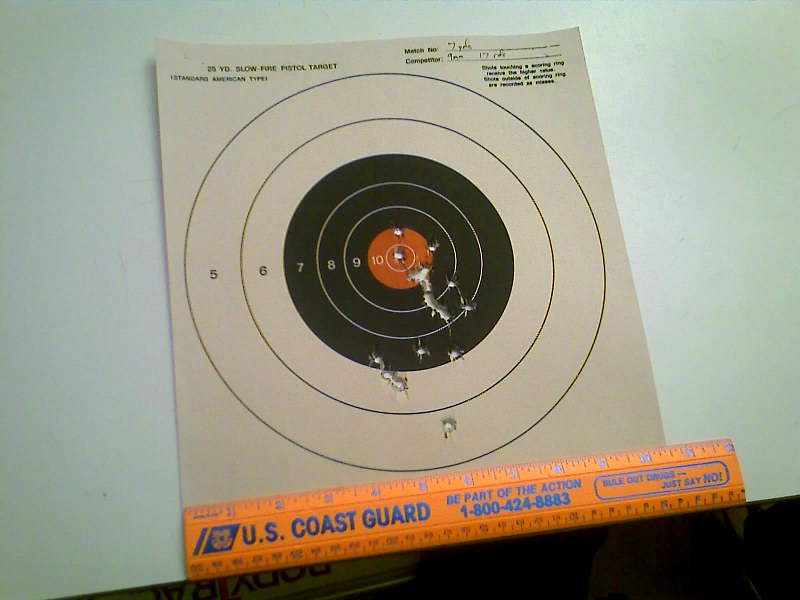
I mentioned just over a week ago that my birthday present this year was a Smith & Wesson M&P 9 semi-automatic handgun. Well, I finally got out to the range today to give it a try (almost a week later than I had originally planned; too much going on lately).

The gun shoots very well; quite similar in recoil to our revolver when we are shooting .38 Special rounds (as opposed to the more powerful .357 Magnum rounds). My accuracy is roughly comparable to my accuracy with the revolver. Of course, I’ll continue practicing and improving . . . but as you can see, firing 17 rounds from a distance of seven yards, I didn’t do too bad. All rounds landed well within the target circle (roughly 10″).

I’m still new at this though, so there’s definitely room for improvement!

Election Coverage Plans

In-keeping with past years, Off on a Tangent will be providing live election coverage on November 4 starting at 7pm EST. Coverage will include live results for all races in which I have made endorsements, as well as a running list of relevant local and national news. Off on a Tangent results will be based primarily on actual returns as-published by government agencies and media exit-polling and projections. This ‘raw data’ will be combined with independent analysis in making any projections.

Coverage will continue with constant updates from 7pm until all covered races have projected winners or 1am, whichever comes first. In the event that any races remain un-called at 1am, I will resume updates on the morning of November 5 as time permits.

While I have my biases, I always strive to make my live coverage as accurate and reliable as possible. I will err on the side of caution at all times without regard for party affiliations or my personal political preferences, but—at the same time—I won’t hesitate to make a projection when a winner is clear. Per site policy, candidates will be listed alphabetically by last name.

Stay tuned!

Your Responsibility as a U.S. Citizen

I know what you’re thinking: I’m going to tell you it’s your responsibility as a U.S. citizen to vote. It is, but that’s not the focus of my comments to you today. No, today I am going to ask you to vote smartly.

I don’t mean to vote for McCain, though that is who I am voting for. I’m asking you to spend some time researching the candidates and what they stand for. Read my endorsements, read other endorsements, read the candidate’s web sites, talk (non-judgmentally) to your friends and family, and come to an honest conclusion based on what candidate most-closely represents your beliefs and values. This is not about who’s the better speaker, or who’s the ‘cool’ candidate, who has the better zingers, or who has the most clever advertisements. This is about who will lead this country for the next four years.

The key is not to buy into meaningless hype. Don’t vote for Obama because he’s the candidate of ‘change’. Don’t vote for McCain because he was a P.O.W. in the Vietnam war. Don’t vote for Obama because he’s an excellent speaker. Don’t vote for McCain because he’s experienced. Don’t vote for Obama because he ‘stands for the middle class’. Don’t vote for McCain because he ‘stands against the redistribution of wealth’.

These are the catch-phrases that will get thrown around by the campaigns, but they are just that: catch phrases. There are snippets of truth in each of them, but they are not sufficient for making a decision. Each candidate has ideas for this country and for what his presidency will mean. It’s easy to vilify McCain and Palin as radical neoconservatives, or to vilify Obama and Biden as socialist re-distributors. It’s easy to vilify McCain and Palin as pandering to the religious right, or to vilify Obama and Biden as pandering to secularist society. If these half-truths, or mere party affiliation, are what you use to make your decision, then do me a favor: stay home on Tuesday.

It is your responsibility as an American to honestly research each candidate, without preconceived notions of political parties or individual ideology, and make an honest decision based on your beliefs. It is your responsibility not to buy into hype and catch-phrases on either side, or to blindly vote a party line—whether that party line be Republican or Democratic. This is my solemn request of you this election season.

And, after you do that, it is also your responsibility to respect that I have done the same thing, and have come to my own conclusions, and they might not agree with yours. It doesn’t make me a traitor or a bad person any more than your decisions make you a traitor or a bad person, and I am just as entitled to support the candidates I support as you are.

Is Microsoft Getting It?

I’ve spoken before about my disdain for Microsoft’s flagship operating system, Windows 6.0 (Vista), before. Vista took nearly six years to develop, and the only things it really added over its Windows 5.1 (XP) predecessor were some eye candy and things that annoy the users—you know, things like the constant UAC prompt, bugs, and incompatibilities. Most of the groundbreaking promised features, like the WinFS file system and such (the things that get nerds happy) were scrapped from the system entirely. Apparently six years isn’t long enough to produce a compelling update from either the technical or usability standpoint.

Real-world Windows 6.0 (Vista) experiences are a mixed bag. Roughly 50 percent of people I know that run Vista daily are happy with it and have had minimal problems. The remaining 50 percent, however, have had problems worse than any previous version of Windows had ever given them. Some of those people worked through these problems, installing service packs and engaging in earnest troubleshooting, and finally became happy Vista users. Most, however, upgraded back to Windows 5.1 (XP), switched to Mac, or switched to Ubuntu Linux happily.

Has Microsoft learned from their mistakes? It looks like they might have. The next version of Windows, which will return to the venerable tradition of logical naming, might actually be a compelling and worthwhile update called Windows 7. (Of course, for reasons I don’t understand, Windows 7 will be code-versioned as 6.1—come on Microsoft, you’re so close to fixing the versioning/naming insanity that you started with Windows 95, just go all the way and make it Windows 7 everywhere!)

What will Windows 7 offer? Well, the promise is that it will be less annoying (fewer UAC prompts), more stable, usable on a wider variety of hardware (even underpowered ‘netbooks’), and incorporate many usability features that Apple and various Linux implementations have had for years. In light of Microsoft’s propensity to over-promise and under-deliver, I’ll believe it when I see it. But the screenshots sure look great, and I’m cautiously optimistic that the giant from Redmond has finally awoken.

Does this mean that I might be switching back to Windows? Don’t bet on it. But it benefits everybody when the competition heats up, so improvements in Windows will drive improvements on all other platforms as well.

Two Sinking Ships Want a Bailout to Rescue One Another

Like I said a couple weeks ago, two sinking ships cannot rescue one another. The proverbial sinking ships, General Motors (GM) and Chrysler, seem to have finally come to this conclusion in the course of their earnest and horribly misguided merger talks. The problem is that, instead of quietly sulking away into Chapter 11 bankruptcy for one or both automakers, they now want to enlist Mommy Government’s help (and thus, your help) in sealing the deal. That’s right, GM and Cerberus Capital Management (Chrysler’s owner) want the United States government to hand them 10 billion dollars so that they can merge.

I am absolutely aghast.

What would the government and—by extension—you and I get in return? Well, 3 billion dollars of that money would buy a chunk of GM/Chrysler’s ‘equity’. Of course, when the combined firm goes under anyway because of the UAW, mismanagement, and other problems that ‘equity’ will be worthless. Another 3 billion dollars would go to taking over GM and Chrysler pension obligations, and the rest would apparently just be free money. This is not a gamble investors will take, so why should the government take it?

Not to mention that it was only a month ago that the U.S. government gave these same automakers 25 billion dollars in loan guarantees—for a running total of 35 billion dollars that you and I are on the hook for if the American auto industry bankrupts itself. Anybody else feel a bit ill?

Update: Hours after I wrote this, I came upon an opinion piece by Steven Pearlstein in the Washington Post who says the same thing, but with a well thought-out alternative solution. Kudos to Pearlstein; I sure hope GM, Chrysler, and Congress are listening.

Update 11/3/2008: The International Herald Tribune reports that the Bush Administration will not be negotiating this new 10 billion dollar bailout with GM. Finally, the government makes a smart economic decision.

Scott Bradford is a writer and technologist who has been putting his opinions online since 1995. He believes in three inviolable human rights: life, liberty, and property. He is a Catholic Christian who worships the trinitarian God described in the Nicene Creed. Scott is a husband, nerd, pet lover, and AMC/Jeep enthusiast with a B.S. degree in public administration from George Mason University.