

Expanding Usage of the V-Chip

Driving home from work yesterday, I ended up behind a truck with a large, bright, orange label attached to the back stating “THIS TRAILER MONITORED BY V CHIP TECHNOLOGY.” This struck me as odd, since the V-Chip is the name of the parental control technology included by law in all televisions manufactured since 2000. The V-Chip, which was introduced along side all those stupid TV ratings (e.g., TV-MA), allows parents to censor what their children see—you know, since the best way to prepare children for the harsh realities of life is to shelter them from those realities.

Regardless, the federally-mandated V-Chip included in every TV since 2000 is rarely used, since most parents don’t know it exists and those who do either don’t understand how to use it or don’t want to. Perhaps, in an effort to put all that tax money to better use, the federal government is going to be mandating that V-Chips be added to trucks. The chip will prevent those trucks from driving down any highways that include offensive billboards or suggestive lane markings, filter bad language from the CB radio, and prevent drivers from listening to Paul McCartney or looking at Janet Jackson’s nipple.

Symbian (Mobile) Support Added

My U.S. readers have probably never heard of Symbian, which is a smartphone operating system that dominates the mobile phone market pretty much everywhere but here. With today’s news that Nokia has purchased the remaining 52 percent of Symbian it didn’t already own (with the stated intent of making the OS an open-source product), I figured it was about time to give Symbian users some love.

With some minor adjustments, I am initiating official Off on a Tangent support for Symbian mobile phones today—whether they use the S60 or UIQ interface systems. The WebKit-based S60 browser has full ‘hi-fi’ support (see ‘zoomed’ image at right), while the Opera Mobile-based UIQ browser currently has only ‘low-fi’ support. I am expecting to move UIQ support up to ‘hi-fi’ after Opera Mobile 9.5 rolls out. Symbian joins Windows Mobile, Palm OS, Blackberry, Apple iPhone, and the Android betas as supported and tested mobile platforms that work well with this site.

As an aside, I’m very excited about the direction of the smartphone industry lately. Apple’s iPhone seems to have kicked the other companies in the butt, and we’re just now starting to see some real improvement and innovation in a field that—frankly—completely sucked only a year or two ago. Soon we’ll have at least two solid, open source smartphone operating systems (Symbian and various flavors of Linux) competing with Apple and Microsoft for your handsets, and that’s very good for us consumers!

Study: 70mph [Is As] Safe As 65

I have long contended that most speed limits, at least in my home state of Virginia, are set too low (which is part of why I oppose speed cameras). I’m a big believer in laws and other government regulations saying what they mean and meaning what they say. Speed limits are supposed to be the absolute maximum speed at which a car can travel safely on a road (even if individual vehicles or current conditions require slower travel in some cases). States should set the limits at the maximum safe value (on an open, rural freeway that’s in the area of 75 or 80 miles-per-hour) and then ticket people for breaking that limit by even 1 miles-per-hour. None of this 5-10 miles-per-hour ‘buffer zone’ junk.

One of the fastest rejoinders of the slowpokes is that higher speed limits result in more, and more severe, accidents. I have never felt right about that claim, and more and more studies are starting to show I’m right (though, admittedly, a fair number of studies show the opposite). At minimum, the evidence is very weak for a direct correlation between speed limits and accident volume or severity—and even if there is a correlation, it would likely be mitigated or eliminated if we were more cautious about who we issued driver’s licenses to (e.g., requiring demonstration of solid driving skill before giving license to drive).

In reality, most drivers drive at a reasonably safe speed. Only 10 or 20 percent of drivers, in my humble opinion, drive dangerously fast, and it turns out that many traffic engineers agree! The general rule in-practice (on paper) in the U.S. is that speed limits are to be set at the 85th percentile—meaning the departments of transportation should measure the speed of drivers on the road and set the speed limit high enough that only 15 percent of them would be breaking it. Speed limits in the U.S., however, average about 8-12 miles-per-hour lower than the appropriate 85th percentile speed. Either the DOTs in this country have really, really bad math skills, or they’re not really using the 85th percentile rule.

Late for Billy Joel (Updated w/ Photos)

Great concert . . . but we were late. No fault of our own though, since we left Richmond headed for Virginia Beach with plenty of time to spare (more than 1.5 hours earlier than should have been necessary).

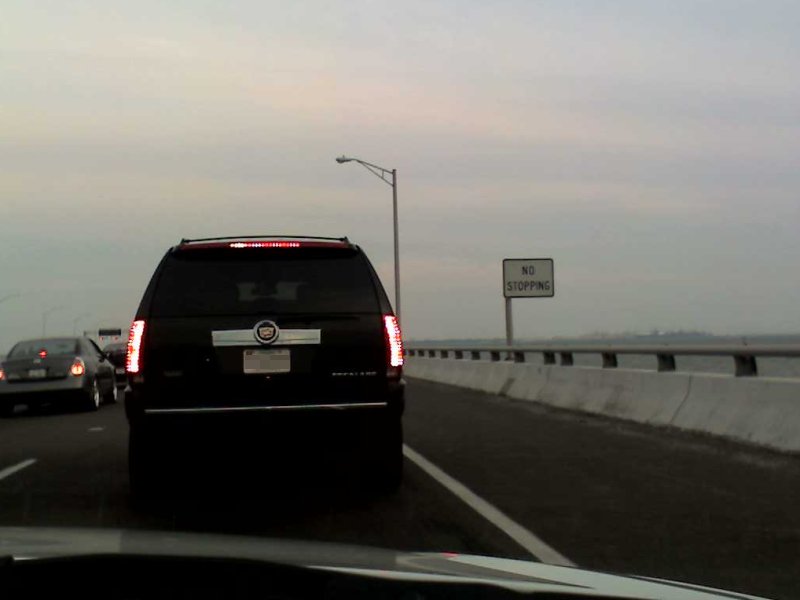
First, we got caught in a brutal thunderstorm—hail and everything. That slowed us down, but not enough to make us late. Then, passing through Hampton, we approached the bridge-tunnel and traffic stopped. Not just slowed, but stopped (see the photo Melissa took of us dead-stop next to a sign that says, what else, “No Stopping”). We inched ahead a few feet at a time for well over an hour, eventually seeing a sign that helpfully informed us that a disabled car was in the tunnel and thus (inexplicably) the tunnel was closed. Way to operate a tunnel, guys. I don’t know whether to blame Virginia Beach for this idiocy or VDOT and the state legislature for their perennial failure to fund transportation.

We finally got through and parked past 8:30 for a show that started at 8:00 (and without getting our planned dinner) and took a small spot on the grass at the venue nearer to 9:00 after the long hike from the lot. The remainder of the show was great, despite fairly poor (last-choice) seats, but I’m pretty mad we missed almost half of it. Oh well. Virginia Beach will not likely be a place we travel to in the future for concerts, since their roads seem to be pretty unreliable. At the right you’ll see grainy, low-quality pictures (the second of which is artificially enhanced to make it show . . . anything) of Billy Joel on a big screen and a wacky crowd of people.

What are your experiences (if any) with Virginia Beach area roads? Should I give them another chance?

Scientists: Water Ice Found on Mars

While minor glitches continue to effect the mission of the Phoenix Mars Mission, there’s some fairly big news from the Red Planet today. A small trench dug by the lander four days ago exposed some small, white clumps of something—possibly just salt, but possibly frozen water. Looking again at the trench today, scientists discovered that the chunks had disappeared. Scientists believe that the chunks sublimated, which is basically when something evaporates directly from a solid into a gas (without passing through a liquid phase). Apparently salt doesn’t do this, but water does.

NASA and the University of Arizona have released a press release (and associated images) claiming, essentially, that water ice exists on Mars. I’d be willing to bet they’re right, but I’ll wait for direct evidence rather than an indirectly-observed sublimation before I buy into it 100 percent. Scientists shouldn’t be jumping to conclusions . . . the disappearance of the white material could be sublimation, but then again it could be something else (in four days, I’m sure some white, non-water substances could melt into a liquid and be reabsorbed into the soil, for example). You can’t conclude that the material is water ice unless a) its sublimation was directly observed or b) you test it directly.

I’m sure one of those is on the scientists’ to-do list, along with checking out that flagpole I mentioned the other week.

Update 7/31/2008: The findings have been confirmed; there is water on Mars.

Scott Bradford is a writer and technologist who has been putting his opinions online since 1995. He believes in three inviolable human rights: life, liberty, and property. He is a Catholic Christian who worships the trinitarian God described in the Nicene Creed. Scott is a husband, nerd, pet lover, and AMC/Jeep enthusiast with a B.S. degree in public administration from George Mason University.