United Methodist Church Upholds Status Quo on Homosexuality

At General Conference, the body that meets every four years to make the official policy decisions of the United Methodist Church, delegates voted yesterday to uphold the status quo with regard to homosexuality. The UMC Book of Discipline describes homosexual activity as being “incompatible with Christian teaching” and prohibits the ordination of “avowed”, practicing homosexuals as pastors, but also condemns violence and discrimination against homosexual people. This dichotomy is in-keeping with scripture and will remain the law of the church at least for the next four years (likely delaying the UMC following in the U.S. Episcopal Church’s footsteps).

But the news is not all good for those of us who fear that Christianity is losing its moral compass. No fewer than 417 of the 918 delegates who voted—a whopping 45 percent—supported replacing the clear, accurate “incompatible with Christian teaching” text with language that would make no moral statement whatsoever on behalf of the church: “Faithful, thoughtful people who have grappled with this issue deeply disagree with one another; yet all seek a faithful witness.”  . . . What?

This, my friends, is the definition of moral relativism. “Do whatever you want to do; agree to disagree; the Bible (Leviticus 18:19-30, Romans 1:18-32, 1 Corinthians 6:9-10) and millenia of Judeo-Christian traditions be damned!” While I accept this attitude (and even sometimes endorse it) when we talk about government, it is unacceptable in a moral religious community. It is the church’s job to make moral judgments, not to avoid doing so. I must now question, as any faithful member of the United Methodist Church must, whether I wish to remain part of a denomination where the relativists are a mere 5 percent shift away from running the show.

Seeing the Old Car

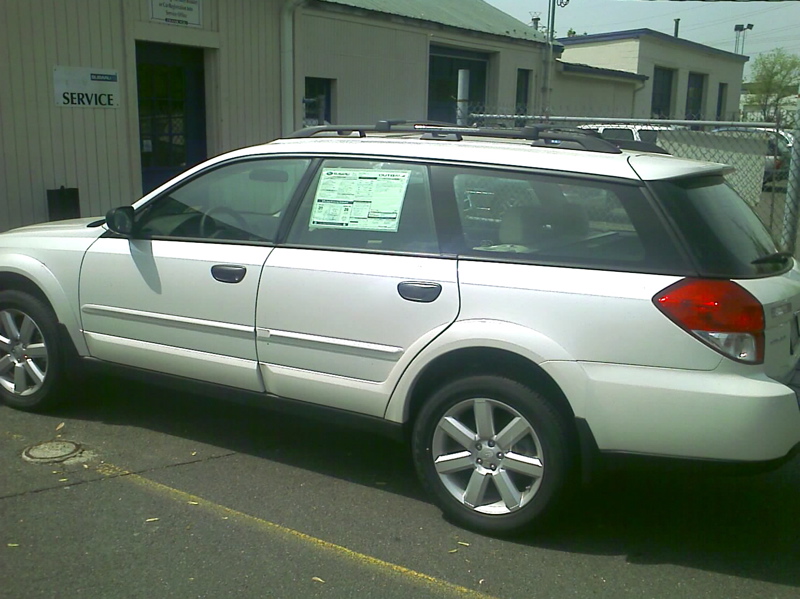
So an interesting thing happened on the way home from church a couple weeks ago. As we were driving back to the apartment, we saw a car that looked eerily familiar: a late-1990s Chrysler Cirrus in red with an Apple sticker evenly-spaced between the tail lights. A closer inspection revealed the same miscellaneous scratches and dents that I was once so familiar with.

Yes, for the first time I saw one of my old cars . . . more than a full year after trading it in, no less. It was a bit of an eerie feeling seeing a complete stranger driving the first car I ever bought on my own. It was even eerier feeling a twinge of vehicular protectiveness when I saw he had run into something and damaged the hood (a hood which had already been replaced once by my insurance company).

In a strange coincidence, the gentleman driving it pulled in to our apartment complex (apparently visiting, since there was no resident sticker in the window). After he pulled into a spot, we started feeling a little weird following him around so we abandoned the chase—but not after Melissa snapped a picture on her camera-phone to document the event!

Microsoft Releases Windows XP SP3; Vista Still Bad

Despite the gradual disintegration of Windows I’ve talked about before, many of us—and I’m no exception—still have to run the Microsoft operating system. In my case, the laptop issued by my employer came with Windows XP. Although our IT guy is pretty open-minded and was willing to let me install Linux on the machine (with the understanding that I was on my own if I needed tech support), many of our business applications (like our electronic timesheets) require Windows so I couldn’t make the switch. I also need to make sure my web sites work on the Windows platform, so having a copy around in Parallels Desktop on my Mac is a necessity as well.

I am running Windows XP as my preferred Windows now, so the big news for my Microsoft-branded sub-universe is today’s release of Windows XP Service Pack 3, which is available through Windows Update. SP3 includes a ‘roll-up’ of most/all security fixes in XP to-date, as well as some relatively minor feature enhancements. If you’re behind on your Windows Updates, I strongly recommend installing the service pack. Even if you keep up-to-date, it’s worth installing (I’ve already upgraded my two XP installs with no hassles). SP3 is expected to be the ‘final’ version of XP, excluding further security updates, so if you’re avoiding Vista this will be what you have to live with for the long-haul—unless you’re switching to Mac OS X or Linux, that is.

Mei Mei the Wet Rat

Mei Mei, our goofy little orange tabby, is not a big fan of getting baths. This is pretty standard for a cat, but—since Melissa is allergic to cats—regular cleaning is part of Mei Mei’s life. My favorite part of this process is how, afterwards, she looks like a giant, spiky, wet rat. Today, she jumped up on some furniture in my office, perched herself right over the lamp, and commenced her drying-out (which involves standing in curious yoga poses and licking herself).

Implementing Google’s ‘20% Time’ in a Small Contracting Firm

Background

Google is one of the most successful and innovative companies of the digital age. They have been so successful that ‘Googling’ has become a synonym for performing an Internet search, and Google’s web sites are quickly becoming the main Internet destinations for news, maps, email, and more. Their original search site remains the most widely used search engine on the Internet by a significant margin.

One of the keys to Google’s success has been a program known as ‘20 percent Time’ or, officially, ‘Innovation Time Off’. All of Google’s software engineers are encouraged to spend 20 percent of their time—one full day per week—on an unofficial project that interests them. Some of Google’s newer services, including Gmail and Google News, were hobbies started by company employees during their ‘Innovation Time Off’ that were later expanded into official, flagship Google projects. These projects, each now recognized as innovation leaders in their respective fields, would not exist if employees were expected to spend all of their time on their assigned projects (or, in terms employees of contracting firms might be more familiar with, if their employees were completely ‘billable’).

Scott Bradford is a writer and technologist who has been putting his opinions online since 1995. He believes in three inviolable human rights: life, liberty, and property. He is a Catholic Christian who worships the trinitarian God described in the Nicene Creed. Scott is a husband, nerd, pet lover, and AMC/Jeep enthusiast with a B.S. degree in public administration from George Mason University.