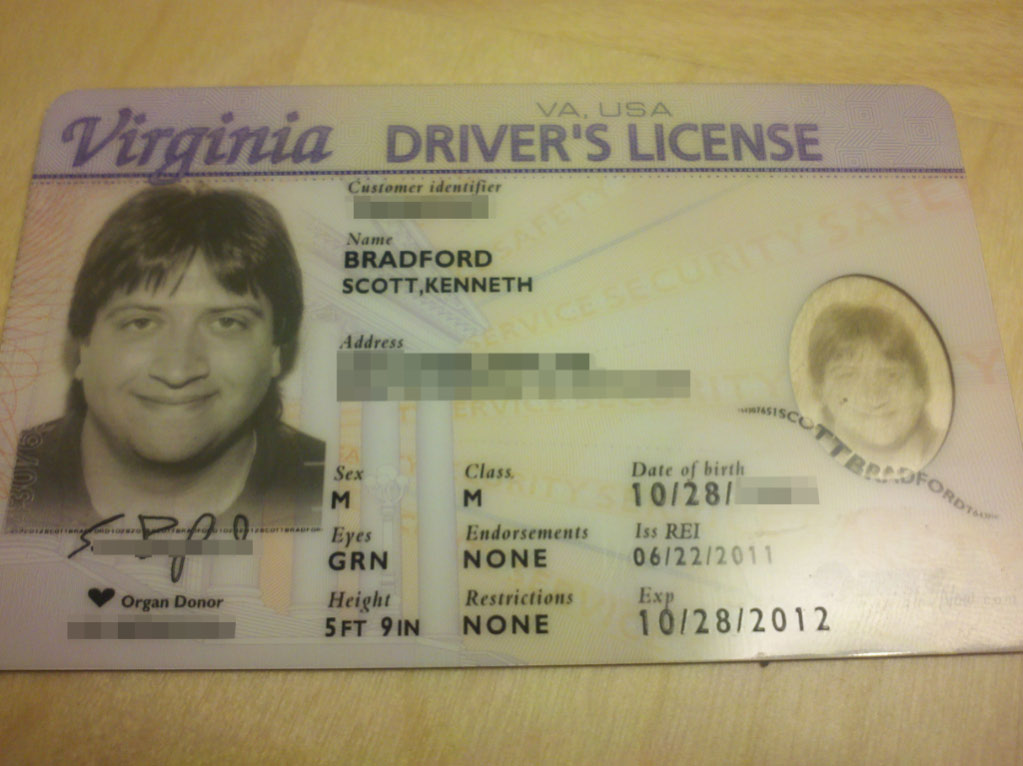
My ‘Class M’ License

Class ‘M’ License

Back in June I took a three-day Apex Cycle Education Basic RiderCourse to learn to ride a motorcycle. I figured that it would be a fun and interesting way to spend a weekend, if nothing else. It most-certainly was.

The course was an evening classroom session, followed by two afternoons on ~250cc trainer bikes (a Honda Rebel in my case) learning progressively difficult rider techniques. Assuming you pass the written exam and on-bike skills test, you finish the class with a certificate that serves as a temporary 30-day motorcycle license. This certificate, after a trip to the Department of Motor Vehicles (DMV), becomes a permanent license. I passed, and my license now has a “Class M” indication on it. In fact, I passed with the highest score in my class of twelve students (one-hundred percent on the written exam, and -2 [up to -20 is ‘passing’] on the skills test).

I didn’t realize until today that I had never mentioned this on Off on a Tangent. As Facebook has become more and more of an outlet for ‘personal’ blatherings, this site has become more and more of a (dare I say it?) ‘journalistic’ outlet. There’s been less and less about my day-to-day life here. In some ways that’s a good thing, and I’m really proud of how this site has developed and grown over the years. But I probably need to do a better job of striking a balance. My lengthy diatribes on politics and religion aren’t going anywhere any time soon, but maybe I should be spending a bit more time on the other random esoterica of my life.

Anyway, I’ve been a licensed motorcyclist for nearly five months now . . . but I don’t yet have a bike. Hopefully that will be changing some time soon. Slowly-but-surely I have been putting some money aside. Melissa has been helping by enlisting my technical assistance with some of her freelance web design work, and putting my portion of those revenues into a motorcycle fund. I’ve also been setting aside the bulk of monetary gifts I’ve received (for birthdays and other holidays) for this purpose. As of right now, the bike fund is floating somewhere around $1,500—which is probably enough for a serious down payment on one of the $7,000 or $8,000 bikes I’m looking at (e.g., the Yamaha V-Star 650 Custom or the Honda Shadow Spirit 750). By next spring—based on our expected tax refunds, annual bonuses, and additional freelance work—I expect this fund to have doubled.

Of course, as a new motorcyclist I would have to worry about a lot of additional expenses beyond the bike itself. Helmets, jackets, gloves, and boots are necessary safety equipment, and they don’t always come cheap. There is also the recurring expense of motorcycle insurance, though I expect this to be quite affordable (and I expect it to be largely offset by fuel cost savings, as bikes get ~50mpg compared to my Subaru’s average of ~23mpg). All-in-all, we’re not quite in a position to buy just yet . . . but it is definitely on the horizon. In fact, I’m told that the best time to buy is in the dead of winter . . . because nobody wants to buy a motorcycle when it’s freezing cold, and the dealers are desperate to sell. It’s starting to get cold, so stay tuned ;-).

Share to:

Send to:

Belated Thoughts on the Feast of All Souls

Icon of the Second Coming (courtesy WikiMedia Commons)

I’m having no luck with timely posts over the last couple weeks. So in the interest of consistency, here are my belated thoughts on Halloween, All Saints Day, and All Souls Day.

I observed with some incredulity this year as some ‘evangelical’ Christian groups tried to replace Halloween with the unfortunately-named “Jesus Ween.” Intended to be a ‘Godly’ alternative to Halloween, the idea is that instead of focusing on demons and death we should focus on Jesus Christ. I have no doubt that the proponents of this alternate celebration are well-intentioned, but they have forgotten something very important: Halloween is already a Christian holiday.

Oh yes, some of my more skeptical friends have already launched into a tirade about how Halloween was a Pagan festival that was usurped and corrupted by us heathen Catholics. There is a little bit of truth in this, but not so much as you might think. It is true that the various cultures across European Christendom are an amalgamation of Christian tradition with the traditions that had been there before, but this is nothing to condemn the Church for. On the contrary, one of the most wonderful things about the Christian Church is that, when you become a Christian, you do not have to abandon what came before except where there is a direct conflict. The very oldest traditions of our faith incorporate elements of Jewish, Greek, and Roman culture combined with newer, uniquely-Christian traditions. There is no such thing as a ‘pure’ Christianity separate from the cultures in-which it developed and grew. No, Christianity is a beautifully-diverse combination of the best elements of tens and hundreds of cultures and faiths it has come in contact with over the centuries—all merged together and conformed to the universal truth.

You see, as Christians we recognize that there are elements of truth in the practices and traditions of other world religions, and even in many non-religious cultural traditions. Until the sad separations of the Church later in her history, nobody thought it was a good idea to ‘purify’ the Church of these influences on her practice. On the contrary, we can and should embrace the elements of truth in other faiths when we find them. As the Catechism of the Catholic Church states, “The Catholic Church recognizes in other religions that search, among shadows and images, for the God who is unknown yet near since he gives life and breath and all things and wants all men to be saved. Thus, the Church considers all goodness and truth found in these religions as ‘a preparation for the Gospel and given by him who enlightens all men that they may at length have life'” (CCC 843).

Basic Reasoning: The Greek Default

Greek Debt vs. Eurozone Avg. (courtesy WikiMedia Commons)

Let’s review some basic reasoning: “If it looks like a duck, swims like a duck, and quacks like a duck, then it probably is a duck.”

Greece, the cradle of democracy and western civilization, is in national default. It is unable to pay its debtors. Standard & Poor’s (S&P) has rated Greece’s sovereign debt as junk since April 2010, and the Greek government had to be bailed-out by a €110 billion European Union (EU) and International Monetary Fund (IMF) loan package in May 2010. Despite the loans and some broad ‘austerity’ cuts, the situation did not improve. By June of this year, S&P had downgraded Greece’s debt to the lowest rating in the world.

Last week, leaders of the ‘Eurozone’ monetary alliance and the IMF reached a new agreement to try and alleviate Greece’s sovereign debt crisis. As part of this agreement, many of Greece’s debtors will accept a fifty percent write-off—another one-hundred billion euro gift to Greece. But consider what this means; many banks that bought Greek bonds will get only fifty percent of their investment back. Greece is not able to pay what it owes. We can perform rhetorical back-flips all we want, and fluff it up with as many euphemisms we can come up with (‘Haircut?’ Really?) . . . but when a country can’t pay its debtors the correct word to describe it is default.

In 2011, Greece’s public debt is expected to rise to over 160 percent of its gross domestic product (GDP). In other words, the Greek government will owe its debtors more than the entire economic production of the country over more than one and a half years. This ratio is expected to rise to something over 175 percent in 2012. It is unclear what impact the default will have on this projection, but it’s stated goal is to reduce Greece’s sovereign debt to 120 percent of GDP by 2020. For the record, a debt-to-GDP ratio of anything approaching one-hundred percent is generally considered to be a crisis. So the most optimistic target for Greece over the rest of this decade is that their crisis will diminish to a slightly smaller crisis. Nobody has yet proposed actually fixing the core problems facing Greece. Like Congress dealing with our own debt crisis, the strategy seems to make a few small tweaks around the edges and call it a day.

The fundamental problem for most of western Europe—and for the United States—is that we have bought bigger governments than we have the means to pay for. The Europeans have gone much further down this road than we have, which is why Greece is already in default and why Ireland, Portugal, and Spain are much closer to it than we are. But in the end, the only way to really solve these sovereign debt crises is for all of us to get our government expenditures in-line with government revenue. Greece did not implement any kind of austerity plan until it was too late, and the plan they finally implemented fell far short of what was really needed.

Nobody seems willing to state the obvious. Nobody seems willing to use some basic reasoning. We simply can’t keep spending more than we make and expect it to magically work out in the end. There ain’t no such thing as a free lunch.

Gadhafi Dead; Libya to Declare Liberation

Moammar Gadhafi

I apologize for not covering this in a particularly timely manner (I’ve been dealing with a bad cold), but the big news of the last week has been that Libyan dictator Moammar Gadhafi was killed by Libyan opposition fighters on Thursday. Libya’s new interim leaders plan to formally declare liberation tomorrow, and NATO officials plan to end all military operations there by the end of the month.

President Barack Obama (D) authorized U.S. involvement in the Libyan conflict as part of a NATO alliance, which began military operations on March 19. Obama, however, failed to receive Congressional authorization for the conflict within the time required by the War Powers Resolution of 1973 . . . so since May 20, U.S. involvement has been on questionable constitutional footing (at best).

Having said that, I have generally supported efforts to depose Gadhafi. Since coming to power in 1969, he kept tight control over internal dissent, executing political enemies and imposing a culture of fear where ten to twenty percent of Libyans were employed as informers against their countrymen. In the 1980’s, Gadhafi had at least twenty-five critics of his regime assassinated overseas, and the Libyan government offered bounties up to 1 million dollars on its enemies’ heads—whether they be foreign statesmen, journalists, or Libyan defectors. Like in Hussein’s Iraq, petty criminals under Gadhafi’s regime were punished with flogging and the amputation of limbs.

The Libyan government attempted to buy nuclear weapons from China in 1972, Pakistan in 1977, and India in 1978. As of 2004, their stockpile of chemical weapons included 23 metric tons of mustard gas and more than 1,300 metric tons of precursors. Gadhafi’s Libya was also a major funding source for terrorist organizations around the world, including radical groups operating in the Philippines, Indonesia, Vanatu, Australia, New Zealand, Ireland, and more. Libyan agents acting on their own under Gadhafi’s authority were responsible for bombings in Berlin, shootings in London, attempted bombings of government buildings and aircraft in the United States, and the bombing of Pan Am Flight 103 over Lockerbie, Scotland.

Needless to say, he was not a great guy . . . for Libya or the rest of the world. I do not rejoice at his death (for the same reasons I didn’t rejoice at Osama bin Laden’s), but I am glad he is no longer running Libya. Like the people of Iraq and Afghanistan, the people of Libya now have a chance to rebuild themselves as a vibrant, free country with robust civil and economic freedoms. Or they could choose a new variant of the regressive path they were on before. For the first time since 1969, Libya’s future is in the Libyan people’s hands. Here’s hoping they choose their path well.

The right of a nation to kill a tyrant, in cases of necessity, can no more be doubted, than to hang a robber, or kill a flea. But killing one tyrant only makes way for worse, unless the people have sense, spirit, and honesty enough to establish and support a constitution guarded at all points against the tyranny of the one, the few, and the many. – President John Adams (Federalist)

On ‘Occupy Wall Street’

In the last month or so, protesters representing the ‘Occupy Wall Street‘ movement have been descending on city centers to protest against corporations and the political cronyism that often benefits them. Many of their complaints and concerns have some validity. Most of us should be able to agree that large, profitable corporations like General Electric shouldn’t be able to get away with paying no taxes (as they did in 2010). Most of us should be able to agree that the government bailouts under Presidents George W. Bush (R) and Barack Obama (D) were ill-advised, anti-capitalist, and motivated by cronyism. Most of us should be able to agree that if the government is going to be bailing anybody out, it ought to be bailing out the taxpaying public in a fair, equitable way . . . rather than bailing out Wall Street bankers and failed car companies alone.

On these subjects you will get little objection from me against the ‘occupiers,’ though I do object to some of the forms the protests have taken—e.g., attempting to storm the Air and Space Museum in Washington, trashing public parks, obstructing traffic flow, etc. Thankfully the protests here have been much more docile than their European counterparts, especially in Italy, but they still have a distinctly more raucous tenor than, say, the ‘tea party‘ protests of 2008 and 2009 tended to have. Regardless, I do think the protesters are misguided in a few key ways.

Blame for Bailouts

Imagine, for a moment, that you are teetering on bankruptcy. You had a sudden unexpected expense, or you were laid off from your job, and now you don’t know where next month’s rent is going to come from. Maybe you are to blame, maybe you aren’t. That’s not important. What’s important is that you are in trouble. You and the people who depend on you are at risk. So, imagine now that a man from the government knocks on your door and tells you that, “Look, you messed up, but it’s important that you be able to provide for yourself and your family . . . so here’s ten-thousand dollars.”

Scott Bradford is a writer and technologist who has been putting his opinions online since 1995. He believes in three inviolable human rights: life, liberty, and property. He is a Catholic Christian who worships the trinitarian God described in the Nicene Creed. Scott is a husband, nerd, pet lover, and AMC/Jeep enthusiast with a B.S. degree in public administration from George Mason University.