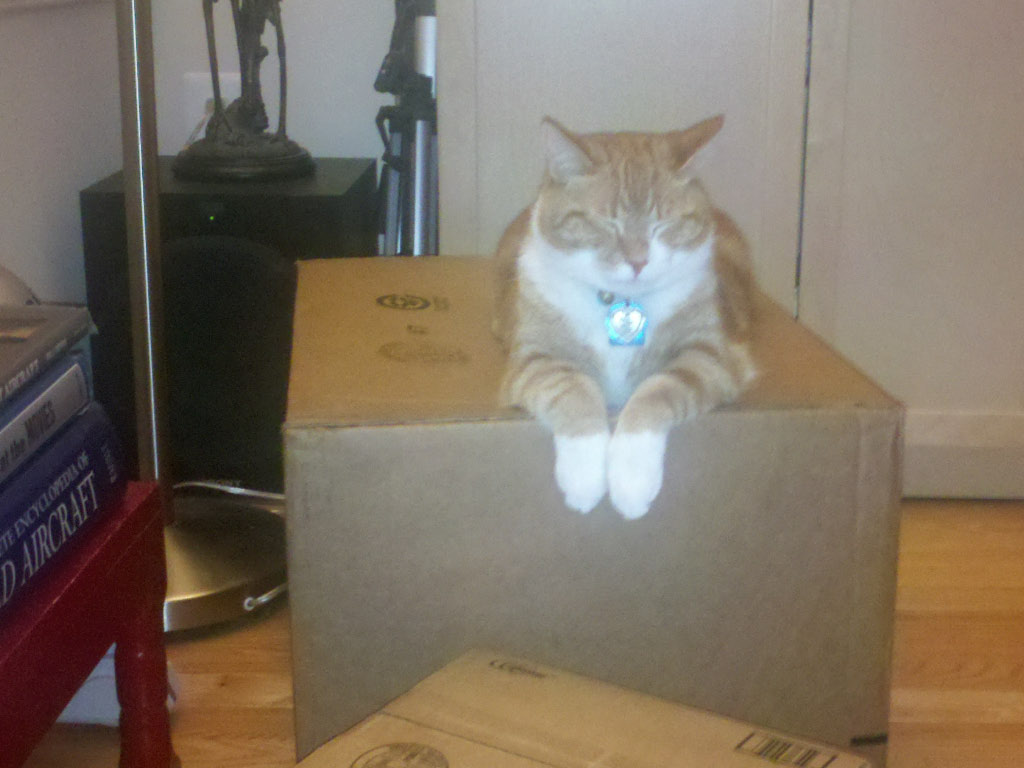
In the midst of a bunch of serious works of time-consuming writing, here are a bunch of random photos I’ve taken over the last month or two on my phone. My favorite is the derelict hat, left sitting on a highway, that the always-impressive professionals at the Virginia Department of Transportation simply painted right over instead of, you know, picking it up and throwing it away.
To Kill the Killer
It has been a while since I have discussed the subject of capital punishment on this site. Indeed, my only piece of writing dealing solely with the subject is an 11th Grade English paper titled “Thou Shalt Not Kill“—coincidentally, the oldest piece of content still present on this site. If you go read it, please bear in mind that it doesn’t exactly reflect my opinions today (though it does come pretty close), and I was a much worse writer back then.
There have been a few passing mentions in the mean time, but in general I’ve been pretty quiet on the subject. In light of yesterday’s execution of Troy Davis in Georgia, which has proved quite controversial, I figured it was time to finally give capital punishment the full Off on a Tangent treatment. This subject is one where I have basically always found myself at-odds with my fellow conservatives. While right-wing politicos are usually the loudest supporters of the death penalty, I have always found it distasteful.
Our legal system is predicated on the idea that it is better for ten guilty persons to go free than to convict one innocent. This is why so many prominent accused criminals—O.J. Simpson and Cacey Anthony, for example—are acquitted when the evidence against them seems overwhelming. Even so, our courts do convict innocent people from time-to-time. Often they are exonerated later, though I am sure that sometimes they are not. That this will happen occasionally is inevitable, though we must do everything we can to prevent it. When it does happen and the error is discovered, the victim of that miscarriage of justice must be set free and generously compensated for their unjust hardship. We can, and must, always set these errors right.
But when the innocent has been put to death, they cannot be set free. The dead cannot be compensated by the government for their troubles. The punishment is permanent. This is the primary reason that I have always opposed the death penalty: the risk, however remote, of killing an innocent far outweighs any potential benefit to the victims of crime or for the society.
2011 Endorsement & Election Plans
I’ve been extra busy over the last couple of weeks (if you haven’t gathered from the relatively slow rate of posting), but that hasn’t stopped me from preparing for the annual Off on a Tangent election coverage. Since 2004, I have made formal political endorsements in every election in-which I am eligible to vote. I plan to post the official 2011 Off on a Tangent endorsements next week.
Though overshadowed in the media by the 2012 presidential election, the 2011 elections in Virginia are very important and deserve the full attention of the people of the Commonwealth. The entire General Assembly stands for election this year (Senate and House of Delegates), as do our local Boards of Supervisors, School Boards, and most of our local constitutional officers including Commonwealth’s Attorneys, Sheriffs, and Treasurers. As tempting as it might be to look to the more glamorous national elections—which are still more than a year away—we need to stay focused. These state and local officials often have much much real-world impact on our day-to-day lives than anybody at the federal level.
In addition to these endorsements, I intend to provide live election night coverage from approx. 7pm until midnight on 11/08/2011. This will include results for all races in which I’ve made endorsements and a feed of any relevant local, state, or national news that might come up. I project winners based on my own method that includes analysis of media reports, exit polling, and official returns. I have been known to occasionally call an election winner correctly before any mainstream media outlet does, if the data supports it.
The War in Iraq: Ten Myths
We need to take an honest, dispassionate, rational look back at the War in Iraq.
During George W. Bush’s (R) presidency, no other issue incited the kind of vitriolic rage that Iraq did. It has since become “common knowledge” that our involvement there was, as the Eagles put it in the title track of their 2007 album Long Road Out of Eden, “a bloody stupid waste.” But many of the “facts” people seem to remember about the war aren’t even true. We must untangle the myths and reevaluate our preconceptions.
There’s plenty of room to disagree about whether the Iraq War was justified or right. As long as your opinion isn’t based on the falsehoods described below, I respect it. But at least know what you’re talking about. Don’t believe the mythmakers. Many of the same people and institutions who lied to you about practically everything over the last ten years were lying to you about Iraq a decade earlier too—but not in the way you might think.
It is true that I supported the Iraq war at its inception; you can find plenty of evidence for that on this website. You might accuse me of confirmation bias or cherry-picking evidence to support my preconceived position. I try to avoid that, but I’m not perfect. I have blind spots. Contact me and tell me about them. If you make a good, rational, intelligent argument, and give me permission to use it, I might add it below as a rebuttal.
I hate war. It hurts people. It undermines their rights to life, liberty, and property. I wish it was never necessary, but sometimes it is. We are a fallen, contradictory species. The human right to keep and bear arms, for example, is indispensable because sometimes the use of deadly force is the only way to protect life. War works the same way.
Yet I was never a true “war hawk.” I thought—and still think—that Bush was right to launch the war, but I was already writing biting critiques of some of his war policies all the way back in 2004. When I learned about the abuse of prisoners at the Abu Ghraib prison, I condemned it as loudly as anybody on the anti-war left . . . I thought the perpetrators should have been charged with treason. I unequivocally condemned the use of ‘waterboarding’ torture on enemy combatants. I supported President Barack Obama’s (D) withdrawal plans. You know me; I’m not a blind partisan idealogue.
With all that in mind, here are ten stubborn, pernicious myths about the Iraq War . . . and the truths that lie behind them.
Recognize Palestine (and Hold the PNA Accountable)
The Palestinian National Authority (PNA), the official government of Palestine (which controls the West Bank, but has essentially no power whatsoever in Hamas-dominated Gaza), will be petitioning the United Nations General Assembly for recognition as an independent state. The United States and Israel oppose the PNA’s move, but I figure it’s a good idea. Give ’em the recognition they want. Why not?
With Palestine as a recognized, sovereign state, Israel would have to do in the West Bank what they have already done in Gaza: withdraw completely. Asking Israel to do this flies afoul of the basic precepts of international law. All else being equal, Israel has every right to the West Bank and Gaza territories, since Israel was attacked by its neighbors and seized those territories fair-and-square in the war that resulted. Never in the history of the world has the country that got attacked been asked to return the territories it won in the war that followed. But Israel supposedly wants a two-state solution too, so let’s hold ’em to it.
But giving Palestine the gift of formal recognition as a sovereign state comes with a big catch for the PNA, which is why I would advise them to be careful what they wish for. As an independent state, the PNA will be expected to be responsible for securing itself (since Israel will no longer have authority), for defending itself, and for preventing its people from committing acts of war against neighboring countries.
When Hamas launches rockets from ‘occupied’ Gaza (which hasn’t actually been occupied since 2005), it’s technically an internal Israeli matter. As such, Israel’s military response gets characterized as wanton criminal destruction akin to, say, Muammar Gaddafi’s attacks on his own Libyan people. I disagree with this characterization for a long list of reasons, but I can at least see the logic. By neutral outside judgment, without the benefit of historic context, the people of Palestine are Israeli citizens who were born and raised in Israeli territory. By that standard, they are oppressed; they have no say in Israeli government.
But when the Palestinian territories become an independent, sovereign territory—the ‘two state solution’ everybody supposedly wants—things change. Hamas’s rocket attacks on their Israeli neighbors would stop being an internal matter. They could no longer be characterized as an ‘oppressed people attacking their oppressors.’ No, the whole world would have to admit that they are what they really are: acts of belligerent, unjustified war that target innocent civilians.
Those of us who have studied the history of the Israeli/Palestinian conflict already know this. With a formally recognized, sovereign Palestine, everybody else will have to admit it too. So I urge the PNA to go for it, and I urge the whole world community—us included—to support them in their bid for independence. And afterwards, I urge the world community to handle Palestinian attacks on Israeli civilians the same way they would handle any other sovereign nation attacking its neighbors: with decisive, justified retaliation.
Scott Bradford is a writer and technologist who has been putting his opinions online since 1995. He believes in three inviolable human rights: life, liberty, and property. He is a Catholic Christian who worships the trinitarian God described in the Nicene Creed. Scott is a husband, nerd, pet lover, and AMC/Jeep enthusiast with a B.S. degree in public administration from George Mason University.